

Categories
Arizona Luxury, Arizona home buying guides, East Valley Luxury, East Valley real estate, moving to Arizona, Market Updates, Paradise Valley Luxury, Paradise Valley Real Estate, Scottsdale Luxury Real Estate, Scottsdale Real Estate, North Scottsdale real estate, Home Buying TipsPublished September 29, 2026
Why Property Boundaries Matter More on High-End Arizona Estates

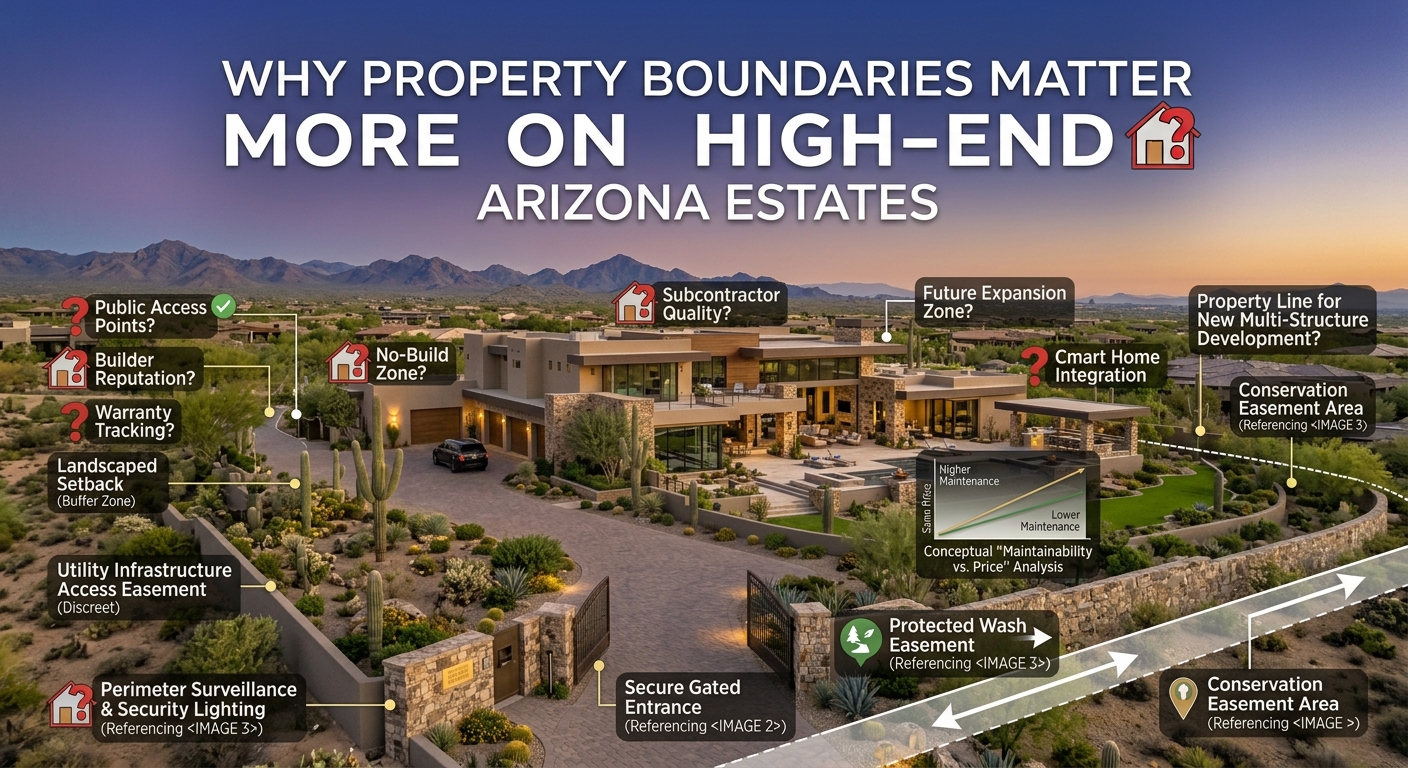
When buyers tour a luxury estate, they naturally focus on the home.
- The architecture.
- The finishes.
- The kitchen.
- The primary suite.
- The pool.
- The views.
- The landscaping.
But there is another part of the property that can be just as important—and much harder to see during a showing:
Where the property actually begins and ends.
Property boundaries may seem like a technical detail reserved for surveys and closing documents.
On a high-end estate, however, the location of the boundary can influence much more than a line on a map.
It can affect privacy.
Landscaping.
Walls and gates.
Driveways.
Outdoor living.
Views.
Maintenance.
Neighbor relationships.
Future improvements.
And the way you ultimately experience the property.
For luxury buyers, understanding the land beneath and around the home is an essential part of understanding the estate itself.
📍 1. A Large Lot Can Create a False Sense of Space
Luxury estates often sit on substantial lots.
That can make it easy to assume that everything surrounding the home belongs to the property.
But visual space and legal property lines are not always the same thing.
- A landscaped area may appear connected to the estate.
- A wall may look like the obvious boundary.
- A driveway may seem to serve only one property.
- A mature tree may appear to be entirely within the lot.
- The physical appearance of a property doesn't necessarily establish its legal boundaries.
That's why buyers should understand the actual lot configuration rather than relying solely on what they see during a showing.
🌵 2. Desert Landscaping Can Blur the Lines
Arizona landscapes can make property boundaries particularly difficult to visually interpret.
- Natural rock.
- Desert vegetation.
- Berms.
- Trees.
- Decorative walls.
- Large landscaped setbacks.
- Open spaces.
These features can create a seamless transition between neighboring properties.
A buyer may see one continuous desert landscape without realizing that ownership changes somewhere within it.
That distinction matters when deciding what can be modified, removed, planted, irrigated, or maintained.
🧱 3. Walls and Fences Aren't Automatically the Boundary
One of the easiest assumptions to make is:
“The wall is the property line.”
Sometimes it may be.
But buyers shouldn't assume that every wall, fence, retaining structure, or landscape barrier precisely follows the legal boundary.
A structure can have a different relationship to the lot line for various reasons.
That's why boundary questions should be addressed through appropriate property documentation and professional due diligence rather than visual assumptions.
🌳 4. Mature Landscaping Deserves a Closer Look
Imagine purchasing an estate surrounded by beautiful mature trees.
Then imagine discovering that part of the landscaping sits outside the property's actual boundary.
That could create questions about:
- Maintenance responsibility
- Irrigation
- Trimming
- Removal
- Replacement
- Privacy
- Access
- Neighbor agreements
The older and more established the landscaping, the more important it can be to understand exactly where it sits.
🏊 5. Outdoor Features Can Make Boundary Questions More Important
Luxury properties often extend far beyond the main structure.
Think about:
- Pools
- Spas
- Outdoor kitchens
- Patios
- Fire features
- Sports courts
- Guest structures
- Putting greens
- Garden areas
- Ramadas
- Decorative walls
When evaluating a property, buyers should understand how these improvements relate to the lot.
A visually impressive outdoor environment doesn't eliminate the need to understand the underlying property configuration.
🚗 6. Driveways and Entry Areas Deserve Special Attention
The front of a luxury estate can be visually dramatic.
Long driveways.
Private gates.
Large motor courts.
Landscaped entrances.
Guest parking.
But ask a simple question:
Where exactly does the property's access begin and end?
If an access area involves land beyond the owner's parcel, the legal documentation governing that access becomes particularly important.
This is one reason buyers should not evaluate a luxury estate solely from the curb.
🔐 7. Privacy Depends on More Than Distance
A large lot can create a powerful sense of privacy.
But privacy isn't determined only by acreage.
The placement of neighboring parcels, walls, landscaping, access routes, and surrounding improvements can all influence how private the estate actually feels.
Imagine buying a property because the backyard appears completely secluded.
Then discover that a neighboring parcel has a different configuration or potential use that changes the character of that space.
Understanding the surrounding property lines can help buyers evaluate privacy more realistically.
👀 8. Views Are Connected to the Land Around You
Views are often one of the most valuable lifestyle features of an Arizona luxury property.
Mountain views.
Desert vistas.
City lights.
Sunsets.
Open desert.
But buyers should distinguish between:
What you see today
and
What the surrounding land legally and physically allows tomorrow.
A view across another parcel isn't necessarily the same thing as a protected view.
That doesn't mean a view will disappear.
It simply means buyers should understand what land surrounds the property and what rights or restrictions may affect it.
🏗️ 9. Future Improvements Need Space
Luxury buyers often think about what they might add after purchasing.
Perhaps:
- A guest house
- Pool expansion
- Outdoor kitchen
- Sport court
- Garage improvements
- Additional landscaping
- Privacy walls
- Entertainment areas
Before becoming attached to a future project, understand the actual usable portion of the lot.
Property boundaries can interact with:
- Setbacks
- Building restrictions
- Existing structures
- Access
- Utility locations
- Community requirements
- Local regulations
A large parcel doesn't necessarily mean unlimited buildable space.
📐 10. Lot Size Isn't the Same as Usable Space
Two properties can have similar acreage and completely different usable outdoor areas.
Consider:
- Shape of the parcel
- Terrain
- Existing structures
- Setbacks
- Drainage
- Access
- Landscaping
- Walls
- Utility infrastructure
For a luxury buyer, the question isn't simply:
“How many acres is it?”
It may be:
“How much of this land functions the way I want it to?”
🏔️ 11. Arizona Terrain Can Complicate the Picture
High-end properties in Arizona can have distinctive terrain.
Slopes.
Rock formations.
Washes.
Elevated areas.
Natural desert features.
Irregular lot shapes.
These characteristics can make boundaries less obvious than they appear on a simple property map.
Terrain can also influence where improvements, landscaping, drainage features, and access routes are located.
The physical character of the land deserves as much attention as the house sitting on it.
💧 12. Water and Drainage Patterns Matter
Land ownership and water movement are separate concepts.
Rainfall and drainage don't necessarily stop at a property line.
A luxury estate's landscaping or terrain may influence how water moves across portions of the property.
When evaluating a property, buyers may want to understand:
- Drainage patterns
- Grading
- Existing drainage features
- Irrigation
- Areas prone to runoff
- Improvements designed to manage water
The objective isn't to assume there is a problem.
It's to understand how the land functions.
🤝 13. Neighbor Relationships Can Depend on Boundary Clarity
Clear boundaries can help prevent misunderstandings.
Questions may arise about:
- Landscaping
- Trees
- Walls
- Gates
- Maintenance
- Parking
- Access
- Improvements
On closely positioned luxury properties, these issues can become particularly noticeable because the landscaping and outdoor environments may be highly customized.
Knowing what belongs to whom creates a clearer foundation for future decisions.
🔎 14. Don't Rely on a Listing's Visuals Alone
Real estate photography is designed to showcase the property.
It isn't designed to provide a legal boundary analysis.
Aerial photographs can be useful for understanding the overall setting.
But they shouldn't replace appropriate property documentation.
The same applies to:
- Listing photos
- Virtual tours
- Satellite imagery
- Landscaping
- Fences
- Walls
- Driveways
Use visual information to ask questions—not to answer legal property questions.
📋 15. Understand What Your Due Diligence Documents Show
During the purchase process, buyers should carefully review the relevant property documentation and obtain professional guidance where appropriate.
Depending on the property, this may involve reviewing:
- Survey information
- Title documents
- Property disclosures
- Plat information
- Recorded documents
- Existing improvement locations
- Access documentation
The exact documents and level of review will depend on the property.
For questions about legal boundaries, title, surveys, or rights affecting the property, buyers should consult the appropriate qualified professionals.
🧭 16. Walk the Boundary—Not Just the House
One of the simplest ways to better understand a property is to experience the entire site.
Don't only walk:
Front door → kitchen → primary suite → backyard.
If practical and permitted, explore the broader property.
Look at:
- Side yards
- Rear lot areas
- Walls
- Gates
- Landscaping
- Access points
- Neighboring structures
- Terrain
- Outdoor improvements
Seeing the property as land first and a house second can reveal details that are easy to miss during an interior-focused tour.
🪴 17. Ask About Longstanding Landscaping Arrangements
Sometimes landscaping practices continue for years.
A homeowner may maintain an area because it has always been maintained that way.
A neighbor may care for vegetation near a boundary.
An irrigation system may serve an unusual configuration.
These arrangements shouldn't automatically be assumed to establish ownership rights.
Instead, they are useful questions to investigate during due diligence.
🏡 18. Boundary Awareness Can Protect Your Future Plans
Imagine purchasing a luxury estate with plans for a major outdoor renovation.
You envision:
A new pool.
A larger entertaining area.
More privacy landscaping.
A detached structure.
A sports court.
The project may look simple on paper.
But once the actual property boundaries and applicable restrictions are understood, the available options may look different.
Understanding the land first can help you plan more realistically.
💎 19. The Most Valuable Part of the Property May Extend Beyond the House
For many luxury buyers, the land is part of what makes the estate special.
The lot provides:
- Privacy
- Outdoor living
- Views
- Landscaping
- Space
- Separation
- Architectural context
That means the land shouldn't be treated as an afterthought.
The house may be the centerpiece.
But the surrounding property creates much of the experience.
📝 20. Create a Property Boundary File
Once you purchase an estate, keep important boundary-related information organized.
Your property file can include:
- Survey documents
- Plat information
- Title materials
- Relevant recorded documents
- Property maps
- Photographs
- Improvement records
- Landscaping plans
- Notes about gates and walls
- Documentation relating to access
Keeping these materials together can make future maintenance, improvements, and property questions easier to manage.
💬 A Murphy Group Perspective
“Luxury buyers often fall in love with the home first, but the land is an equally important part of the property. Understanding the boundaries, outdoor spaces, access, privacy, and surrounding environment helps buyers see the estate as a complete property—not simply a beautiful house.”
— Mary Murphy, The Murphy Group
The goal isn't to make a luxury purchase feel complicated.
It's to make sure the buyer understands what they're actually purchasing.
📊 The Bottom Line
Property boundaries may not be the most glamorous part of luxury real estate.
They're rarely the first feature mentioned in a listing.
But they can influence some of the things luxury buyers value most:
Privacy.
Outdoor living.
Landscaping.
Access.
Views.
Future improvements.
Long-term enjoyment.
The larger and more complex the property becomes, the more important it is to understand the relationship between the home, the land, and everything surrounding it.
Before falling completely in love with the house, take a closer look at the property itself.
Know where your estate begins. Know where it ends. And understand what lies between those lines.
📲 Explore Arizona Luxury Real Estate With the Bigger Picture in Mind
If you're searching for a luxury home in Scottsdale, Paradise Valley, North Scottsdale, or the East Valley, The Murphy Group can help you evaluate more than the architecture and finishes.
From lot configuration and privacy to outdoor living, access, views, landscaping, and long-term property potential, understanding the entire estate can help you ask better questions before making a major purchase.
Because with a luxury estate, the property line is part of the property story.

Mary Murphy
Team Leader | The Murphy Group - AZ | eXp Luxury | PLACE
or another way