

Categories
Queen Creek real estate, East Valley Luxury, East Valley real estate, Arizona Real Estate, Arizona Lifestyle, Arizona Luxury, East Valley, Chandler Real Estate, North Scottsdale homes, Phoenix, ArizonaPublished August 20, 2026
What Happens to Home Values When Arizona Neighborhood Gets New Businesses

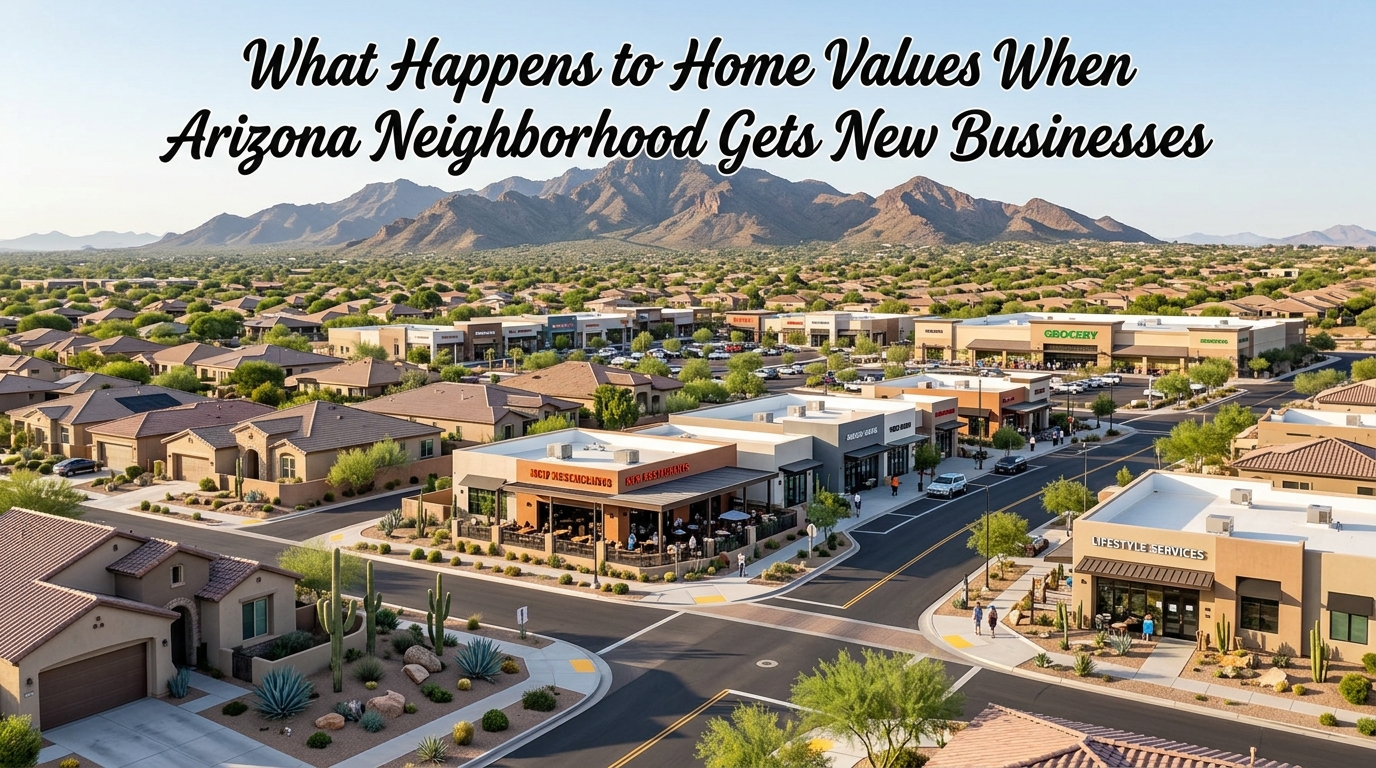
When a new business opens near an Arizona neighborhood, the first reaction usually isn't about real estate.
It's something much simpler:
"There's finally a good restaurant nearby."
Or:
"Now we have a grocery store five minutes away."
Or:
"I don't have to drive across town for that anymore."
But those changes can have a much larger effect on how buyers perceive a neighborhood.
A new business can add convenience.
Several new businesses can create a destination.
And a growing collection of restaurants, retail, healthcare, fitness, entertainment, and professional services can signal that an area is attracting investment and population growth.
That relationship is already visible across Greater Phoenix. Current retail research shows continued demand for grocery-anchored centers, neighborhood retail, restaurants, medical users, and experiential businesses, particularly in high-growth suburban corridors.
But there's an important distinction:
A new business doesn't automatically make nearby homes more valuable.
The type of business, its location, traffic, noise, accessibility, surrounding development, and overall neighborhood experience all matter.
So what actually happens when an Arizona neighborhood starts attracting new businesses?
🏪 1. New Businesses Can Change How Buyers See a Neighborhood
A home doesn't exist in isolation.
When buyers evaluate a property, they're also evaluating everything around it.
That includes:
- Restaurants
- Grocery stores
- Shopping
- Healthcare
- Fitness
- Entertainment
- Parks
- Schools
- Employment centers
- Transportation
A neighborhood that previously required residents to drive 15 or 20 minutes for everyday needs can feel very different once those services arrive nearby.
The home hasn't changed.
The location experience has.
And that can influence buyer demand.
☕ 2. Sometimes a Small Business Can Make a Big Lifestyle Difference
Consider a neighborhood that gets a new:
- Coffee shop
- Bakery
- Boutique restaurant
- Fitness studio
- Salon
- Pet service
- Specialty market
None of these businesses automatically adds a specific dollar amount to nearby homes.
But they can make the neighborhood feel more convenient and enjoyable.
A buyer touring a property may think:
"I could actually see myself living here."
That emotional response matters because lifestyle appeal can influence which neighborhoods buyers choose to explore and ultimately purchase in.
🛒 3. Grocery Stores Can Be Particularly Important
Not every business has the same effect on residential appeal.
A grocery store can be especially meaningful because it solves an everyday need.
Think about the difference between:
A neighborhood where groceries are 15 minutes away
and:
A neighborhood where a quality grocery store is five minutes away.
For many households, that convenience becomes part of the value of the location.
This is one reason grocery-anchored retail continues to attract strong interest in Phoenix's commercial market. Recent market research shows grocery-anchored and necessity-based retail remaining among the more resilient parts of the Valley's retail landscape.
🍽️ 4. Restaurants Can Change the Personality of an Area
A neighborhood with a collection of restaurants can develop an entirely different identity.
New dining options can create:
- More local activity
- Social gathering places
- Evening destinations
- Walkable or convenient experiences
- Greater neighborhood recognition
This can be particularly attractive in areas where buyers want more than a traditional suburban environment.
But proximity matters.
A buyer may love being five minutes from restaurants.
That same buyer may not want to live directly behind a busy restaurant parking lot.
🏥 5. Healthcare and Professional Services Add Practical Value
Arizona's growing communities are attracting more than restaurants and retail.
New medical offices, dental practices, urgent-care facilities, pharmacies, and professional services can make an area more convenient for residents.
For:
- Families
- Retirees
- Multigenerational households
- Professionals
- Buyers planning to stay long term
having essential services nearby can be a meaningful advantage.
It's not necessarily exciting in a listing description.
But it can become extremely valuable in everyday life.
🏋️ 6. Lifestyle Businesses Can Strengthen Neighborhood Appeal
Arizona buyers often prioritize an active, outdoor-oriented lifestyle.
That makes businesses such as these particularly relevant:
- Fitness studios
- Golf-related services
- Cycling shops
- Wellness centers
- Spas
- Outdoor recreation businesses
- Specialty food stores
- Pet services
These businesses can complement the lifestyle buyers are already seeking in Arizona.
The result can be a neighborhood that feels increasingly self-contained.
💼 7. New Employers Can Have an Even Bigger Impact
There's an important difference between:
A new restaurant
and
A new major employment center.
Restaurants primarily add convenience.
Large employers can add housing demand.
When businesses create significant numbers of jobs, workers may begin searching for homes closer to those employment centers.
North Phoenix provides a useful example.
Commercial development around the semiconductor industry has helped attract additional retail and housing investment. Reporting on the area's "Golden Triangle" describes new shopping, restaurants, childcare, and other businesses developing alongside housing growth and proximity to TSMC.
This is the larger relationship:
Jobs → workers → housing demand → businesses → more neighborhood activity.
🏭 8. Arizona's Semiconductor Growth Shows How Commercial Investment Can Spread
The relationship between employment and residential development is particularly visible in parts of the Phoenix metro.
TSMC's continued investment in Arizona is contributing to a broader ecosystem of employment, suppliers, housing, and supporting businesses.
When major employment centers expand, nearby communities can become more attractive to people who want shorter commutes.
That can increase demand for:
- Apartments
- Townhomes
- Starter homes
- Move-up properties
- Luxury homes
Not every property benefits equally.
But the broader neighborhood can become more economically significant.
🏙️ 9. New Businesses Can Signal That a Neighborhood Is Entering a New Phase
One business opening doesn't necessarily mean much.
But consider this sequence:
New homes
↓
New residents
↓
New grocery store
↓
New restaurants
↓
New fitness and healthcare services
↓
More investment
That pattern can indicate that a neighborhood is becoming more established.
For buyers, the question isn't simply:
"What's here today?"
It's:
"What is this area becoming?"
📈 10. More Amenities Can Increase Buyer Demand
Businesses don't directly set residential prices.
Instead, they can influence demand.
If more buyers want to live near a desirable collection of amenities, competition for nearby homes can increase.
And when demand is strong relative to available inventory, sellers may have more pricing leverage.
That's why neighborhood development can eventually become relevant to residential values.
However, the effect isn't guaranteed or uniform.
🏡 11. A New Business Doesn't Automatically Add Value to Every Home
It's important not to oversimplify the relationship.
You can't say:
"A new grocery store opened, so every house nearby is now worth $30,000 more."
Real estate doesn't work that way.
Home values are influenced by many factors:
- Comparable sales
- Inventory
- Interest rates
- Property condition
- Lot size
- Views
- Schools
- HOA costs
- Taxes
- Buyer demand
- Location
- Overall market conditions
New businesses are one part of a much larger equation.
📍 12. Distance From the Business Matters
Consider three homes:
Home A
0.3 miles from the new shopping center
Home B
2 miles away
Home C
6 miles away
All three technically benefit from the same commercial development.
But Home A may have a stronger convenience advantage.
This is why micro-location matters.
Two homes in the same city can have very different experiences based on what's immediately around them.
🚗 13. Convenience Can Come With a Trade-Off
More businesses can mean more:
- Traffic
- Parking
- Deliveries
- Pedestrian activity
- Noise
- Construction
That's why buyers shouldn't automatically assume:
More businesses = better home value.
A high-quality restaurant district can be attractive.
A major delivery facility directly behind a home may not be.
The type and placement of commercial activity matter.
🔊 14. Noise and Operating Hours Can Influence Buyer Preferences
Imagine two new businesses.
Business A
A neighborhood café that closes at 3 p.m.
Business B
A late-night entertainment venue that operates until 2 a.m.
Both are technically "new amenities."
But their effect on nearby homeowners can be completely different.
When researching development, buyers should consider:
- Operating hours
- Lighting
- Parking
- Noise
- Delivery activity
- Weekend traffic
- Outdoor seating
The best commercial growth improves convenience without compromising residential quality.
🌵 15. Arizona Buyers May Value Outdoor Lifestyle Businesses Differently
Arizona's lifestyle creates some unique demand patterns.
Buyers may place a premium on convenient access to:
- Golf
- Hiking
- Trails
- Fitness
- Wellness
- Restaurants
- Resort amenities
- Outdoor recreation
A new business that complements that lifestyle may contribute to a neighborhood's overall appeal.
For luxury buyers especially, what you can do nearby can be nearly as important as the house itself.
🏜️ 16. A Neighborhood Can Become More "Complete"
One of the biggest changes commercial growth can create is a sense of completeness.
Imagine a new community that originally has:
Homes + roads
Then gradually gains:
Homes + grocery + restaurants + fitness + healthcare + services + recreation
The neighborhood becomes easier to live in.
Residents don't need to leave the area for every errand.
That can make the community more attractive to future buyers.
🛍️ 17. Retail Corridors Can Become Part of a Neighborhood's Identity
Certain Arizona areas are recognized not just for their homes but for the lifestyle surrounding them.
A strong commercial corridor can give residents access to:
- Dining
- Shopping
- Entertainment
- Services
- Fitness
- Healthcare
Phoenix's retail market continues to show demand for well-located neighborhood centers and service-oriented businesses. In Q2 2026, Phoenix retail vacancy was reported around 4.7%, with strong demand concentrated in well-located neighborhood and necessity-based retail.
For residential buyers, that can reinforce the importance of what surrounds the home.
🏙️ 18. Mixed-Use Development Can Change How Buyers Experience an Area
Arizona is also seeing redevelopment projects that combine housing, retail, restaurants, recreation, and transportation.
One example is the redevelopment of Phoenix's former Metrocenter area into The Metropolitan, an $850 million mixed-use project planned with townhomes, retail, restaurants, parks, and bike paths.
The City of Phoenix describes the broader Metro District vision around integrating living, working, shopping, recreation, and entertainment while improving transportation and economic development.
For nearby homeowners, projects like these can potentially change how the surrounding area is perceived over time.
🌇 19. New Businesses Can Help Create a Stronger Sense of Place
The best neighborhoods aren't simply collections of houses.
They have identity.
That identity can come from:
- Architecture
- Parks
- Restaurants
- Local businesses
- Trails
- Events
- Shopping
- Community gathering spaces
When new businesses contribute positively to that identity, the neighborhood can become more memorable to buyers.
And memorable neighborhoods can be easier for buyers to fall in love with.
💎 20. Luxury Buyers May Look for Different Types of Businesses
For a luxury buyer, convenience doesn't necessarily mean having every retailer nearby.
They may prioritize access to:
- Fine dining
- Upscale shopping
- Boutique fitness
- Wellness
- Golf
- Resorts
- Specialty markets
- High-end services
This is one reason location analysis should always be personalized.
The "best" business isn't necessarily the one most people want.
It's the one that fits the lifestyle of the buyers most likely to value that neighborhood.
🗺️ What Buyers Should Research When New Businesses Are Coming
If you're considering an Arizona home in an area experiencing commercial growth, don't stop at the current business directory.
Research:
Current Businesses
What's already nearby?
Approved Development
What has officially been approved?
Proposed Development
What's being discussed or planned?
Zoning
What can potentially be built nearby?
Traffic
How could new businesses affect vehicle flow?
Access
Will the development make everyday trips easier?
Noise
Could the business affect residential quiet?
Future Growth
Is this one project or part of a larger trend?
These questions can reveal far more than simply looking at a listing map.
🔎 21. Look for Clusters, Not Just Individual Businesses
One new business can be random.
Several businesses arriving in the same area may tell a bigger story.
Look for patterns such as:
New housing
- new retail
- new restaurants
- new employment
- new infrastructure
That combination can indicate a neighborhood undergoing meaningful transformation.
And that's the type of change buyers should pay attention to.
💰 22. Sellers Should Understand the Amenity Story
New businesses can also become useful context for homeowners preparing to sell.
Instead of simply saying:
"A new restaurant opened nearby."
A stronger marketing story may be:
"Enjoy convenient access to an expanding collection of dining, shopping, and everyday services."
The difference is subtle.
The first statement describes an event.
The second describes a lifestyle benefit.
Of course, sellers should avoid claiming that a particular business directly increased their home's value unless supported by market evidence.
🧭 23. Buyers Should Think About the Future, Not Just Today
A neighborhood's current amenities are important.
But real estate is a long-term decision.
Ask:
What will this area look like in five years?
A property surrounded by vacant land may look quiet today.
But if several parcels are approved for development, the neighborhood could feel very different later.
Conversely, a neighborhood with established commercial infrastructure may offer greater predictability.
Understanding future development can therefore be an important part of due diligence.
🌵 24. Arizona's Growth Makes This Particularly Relevant
Greater Phoenix continues to experience substantial commercial and residential development.
Recent Phoenix retail research shows continued construction and absorption, with much of the new supply concentrated in suburban growth corridors where residential expansion is creating demand for neighborhood-serving retail.
The West Valley provides another example, with new retail development following population growth and new master-planned communities.
That means today's empty parcel may become tomorrow's:
Grocery store.
Restaurant.
Medical office.
Fitness center.
Shopping district.
Or even a much larger mixed-use destination.
🏠 25. The Right Question Isn't "Will This Raise My Home's Value?"
That's too simple.
Instead, ask:
"How will this change the desirability of the location?"
Then consider:
- Will it make daily life easier?
- Will it attract more residents?
- Will it create jobs?
- Will it improve neighborhood identity?
- Will it increase traffic?
- Will it create noise?
- Will it support future development?
- Will buyers actually value the new amenities?
Those answers provide a much more realistic picture.
📋 Arizona Homebuyer Checklist: Evaluating New Businesses Nearby
Before purchasing near new commercial development, consider:
Convenience
- What businesses are coming?
- How far will they be from the home?
- Will they reduce everyday driving?
Lifestyle
- Are there restaurants?
- Grocery options?
- Fitness and wellness?
- Healthcare?
- Entertainment?
- Outdoor recreation?
Neighborhood
- Does the development fit the community?
- Could it improve the area's identity?
- Does it preserve the character you want?
Potential Drawbacks
- Traffic
- Noise
- Parking
- Deliveries
- Construction
- Increased activity
Long-Term
- What else is planned nearby?
- What does zoning allow?
- Are new roads or infrastructure planned?
- Is the area becoming a larger commercial hub?
💡 The Bigger Lesson: Location Is Always Changing
One of the most interesting things about real estate is that location isn't static.
The house may stay the same.
The lot may stay the same.
But the neighborhood around it can evolve.
A vacant parcel can become a restaurant.
A shopping center can become a mixed-use development.
An industrial site can become an employment center.
A quiet intersection can become a major commercial destination.
That's why buyers should evaluate not only:
"What is this neighborhood today?"
but also:
"What is this neighborhood becoming?"
💼 How The Murphy Group Helps Arizona Buyers Look Beyond the House
The Murphy Group helps Arizona buyers evaluate properties within the larger context of their location.
That can include considering:
- Neighborhood character
- Nearby amenities
- Development patterns
- Commute considerations
- Lot and property characteristics
- Lifestyle fit
- Market conditions
- Long-term desirability
Because the right home isn't simply one with beautiful finishes.
It's a home located in a place that supports the way you want to live.
As Mary Murphy explains:
"A great property can become even more compelling when the neighborhood around it continues to improve."
📊 The Bottom Line
When an Arizona neighborhood gets new businesses, the impact on home values isn't automatic.
But commercial growth can influence several factors that matter to residential real estate:
👉 Convenience
👉 Lifestyle appeal
👉 Buyer demand
👉 Employment access
👉 Neighborhood identity
👉 Future development
👉 Local investment
The strongest potential impact usually comes when new businesses are part of a broader pattern of growth.
A single coffee shop probably won't transform a housing market.
But a new grocery store, restaurant district, healthcare center, employment hub, and recreational amenities arriving together can change how buyers perceive an entire community.
And when more buyers begin thinking:
"This is where I want to live,"
that can become meaningful for homeowners.
In Arizona real estate, sometimes the biggest change to a home's location isn't the house at all—it's what starts happening around it.
📲 Buying or Selling Arizona Real Estate?
If you're considering a home in Scottsdale, Paradise Valley, North Scottsdale, Phoenix, Chandler, Gilbert, Queen Creek, or another Arizona community, don't evaluate the property in isolation.
The businesses, amenities, employment centers, infrastructure, and future development surrounding a home can all influence how buyers experience the location.
The Murphy Group can help you look beyond the listing and understand the property, neighborhood, and broader lifestyle opportunity.
👉 Explore Arizona luxury real estate: www.mgsellsarizona.com

Mary Murphy
Team Leader | The Murphy Group - AZ | eXp Luxury | PLACE
or another way