

Categories
Luxury Property Maintenance, Home Renovation Costs, East Valley Luxury, East Valley real estate, Arizona Luxury, Arizona Real Estate, North Scottsdale homes, North Scottsdale real estate, Luxury Home RenovationPublished October 13, 2026
What Happens When a Luxury Home’s Original Materials Are No Longer Available?

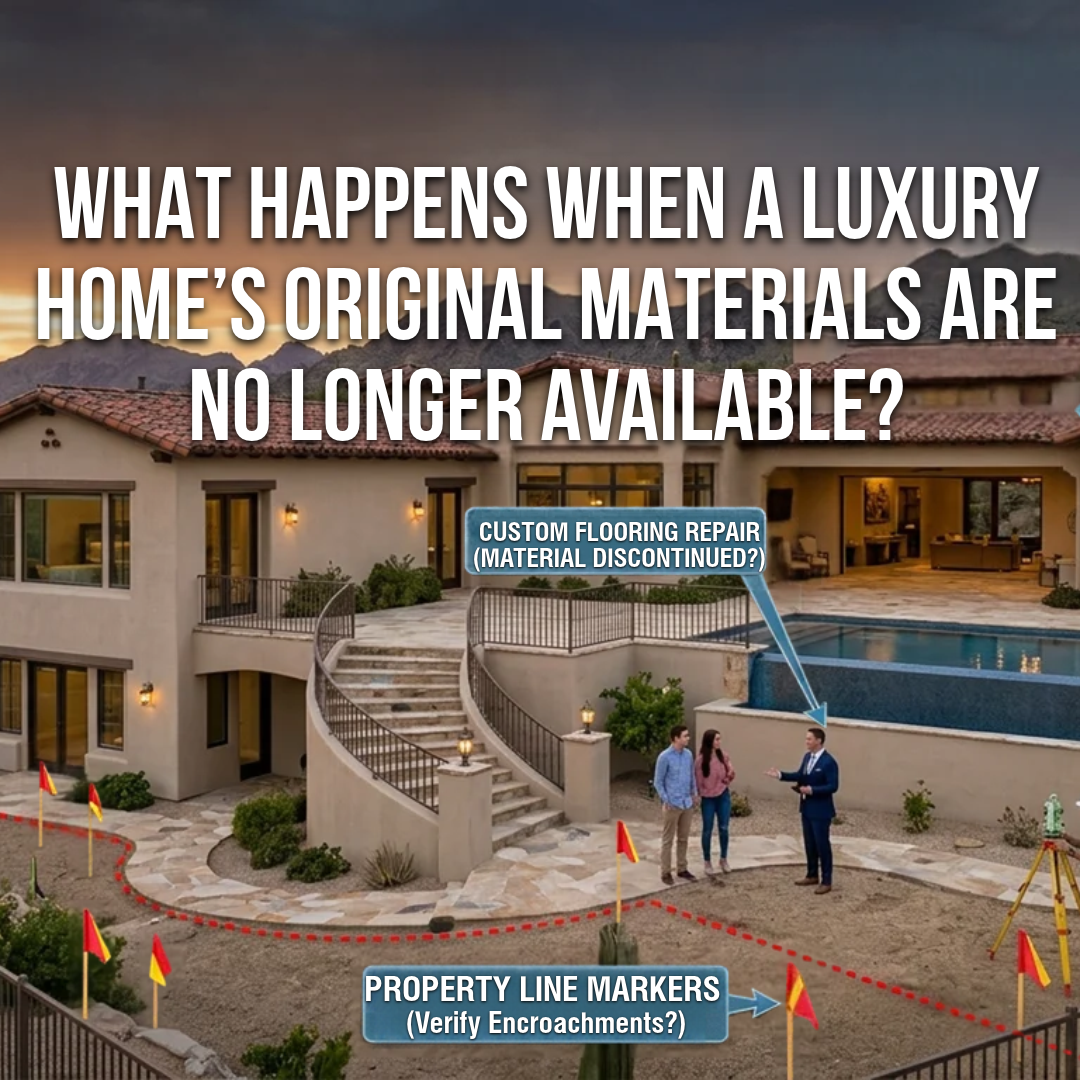
Imagine discovering an Arizona luxury home that feels unlike anything else on the market.
The residence features custom-carved stone, handcrafted cabinetry, distinctive imported tile, architectural millwork, and carefully selected finishes that give every room its own character. From the moment you enter, the materials tell a story of craftsmanship, design, and attention to detail.
Then you discover that a section of the flooring needs repair. A decorative stone panel has cracked. The original kitchen cabinetry requires replacement, or a plumbing fixture from the home's custom collection has failed.
There's just one problem: the original material or product is no longer available.
The manufacturer may have discontinued the collection. The supplier may have closed. The stone quarry may no longer produce the same color variation, or the artisan responsible for a custom finish may have retired.
What initially appears to be a straightforward repair can quickly become a more complicated decision.
Should you search for reclaimed materials? Commission a custom replacement? Replace the entire surface to maintain visual consistency? Or choose a modern alternative that performs well but looks slightly different?
For luxury homeowners, these decisions can affect more than the renovation budget. They may influence the property's architectural character, the consistency of its finishes, maintenance requirements, and the overall experience of owning the home.
When original materials are no longer available, the challenge is not simply finding a replacement. It is determining how to preserve the property's design integrity, functionality, and long-term value without creating unnecessary costs.
Here's what Arizona luxury buyers and homeowners should understand before undertaking repairs or renovations.
1. Identify Which Original Materials Are Truly Irreplaceable
Not every discontinued material presents the same challenge.
A standard bathroom fixture may have a suitable modern equivalent, while a custom-cut stone fireplace surround or a hand-finished ceiling detail may be difficult to reproduce accurately.
The first step is identifying which materials are original, which are custom-made, and which contribute most significantly to the home's architectural character.
During a property inspection or renovation assessment, document distinctive materials such as:
- Natural stone flooring and countertops
- Custom cabinetry and built-in furniture
- Imported tile and decorative mosaics
- Specialty hardwood flooring
- Handcrafted doors and architectural millwork
- Custom metalwork, railings, and hardware
- Decorative plaster, wall finishes, and ceiling details
- Unique lighting fixtures and plumbing fittings
- Exterior stonework, masonry, and façade materials
Ask the seller whether original specifications, manufacturer details, invoices, samples, or maintenance records are available.
For a custom estate, even a small detail may have been selected specifically to complement other finishes throughout the property.
Identifying these materials early helps you distinguish between items that can be replaced easily and those that may require specialized sourcing or craftsmanship.
It also gives you a clearer picture of the property's future maintenance needs before committing to the purchase.
2. Understand Why Matching Materials Can Be Difficult
A discontinued product is not necessarily impossible to replace, but achieving a convincing match can be challenging.
Materials may change in appearance because of differences in manufacturing, natural variation, aging, or the techniques used to create the original finish.
For example, natural stone from the same general source can vary in veining, coloration, and texture. Wood may darken or change tone over time. Tile produced in a different manufacturing run may have a slightly different finish or dimensions.
Even when a manufacturer offers a product with a similar name, its current specifications may differ from those of the original installation.
Common challenges include:
- Differences in color, pattern, and texture
- Changes in product dimensions or thickness
- Different surface finishes or reflectivity
- Variations in durability and maintenance requirements
- Incompatible installation methods
- Differences between aged and newly installed materials
In an Arizona luxury home, these distinctions can become particularly noticeable in large open-plan spaces where flooring, cabinetry, and stone surfaces are visible together.
A replacement that looks acceptable in isolation may stand out when installed beside an older material.
Before selecting an alternative, obtain physical samples whenever possible and compare them under the property's actual lighting conditions.
A qualified designer, contractor, or materials specialist can help determine whether the proposed replacement will blend naturally with the existing finishes.
3. Determine Whether the Original Material Can Be Repaired
When an original material is damaged, replacement should not automatically be the first option.
In some cases, a qualified specialist can repair the existing material, preserve most of the original installation, and avoid the difficulty of sourcing a discontinued product.
For example, a stone specialist may be able to repair a chipped countertop. A skilled woodworker may restore damaged cabinetry, reproduce a missing molding profile, or repair a custom door. A tile restoration professional may be able to remove and reset existing tiles without disturbing the surrounding installation.
Before authorizing a full replacement, ask:
- Can the damaged material be repaired safely and effectively?
- Is the deterioration limited to a small area?
- Can the original finish be restored?
- Will the repair affect the surrounding materials?
- How long is the repair expected to last?
- Would replacing the entire feature provide a meaningful advantage?
The National Park Service's rehabilitation guidance generally favors repairing distinctive historic features rather than replacing them when they remain repairable. Although these standards do not automatically apply to every luxury home, they offer a useful principle for preserving distinctive materials and craftsmanship.
For an Arizona luxury property, a carefully executed repair may preserve the original design while minimizing disruption to adjacent finishes.
However, the condition of the material matters. If the underlying structure is failing or the damage is extensive, repair may not be the most practical solution.
Have the material evaluated before deciding whether restoration, partial replacement, or a more comprehensive renovation is appropriate.
4. Explore Reclaimed and Salvaged Materials
When a manufacturer discontinues a product, reclaimed materials can sometimes provide a closer match than a newly manufactured alternative.
Architectural salvage suppliers may carry vintage tile, hardwood flooring, decorative hardware, stone, doors, light fixtures, and other materials recovered from older buildings or previous renovation projects.
This approach can be particularly useful when the original product has distinctive dimensions, aging characteristics, or craftsmanship that modern mass-produced alternatives do not replicate.
Before purchasing reclaimed materials, verify:
- Whether the product genuinely matches the original material
- Whether sufficient quantities are available
- Whether additional pieces can be sourced if needed
- Whether the material is structurally sound
- Whether its dimensions match the existing installation
- Whether it has been properly cleaned and assessed
- Whether its installation requirements are compatible with the property
Reclaimed materials can introduce their own challenges. Available quantities may be limited, individual pieces may have different wear patterns, and the material may require restoration before installation.
There may also be additional expenses for transportation, storage, sorting, and fitting.
For natural stone, hardwood, or specialty tile, ask your contractor to inspect representative samples before committing to a large purchase.
The objective is to find a material that works both aesthetically and technically, rather than choosing a product simply because it is old or resembles the original.
5. Consider Custom Fabrication or Reproduction
Some luxury-home materials are distinctive enough that a standard replacement will never provide a convincing match.
In these situations, custom fabrication may be worth investigating.
A specialist may be able to reproduce a cabinet door, decorative metal component, molding profile, stone detail, or other architectural feature using measurements, photographs, original drawings, or a surviving sample.
This approach can be especially valuable when the material contributes significantly to the home's identity.
Potential custom-reproduction projects include:
- Handcrafted cabinetry and millwork
- Decorative stone fireplace surrounds
- Custom metal railings and hardware
- Specialty doors and window details
- Bespoke tile patterns
- Architectural ceiling treatments
- Ornamental exterior features
Before proceeding, request samples, drawings, specifications, and a written estimate.
Ask the fabricator to explain how closely the new piece can match the original in color, texture, dimensions, finish, and performance.
Also clarify the expected production timeline, installation requirements, and whether the replacement will require modifications to surrounding materials.
Custom work may involve higher upfront costs and longer lead times, particularly when specialized skills or imported materials are involved.
However, for a prominent architectural feature, a carefully fabricated replacement may preserve the overall design more successfully than an off-the-shelf alternative.
6. Evaluate Modern Substitute Materials Carefully
Sometimes the original product cannot be sourced, repaired, or reproduced at a reasonable cost.
A modern substitute may then provide a practical solution, provided it is compatible with the existing installation and the property's design.
For example, an alternative stone product might replace an unavailable decorative feature. A modern flooring material might provide a similar appearance to discontinued hardwood, or a newly manufactured architectural component might reproduce the original profile.
The critical consideration is that visual similarity alone does not establish technical compatibility.
Materials can differ in weight, moisture permeability, thermal expansion, flexibility, durability, and maintenance requirements. These differences may affect the surrounding construction if the substitute is not selected and installed appropriately.
When evaluating a substitute, consider:
- Appearance under natural and artificial lighting
- Structural suitability and installation method
- Compatibility with adjacent materials
- Performance under Arizona's heat and intense sunlight
- Resistance to moisture where relevant
- Cleaning and maintenance requirements
- Expected service life and repairability
- Availability of replacement pieces in the future
For example, an exterior material exposed to intense sunlight may need different performance characteristics from a decorative interior finish.
Similarly, a replacement flooring product should be evaluated for its thickness, transitions, and compatibility with adjacent surfaces.
Ask your contractor or designer to explain the advantages and limitations of the proposed alternative before approving the work.
A less expensive substitute may be perfectly appropriate for a secondary area, while a prominent architectural feature may justify a closer match.
7. Understand How Material Changes Can Affect the Home's Appearance
A discontinued material can create a design challenge even when the replacement performs well.
Imagine that a luxury home's main living area features a distinctive natural stone floor. A few pieces become damaged, but the original stone is no longer available.
Installing a different stone in only the damaged section may create a visible patch. Replacing the entire floor, however, could be unnecessarily expensive and remove material that remains in good condition.
This is where design planning becomes important.
Depending on the feature, possible approaches include:
- Repairing the damaged section
- Finding a close match for a limited replacement
- Using a deliberate contrasting material as an accent
- Creating a transition between different finishes
- Replacing a larger section to maintain visual consistency
- Redesigning the affected area while preserving surrounding features
The appropriate solution depends on the scale of the installation and the importance of the original material to the overall design.
For example, a subtle variation in a secondary bathroom may be less noticeable than a mismatch across a large open-plan living area.
A designer can help determine whether the replacement should blend into the existing finish or become an intentional design feature.
The key is to make the decision deliberately, rather than allowing the availability of a replacement product to dictate the final appearance.
8. Investigate the True Cost of Replacing Discontinued Materials
The price of the replacement product is only one part of the renovation budget.
When original materials are difficult to obtain, the additional work required to source, fabricate, adapt, or install them can significantly affect the total project cost.
Potential expenses include:
- Specialist inspections and material assessments
- Architectural salvage searches
- Sample production and testing
- Custom fabrication
- Shipping and handling
- Removal of damaged materials
- Preparation of the underlying surface
- Modifications to accommodate different dimensions
- Installation by specialized tradespeople
- Finishing and blending with existing materials
- Future maintenance and replacement planning
A material that appears inexpensive may require extensive preparation or additional labor. Conversely, a more expensive custom replacement may fit the existing installation with fewer modifications.
Request itemized estimates that distinguish material costs from labor, preparation, finishing, and contingency allowances.
Where multiple options are available, compare the total installed cost rather than the purchase price alone.
For a luxury property, it is also worth considering whether the replacement affects other rooms or connected surfaces. A discontinued flooring product, for example, may create additional work at doorways, stair transitions, or adjoining spaces.
A detailed estimate helps you understand the financial implications before authorizing the project.
9. Determine Whether Replacement Materials Affect Resale Appeal
Original materials can contribute to a luxury property's distinctive character, but their value depends on the quality of the material, the design, the property's overall condition, and buyer preferences.
A carefully maintained custom stone installation or handcrafted wood feature may help distinguish a home from comparable properties.
However, an aging material that is difficult to maintain or impossible to repair may also become a concern for some prospective buyers.
Replacing discontinued materials does not automatically reduce a home's value. A well-executed replacement may improve functionality, address deterioration, and preserve the property's overall appeal.
The outcome depends on the quality and appropriateness of the work.
When planning a replacement, consider:
- Whether the original material is a prominent design feature
- Whether the replacement complements the architecture
- Whether the new material is durable and practical
- Whether the installation looks intentional and professionally finished
- Whether the renovation changes the home's established design character
- Whether maintenance information will be available to future owners
Avoid assuming that an expensive replacement will necessarily increase the property's resale price.
Instead, prioritize a solution that balances design integrity, performance, durability, and the expectations of the property's likely buyers.
For a high-end estate, consistency across visible finishes can be particularly important in creating a polished overall impression.
10. Check Whether Permits or Special Approvals Are Necessary
Replacing a finish or fixture does not necessarily require a building permit, but the answer depends on the nature of the work and the applicable local requirements.
A straightforward cosmetic repair may be treated differently from a project that alters structural components, changes plumbing or electrical systems, or involves substantial exterior modifications.
If the property is within a historic district or is subject to specific preservation restrictions, additional review may apply to certain alterations.
Before beginning work, ask your contractor or local building department whether permits or approvals are required.
Consider additional review when the project involves:
- Structural changes to walls, floors, or ceilings
- Changes to plumbing or electrical installations
- Replacement of exterior architectural features
- Significant façade alterations
- Changes to protected or historically significant materials
- Work governed by an HOA or other property restrictions
Do not assume that a material substitution is exempt from review simply because the original product is unavailable.
Confirm the requirements for the specific property and scope of work before ordering materials or scheduling installation.
11. Document the Replacement for Future Owners
Once a discontinued material has been repaired or replaced, preserve the information that will help you maintain it in the future.
This step is easy to overlook, particularly after a renovation has been completed.
However, documentation can make future repairs easier when the replacement material is also specialized or available from only a limited number of suppliers.
Keep records such as:
- Manufacturer and product information
- Material specifications and dimensions
- Supplier and fabricator contact details
- Finish names, colors, and product codes
- Installation instructions
- Maintenance recommendations
- Warranty information
- Photographs taken before and after the work
- Samples or spare pieces, where practical
For custom-fabricated features, retain drawings, measurements, templates, and finish specifications whenever possible.
If the replacement is a close approximation rather than an exact match, document that distinction as well.
This information can help future contractors understand the installation and reduce the need to repeat the original research.
For a luxury homeowner managing multiple distinctive finishes, a centralized property-maintenance file can become a valuable long-term resource.
12. Build a Long-Term Maintenance Strategy Around Material Availability
The best time to think about discontinued materials is before a repair becomes urgent.
If you own a luxury home with specialized finishes, consider documenting the materials throughout the property while they are still in good condition.
Identify products that are difficult to source, features that require specialist maintenance, and installations where future repairs may be challenging.
Where appropriate, keep spare tiles, flooring boards, hardware, or other replacement components. Store them in conditions suitable for the material, and label them clearly.
You may also wish to identify qualified contractors and fabricators who are familiar with the property's construction and finishes.
A practical maintenance strategy can include:
- Periodic inspections of distinctive materials
- Early attention to minor damage
- Records of past repairs and product changes
- Samples of important finishes
- A list of suppliers and specialist tradespeople
- Budget allowances for specialized repairs
- Advance planning for major replacements
This approach is particularly useful for estates with extensive custom interiors, natural stone installations, specialty exterior finishes, or imported architectural components.
A proactive plan can reduce the pressure to make rushed decisions when a material fails or a manufacturer discontinues a product.
13. Investigate Material Availability Before Purchasing a Luxury Home
For prospective buyers, discontinued materials are not only a future maintenance concern. They can also be part of the property's current due diligence.
If a home contains distinctive finishes that appear difficult to replace, ask the seller for available product specifications, invoices, renovation records, and maintenance information.
During the inspection process, identify materials that may require specialist repair or replacement.
Consider investigating:
- Whether replacement products are still manufactured
- Whether the original supplier remains in business
- Whether compatible alternatives are available
- Whether the material has known maintenance limitations
- Whether the property has spare materials or replacement components
- Whether visible damage requires specialist assessment
- Whether planned renovations would affect other original finishes
If a significant material is damaged or nearing the end of its service life, obtain a professional opinion and a preliminary estimate before closing when practical.
For example, a home with extensive custom cabinetry may require a different renovation budget from a comparable property with readily available standard components.
The objective is not to reject a distinctive property simply because its materials are discontinued.
It is to understand the potential maintenance responsibilities and make an informed decision about whether the home fits your budget, design preferences, and long-term ownership plans.
14. Know When to Preserve, Replace, or Redesign
When original materials are no longer available, there is rarely one solution that works for every property.
The decision should account for the material's condition, architectural significance, visibility, technical requirements, availability, and cost.
A useful starting point is to compare three approaches.
Preserve or repair. Best when the existing material remains serviceable and the damage can be addressed without compromising performance.
Replace with a compatible alternative. Appropriate when repair is impractical and a substitute can meet the relevant visual, physical, and functional requirements.
Redesign the affected feature. Worth considering when a convincing match is impossible or when the existing installation needs a more comprehensive update.
These approaches are not mutually exclusive. A project might preserve most of an original stone installation, replace a damaged section with a compatible material, and redesign a small transition area to create a cohesive result.
Before making a decision, weigh the long-term implications of each option rather than focusing exclusively on the immediate repair.
For distinctive or historically significant properties, consult an appropriate preservation specialist when necessary.
The best outcome is one that maintains the home's quality and character while meeting current functional and maintenance needs.
A Murphy Group Perspective
“A luxury home is often distinguished by the details that make it unique. When an original material is no longer available, the right decision involves understanding the home's design, the condition of the existing feature, and the quality of the available alternatives. Thoughtful planning can help homeowners preserve what makes a property special while preparing for its long-term maintenance.”
— Mary Murphy, The Murphy Group
For Arizona luxury homeowners, distinctive materials can be part of the property's appeal, but they also deserve careful consideration during inspections, renovations, and ongoing maintenance.
Understanding what can be repaired, what may need custom fabrication, and where modern alternatives are appropriate can help homeowners avoid unnecessary replacements and make better-informed decisions.
The Bottom Line
When a luxury home's original materials are no longer available, the solution involves more than finding a product that looks similar.
Before undertaking a repair or renovation, investigate:
- Original materials: Identify the products, finishes, and craftsmanship that define the home's character.
- Repair options: Determine whether the existing material can be restored instead of replaced.
- Reclaimed materials: Explore salvage sources when an authentic match may be available.
- Custom fabrication: Consider reproducing distinctive features when standard products cannot provide a suitable match.
- Modern alternatives: Evaluate appearance, compatibility, durability, and maintenance requirements.
- Renovation costs: Compare the full installed cost of each option, including labor and preparation.
- Property appeal: Consider how the replacement will affect the home's architectural consistency and future marketability.
- Permits and approvals: Confirm applicable requirements before beginning work.
- Maintenance records: Keep product specifications, samples, warranties, and installation details.
- Future planning: Identify difficult-to-replace materials before they become urgent maintenance problems.
A discontinued material does not mean a luxury home has lost its character or that every affected surface must be replaced.
With the right assessment, sourcing strategy, and professional guidance, homeowners can often preserve important details while making practical decisions about repairs and future improvements.
The best approach is to preserve what can be saved, replace what genuinely needs replacing, and ensure every new material supports the home's long-term quality and design.
Explore Arizona Luxury Real Estate With The Murphy Group
If you're considering a luxury home in Scottsdale, Paradise Valley, North Scottsdale, or the East Valley, The Murphy Group can help you look beyond the listing photos and consider the property's features, condition, and long-term ownership experience.
From distinctive architectural finishes and custom interiors to renovation planning, maintenance considerations, and property due diligence, a thoughtful approach can help you ask better questions before making a major investment.
Explore Arizona luxury real estate at mgsellsarizona.com.

Mary Murphy
Team Leader | The Murphy Group - AZ | eXp Luxury | PLACE
or another way