

Categories
Arizona Real Estate, Arizona Luxury, Scottsdale Luxury Real Estate, Scottsdale Real Estate, Scottsdale Housing Market, Paradise Valley Luxury, Paradise Valley Real Estate, North Scottsdale homes, Elevated Walkways, Luxury Property Features, Arizona Home Inspections, Structural Engineering, Home Buying Tips, luxury home buying guidePublished November 19, 2026
Buying an Arizona Luxury Property With a Private Bridge or Elevated Walkway

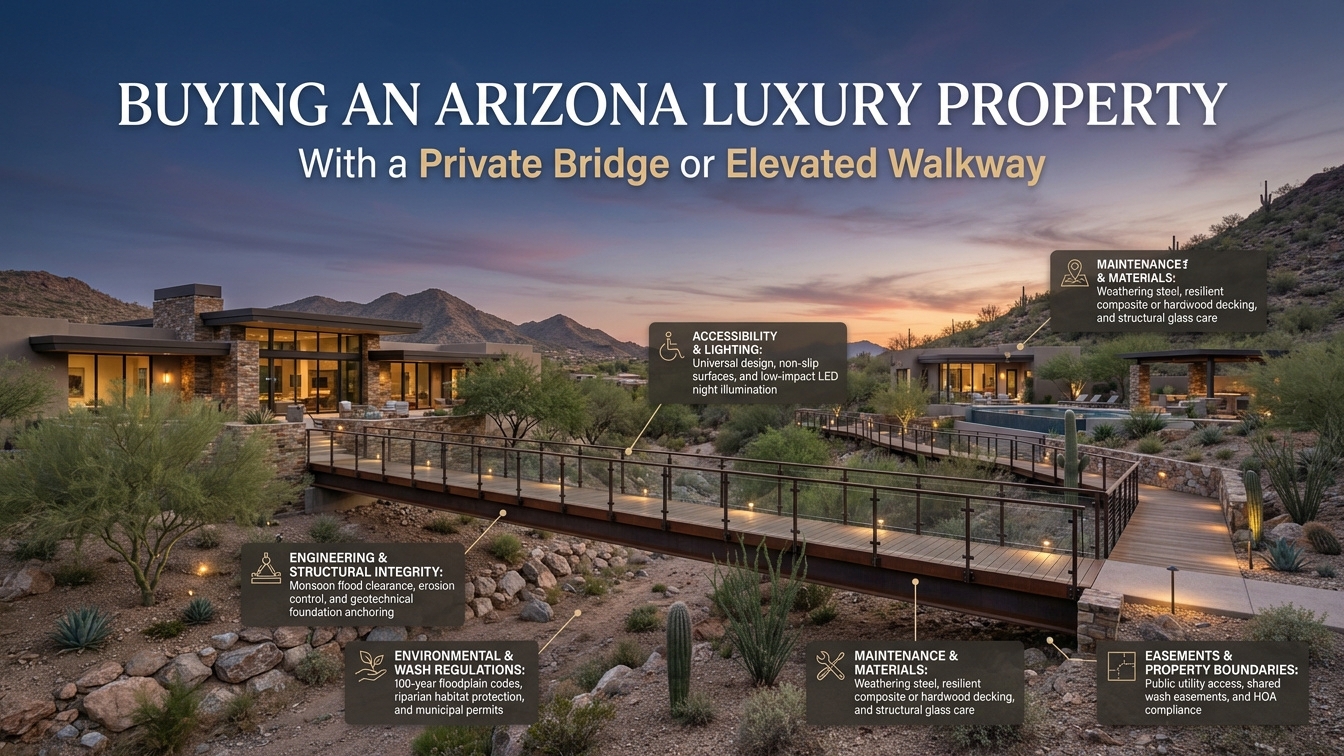
A private bridge or elevated walkway can give an Arizona luxury property a distinctive architectural character while connecting different parts of an expansive estate. Whether it crosses a landscaped ravine, a natural desert wash, a decorative water feature, or a sloping section of the property, an elevated connection can make the grounds more accessible and create an impressive visual feature.
In Scottsdale, Paradise Valley, North Scottsdale, and other upscale Arizona communities, luxury properties may incorporate bridges and elevated walkways as part of their architectural design. Some provide convenient access between a main residence and a guest house, pool area, garden, or detached entertainment space. Others are designed to span changes in elevation while preserving the natural landscape below.
Although these features can enhance the property's appearance and functionality, they introduce important ownership considerations. Buyers need to understand how the bridge was engineered, whether it was properly permitted, how it responds to Arizona's weather conditions, and what maintenance may be required over time.
A structure that looks attractive during a property tour may have concealed concerns involving foundations, corrosion, drainage, waterproofing, guardrails, or structural movement. Its location may also introduce additional questions about flood exposure, natural washes, hillside conditions, and access during severe weather.
Before purchasing an Arizona luxury property with a private bridge or elevated walkway, buyers should evaluate it as an important structural component rather than simply an architectural detail.
1. Understand the Purpose and Design of the Private Bridge
Not all private bridges serve the same purpose. Understanding why the structure was built can help buyers determine what inspections and documentation are necessary.
Depending on the property, an elevated connection may serve as:
- A pedestrian bridge: Provides a walking route between different sections of the estate.
- A residential access bridge: Connects the main residence to a guest house, casita, or detached living space.
- A garden walkway: Creates an elevated path through landscaped grounds or over a natural feature.
- A pool or entertainment connection: Links outdoor recreation areas with the main residence or another structure.
- A vehicular bridge: Supports cars, maintenance vehicles, or other heavier traffic.
- An architectural feature: Adds visual interest while connecting separate levels or sections of the property.
The intended use matters because a pedestrian walkway and a bridge designed for vehicle access have different structural demands.
Buyers should also determine whether the bridge is essential to reaching a building or whether it provides an alternative route. If it is the only practical connection to a guest residence or recreational area, its condition and availability become particularly important.
Buyer consideration: Ask the seller to explain the bridge's intended purpose, permitted use, original design, and any limitations on weight or occupancy. Do not assume that a structure suitable for pedestrians can accommodate vehicles, equipment, or future improvements.
2. Review Structural Engineering and Load Capacity
Structural integrity is one of the most important considerations when purchasing a property with an elevated bridge or walkway.
The bridge must support its intended loads while remaining stable under the environmental conditions associated with its location.
Depending on its design, this may involve evaluating the deck, beams, supports, connections, foundations, railings, and other structural components.
Potential loads include:
- The weight of pedestrians.
- Outdoor furniture or decorative installations.
- Maintenance equipment.
- Service vehicles, where permitted.
- Wind forces acting on the structure.
- Additional weight from accumulated water or debris.
- Other loads anticipated in the original engineering design.
A bridge may be constructed from steel, reinforced concrete, timber, masonry, or a combination of materials. Each material has different structural and maintenance considerations.
Buyers should request available engineering plans, construction drawings, calculations, and inspection records. These documents can help establish what the structure was designed to support and whether later modifications were properly evaluated.
A structural engineer can also identify visible concerns such as excessive deflection, unusual movement, cracking, deterioration, or compromised connections.
Buyer consideration: Have a qualified structural engineer evaluate the bridge, particularly if it is elevated above a ravine, wash, steep slope, or other challenging terrain. This is especially important when the structure is older or its original documentation is unavailable.
3. Investigate the Bridge's Foundations and Supporting Ground Conditions
A bridge's stability depends not only on the visible structure but also on the ground and foundations supporting it.
Arizona luxury properties may feature elevated walkways that cross natural desert washes, landscaped drainage channels, sloping terrain, or engineered retaining areas. These locations can present different soil and drainage conditions.
Buyers should investigate:
- The type and condition of the bridge foundations.
- The stability of the supporting soil.
- Evidence of settlement or ground movement.
- Erosion around support columns or abutments.
- Cracking in concrete footings or retaining walls.
- Signs of soil washout.
- Previous foundation repairs.
- The relationship between nearby drainage patterns and the structure.
A bridge that spans a natural wash may be exposed to changing ground conditions during periods of heavy rainfall. Water moving through or around the site can gradually affect supporting soil and exposed foundation components.
On sloping properties, buyers should also consider whether the walkway depends on retaining walls or other engineered structures that require separate inspection.
Buyer consideration: Request available geotechnical reports and foundation documentation. If the bridge crosses a wash or sits near a slope, consider a site evaluation by an appropriately qualified geotechnical or civil engineering professional in addition to the structural inspection.
4. Evaluate Flood Exposure and Natural Wash Conditions
Arizona's desert environment can create a false sense of security when it comes to water-related risks. Dry washes and drainage channels may appear harmless for much of the year, but heavy monsoon rainfall can produce rapid runoff and localized flooding.
A private bridge crossing a natural wash should be evaluated with particular attention to the site's drainage characteristics.
Buyers should consider:
- Whether the bridge crosses a mapped flood hazard area.
- Whether the wash is natural or part of an engineered drainage system.
- The direction and concentration of upstream runoff.
- The potential for debris accumulation.
- The location of bridge supports relative to expected water flow.
- Evidence of previous flooding or erosion.
- The condition of nearby drainage improvements.
- Whether the bridge restricts or redirects water movement.
A bridge that appears safely elevated above a dry channel may still be vulnerable if its supports, foundations, or access paths are affected by fast-moving water.
Buyers should also distinguish between a property located outside a mapped flood hazard area and one that has no potential for localized drainage problems. Flood maps are useful due diligence resources, but they do not replace a site-specific assessment.
Buyer consideration: Review applicable FEMA flood mapping, local drainage information, and available property records. If the structure crosses a natural wash or drainage corridor, consult a qualified civil engineer about its design and exposure to runoff.
5. Verify Building Permits and Local Regulatory Requirements
A private bridge or elevated walkway may be subject to building, zoning, drainage, and other local requirements.
The applicable rules depend on the structure's design, location, dimensions, intended use, and relationship to other property improvements.
For example, a simple pedestrian connection within a private estate may have different approval requirements from a vehicular bridge spanning a drainage channel. A walkway located within a regulated flood hazard area may also require additional review.
Buyers should request:
- Original building permits.
- Approved architectural and engineering plans.
- Structural calculations.
- Final inspection documentation.
- Grading and drainage approvals, where applicable.
- Floodplain development approvals, if required.
- Records of later modifications or repairs.
- Any applicable easements or access agreements.
The municipality or county with jurisdiction should be identified before buyers assume which rules apply. A property in Scottsdale, Paradise Valley, Phoenix, or unincorporated Maricopa County may be subject to different procedures and review requirements.
Buyer consideration: Contact the relevant planning, building, and floodplain departments to verify the structure's approval history. If the bridge appears to have been built without appropriate documentation, seek professional advice about whether its status can be resolved.
6. Inspect Materials for Arizona's Climate Conditions
The materials used to construct a private bridge can influence its durability, appearance, and maintenance requirements.
Arizona's climate presents several challenges, including intense ultraviolet exposure, high temperatures, temperature fluctuations, dust, and seasonal moisture.
Common bridge materials include:
- Steel: Offers structural strength and a contemporary appearance but requires appropriate corrosion protection and periodic inspection.
- Reinforced concrete: Can provide durability and substantial load-bearing capacity, although cracking, surface deterioration, and reinforcement corrosion should be monitored.
- Timber: Creates a natural appearance that can complement desert landscaping but may require regular sealing, protection, and replacement of deteriorated components.
- Stone and masonry: Can complement traditional or Mediterranean-inspired estates but require attention to mortar, connections, and supporting structures.
- Composite materials: May reduce certain maintenance requirements, but buyers should review product specifications, installation quality, and long-term performance.
The material itself does not determine whether a bridge is safe or durable. Its engineering, construction quality, exposure, and maintenance history are equally important.
For example, a steel bridge may look attractive but have concealed corrosion around its connections or beneath protective coatings. A concrete walkway may appear solid while developing cracks that allow water to reach reinforcing materials.
Buyer consideration: Request information about the materials, protective coatings, installation methods, and maintenance history. Have a qualified professional inspect areas where deterioration may be concealed.
7. Examine Railings, Guardrails, and Pedestrian Safety
A private bridge or elevated walkway should provide a safe and comfortable route for its intended users.
Guardrails, handrails, walking surfaces, lighting, and transitions between different elevations all deserve attention during a property inspection.
Buyers should evaluate:
- The stability of guardrails and handrails.
- The condition of railing connections and mounting hardware.
- The height and configuration of protective barriers.
- Openings that may present safety concerns.
- The walking surface's slip resistance.
- Uneven decking, loose boards, or cracked concrete.
- Adequate lighting along the route.
- Stairway and ramp accessibility.
- Drainage that could create slippery surfaces.
Glass railings may complement modern luxury architecture, but their panels, hardware, and connections should be inspected carefully. Timber and metal railings also require attention to deterioration, looseness, and weather exposure.
If the bridge is used by children, older adults, or frequent visitors, buyers should consider whether its design offers suitable protection and ease of movement.
Buyer consideration: Have a qualified inspector assess visible safety conditions and consult the appropriate building professional if the railing system or walking surface appears altered, damaged, or inadequate.
8. Assess Wind Exposure and Elevated Conditions
Elevated structures can experience different wind conditions from sheltered areas at ground level.
A bridge crossing an open wash, ravine, or landscaped valley may be exposed to wind from multiple directions. The surrounding terrain and nearby buildings can also influence how wind moves through the area.
Wind exposure can affect:
- Structural connections.
- Railing systems.
- Decorative screens.
- Shade structures.
- Lighting fixtures.
- Outdoor furniture.
- Attached architectural features.
Arizona's monsoon season makes this particularly relevant. Strong winds, blowing dust, and sudden storms can place additional demands on exposed structures.
Buyers should pay attention to loose or vibrating components, damaged finishes, displaced decorative elements, and signs of previous storm-related repairs.
Buyer consideration: Ask the seller whether the bridge has experienced storm damage or required repairs. If it includes substantial screens, overhead structures, or other wind-exposed features, have their anchoring and structural connections evaluated.
9. Consider Accessibility and Everyday Convenience
A private bridge may look impressive, but its practical value depends on how comfortably it connects different parts of the property.
Some elevated walkways are designed primarily as architectural features, while others serve as essential pedestrian routes between the main house and important amenities.
Consider whether the bridge provides convenient access to:
- A guest house or detached casita.
- A pool or outdoor entertainment area.
- A garden or landscaped courtyard.
- A private office or studio.
- A garage or parking area.
- A separate recreational facility.
Buyers should also consider the needs of household members and visitors who may have mobility limitations.
A narrow walkway with steep steps may be less practical for everyday use than a wider path with a gradual transition. Surface materials, handrails, lighting, and weather exposure can also influence accessibility.
If the bridge is the only route between two important areas, consider what would happen if it required repairs or temporary closure.
Buyer consideration: Walk the entire route and evaluate how it functions during ordinary daily activities. Consider whether alternative access is available and whether future improvements would be feasible.
10. Review Property Boundaries, Easements, and Access Rights
A private bridge may connect areas that are separated by a drainage corridor, shared boundary, access easement, or other land-use restriction.
This makes a review of the property's legal boundaries particularly important.
Buyers should determine whether:
- The entire bridge is located within the property's legal boundaries.
- Any portion extends over an easement or neighboring parcel.
- The structure crosses a recorded drainage corridor.
- Maintenance access requires entry onto another property.
- Utility or access easements affect the structure.
- Recorded agreements establish shared responsibilities.
- Any restrictions affect future repairs or replacement.
A bridge that appears to connect two sections of an estate may not necessarily be located entirely within the land owned by the seller.
If a structure crosses a drainage easement or another restricted area, the property owner may have obligations or limitations concerning maintenance, access, and future improvements.
Buyer consideration: Review the current boundary survey, title commitment, recorded easements, and relevant property documents. If the bridge crosses or approaches another parcel or drainage corridor, ask a real estate attorney or title professional to clarify the ownership and access arrangements.
11. Understand Insurance and Liability Considerations
A private bridge or elevated walkway may create additional questions when arranging homeowners insurance and evaluating property liability.
The appropriate coverage depends on the property's design, intended use, construction, and insurance policy terms.
Buyers should discuss the structure with their insurance representative and determine whether it is properly disclosed as part of the property.
Questions to consider include:
- Is the bridge included in the property's insured improvements?
- Does the policy address detached structures and elevated walkways?
- Are there exclusions or conditions related to watercourses or flood exposure?
- Does the policy require documented inspections or maintenance?
- Is additional liability coverage appropriate?
- Are previous structural repairs or damage claims documented?
Flood coverage should also be considered separately where relevant. Standard homeowners insurance policies generally do not provide the same coverage as a separate flood insurance policy.
A bridge crossing a natural wash or located in a mapped flood hazard area may require additional investigation into flood exposure and available insurance options.
Buyer consideration: Provide the insurance professional with accurate information about the bridge's location, construction, and intended use. Request clarification about coverage and exclusions before the end of the purchase process.
12. Evaluate Maintenance Costs and Long-Term Ownership
A private bridge can be a distinctive luxury feature, but it also creates an additional structure that must be maintained.
Maintenance requirements depend on the bridge's material, design, location, age, and exposure to environmental conditions.
Potential maintenance responsibilities include:
- Periodic structural inspections.
- Repainting and protective coating applications.
- Repairing cracks or deteriorated concrete.
- Replacing damaged decking or timber components.
- Maintaining railings and connections.
- Inspecting foundations and support structures.
- Removing accumulated debris.
- Monitoring erosion around supports.
- Maintaining drainage pathways.
- Repairing lighting and electrical installations.
If the bridge crosses a natural wash, the owner may also need to understand applicable drainage easement or channel maintenance responsibilities.
The cost of maintenance can vary substantially. A short decorative pedestrian walkway may have relatively straightforward upkeep, while a large engineered bridge spanning a deep drainage corridor may require specialized inspections and more expensive repairs.
Buyer consideration: Request maintenance records, engineering reports, repair invoices, warranties, and information about previous storm damage. Ask a qualified contractor or engineer to identify any anticipated repairs and provide a realistic maintenance outlook.
13. Consider the Bridge's Architectural Contribution and Resale Appeal
A private bridge can distinguish a luxury property from other homes on the market.
When thoughtfully designed, it can create a strong architectural connection between different sections of an estate while complementing the property's landscaping and natural surroundings.
Its appeal may be particularly strong when it:
- Connects important areas of the property.
- Preserves natural drainage features.
- Provides convenient pedestrian access.
- Complements the home's architectural style.
- Offers attractive views of the surrounding landscape.
- Uses durable, visually consistent materials.
- Is properly documented and maintained.
However, buyers should not assume that a private bridge automatically increases market value.
Its contribution depends on buyer preferences, construction quality, functionality, maintenance costs, and the overall appeal of the property.
A poorly maintained or undocumented bridge may create concerns rather than add value. Prospective buyers may question its safety, repair costs, or legal status.
Buyer consideration: Evaluate whether the bridge enhances the property's everyday functionality and architectural identity. A well-designed and properly maintained structure is generally more compelling than one that serves only as a decorative feature.
14. Prepare a Private Bridge and Elevated Walkway Due Diligence Checklist
Before purchasing an Arizona luxury property with a private bridge or elevated walkway, buyers should organize their due diligence around structural integrity, drainage, legal documentation, safety, and long-term maintenance.
The following checklist can help guide the process:
- Identify the bridge's intended use and permitted capacity.
- Obtain original architectural and structural plans.
- Review engineering calculations and inspection records.
- Have the structure evaluated by a qualified structural engineer.
- Inspect foundations, support columns, and retaining walls.
- Review available geotechnical and soil reports.
- Evaluate erosion and drainage conditions.
- Investigate natural washes and flood exposure.
- Review applicable permits and final inspection documentation.
- Confirm whether floodplain or drainage approvals were required.
- Review property surveys and recorded easements.
- Inspect railings, walking surfaces, and safety features.
- Evaluate corrosion, cracking, and material deterioration.
- Examine wind-exposed components and attachments.
- Review insurance coverage and relevant exclusions.
- Obtain maintenance records and repair invoices.
- Estimate future inspection and maintenance costs.
- Consider alternative access if the bridge requires repairs.
For properties with complex bridges or challenging site conditions, buyers may benefit from a coordinated review involving a structural engineer, civil engineer, geotechnical professional, qualified home inspector, insurance representative, and real estate attorney.
The Murphy Group Arizona Perspective
A private bridge or elevated walkway can give an Arizona luxury estate a distinctive architectural identity. It may connect separate living spaces, preserve the natural landscape, or create an elegant route through a property's outdoor environment.
However, its appeal should be considered alongside its structural performance, legal status, and long-term maintenance requirements.
As Mary Murphy might emphasize, the most meaningful luxury features are those that combine exceptional design with practical functionality. A private bridge should complement the property, provide safe access, and support the homeowner's lifestyle without creating unnecessary ownership complications.
For buyers exploring luxury homes in Scottsdale, Paradise Valley, North Scottsdale, and the East Valley, understanding the surrounding terrain is particularly important. A bridge crossing a natural wash or connecting areas of a sloping estate may require more extensive investigation than a simple walkway within a level landscaped courtyard.
The best purchase decisions come from appreciating the architectural experience while taking the time to understand the engineering, documentation, and responsibilities behind it.
Frequently Asked Questions
1. Are private bridges common in Arizona luxury homes?
Private bridges are relatively distinctive features that may appear in larger estates, hillside properties, and homes with expansive landscaped grounds. They can connect different areas of a property, cross natural drainage features, or serve as architectural elements.
2. Does a private residential bridge require a building permit in Arizona?
Requirements depend on the municipality, county, bridge design, location, and intended use. A bridge may also require drainage or floodplain review if it affects a regulated watercourse or flood hazard area. Buyers should verify the approval history with the relevant local authorities.
3. Can a private bridge cross a natural desert wash?
A bridge may be possible, but construction within or across a regulated watercourse can require additional authorization and engineering review. Arizona law restricts certain development that diverts, retards, or obstructs watercourse flows without the required written authorization. The applicable requirements should be confirmed for the specific site.
4. What is the most important inspection for a private bridge?
A structural engineering evaluation is particularly important because it can assess the bridge's design, load capacity, supports, connections, and visible condition. Depending on the location, civil or geotechnical engineering evaluations may also be appropriate.
5. How can buyers determine whether a bridge is safe for vehicles?
Buyers should review the original engineering documentation to establish whether the bridge was designed and approved for vehicular use. A pedestrian bridge should never be assumed to support cars, trucks, or maintenance vehicles.
6. Can a private bridge be built over a drainage easement?
The answer depends on the easement, applicable drainage regulations, floodplain requirements, and the design of the proposed structure. Buyers should review recorded easements and obtain confirmation from the relevant local authority before assuming that construction or future modifications are permitted.
7. What materials are commonly used for private residential bridges?
Common materials include steel, reinforced concrete, timber, stone, masonry, and composite products. Each has different structural characteristics and maintenance requirements. The best choice depends on the bridge's engineering, design, environmental exposure, and intended use.
8. Does a bridge crossing a natural wash increase flood risk?
It can introduce additional considerations because runoff, erosion, and debris may affect the structure and its supporting ground. The actual risk depends on the watercourse, site conditions, bridge elevation, foundation design, and local drainage patterns.
9. Will a private bridge increase the resale value of a luxury home?
It may improve the property's architectural appeal and functionality, particularly when it provides useful access between different areas of the estate. However, its effect on market value depends on buyer demand, construction quality, maintenance condition, legal compliance, and overall property appeal.
10. What documents should buyers request before closing?
Important documents may include structural plans, engineering calculations, building permits, final inspection records, drainage approvals, floodplain documentation, property surveys, easements, maintenance records, and repair invoices. The exact documentation depends on the bridge's location and design.
The Bottom Line
Buying an Arizona luxury property with a private bridge or elevated walkway can offer a distinctive combination of architectural appeal, convenience, and outdoor living.
Whether the structure connects a main residence to a guest house, crosses a landscaped ravine, or provides access across a natural desert wash, buyers should understand its structural design, permitted use, foundation conditions, drainage requirements, and long-term maintenance responsibilities.
A visually impressive bridge is not necessarily a properly documented or well-maintained one. Reviewing engineering records, permits, easements, insurance considerations, and inspection findings can help buyers identify potential concerns before completing the purchase.
Ultimately, a private bridge should enhance the property's functionality and character while providing a safe and durable connection between the different spaces of the estate.
Explore Arizona Luxury Real Estate With The Murphy Group Arizona
If you're considering a luxury home in Scottsdale, Paradise Valley, North Scottsdale, or the East Valley, The Murphy Group Arizona can help you look beyond the listing photos and consider the property, neighborhood, and long-term ownership experience.
From private bridges and elevated walkways to structural engineering, drainage conditions, property easements, and long-term maintenance, a thoughtful approach to due diligence can help you make a more informed decision.
Explore Arizona luxury real estate with The Murphy Group Arizona and discover your next exceptional property.
Website: www.mgsellsarizona.com

Mary Murphy
Team Leader | The Murphy Group - AZ | eXp Luxury | PLACE
or another way