

Categories
Arizona Luxury, Arizona Real Estate, Homeowners Insurance, Scottsdale Luxury Real Estate, Scottsdale Real Estate, Paradise Valley Real Estate, Paradise Valley Luxury, North Scottsdale real estate, East Valley, East Valley Luxury, East Valley real estate, Arizona homebuyers, Property InsurancePublished November 12, 2026
How Wildfire Risk Can Affect Luxury Home Insurance in Arizona

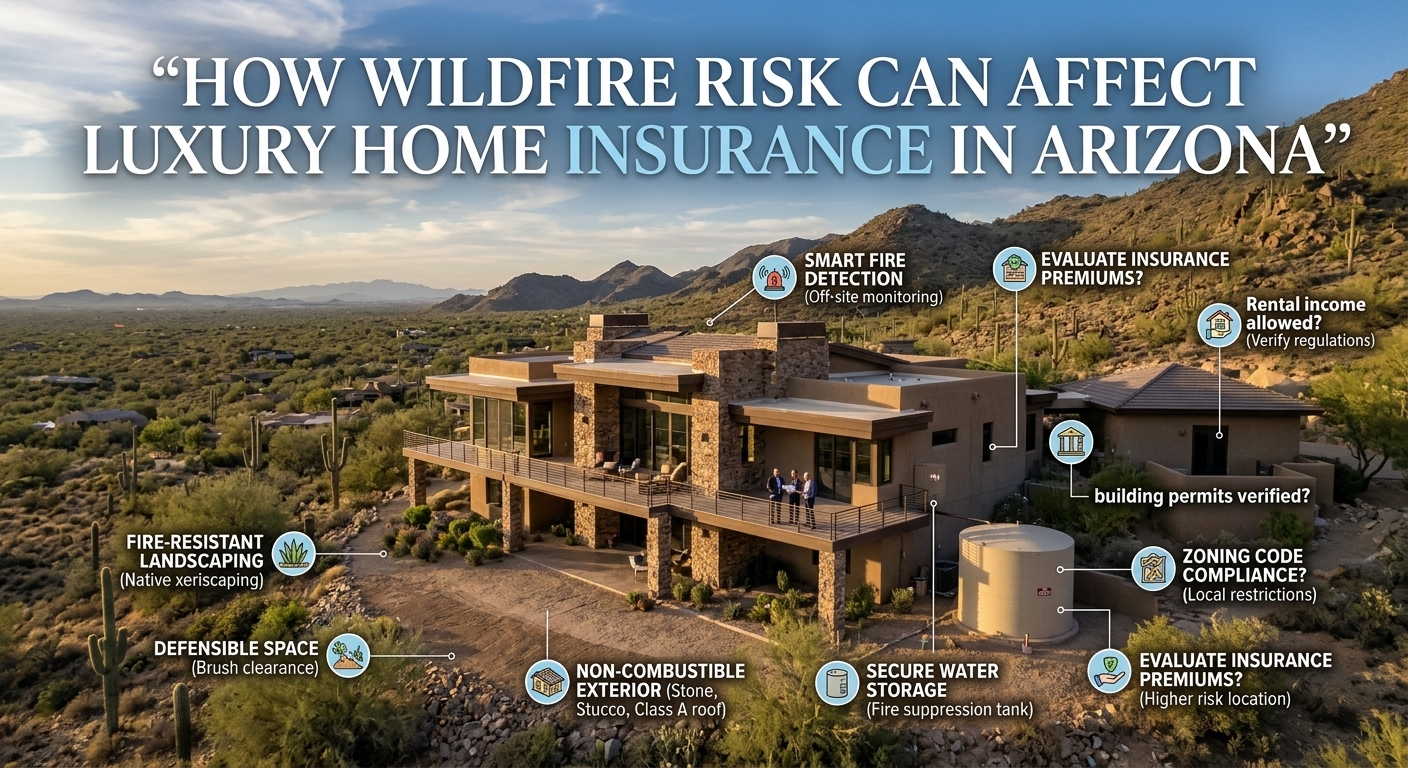
A luxury home in Arizona may offer spectacular desert views, hillside privacy, expansive outdoor living spaces, and a setting surrounded by natural desert or mountain landscapes. These features can make a property especially appealing, but they can also introduce considerations that buyers should evaluate before purchasing—particularly when it comes to wildfire exposure and homeowners insurance.
Wildfire risk is not limited to homes located deep in forested areas. In Arizona, properties near undeveloped desert terrain, vegetation, open spaces, and wildland-urban interface areas may also face exposure. Even homes in communities that appear relatively developed can be evaluated differently by insurers depending on their location, surrounding conditions, access to emergency services, and available fire protection resources.
For luxury homeowners, insurance deserves particular attention. A high-value residence may have extensive custom construction, specialty finishes, outdoor amenities, sophisticated mechanical systems, and landscaping that can make rebuilding more complex and expensive. If wildfire risk affects the availability or cost of coverage, the financial implications can extend well beyond the annual premium.
The Arizona Department of Insurance and Financial Institutions (DIFI) identifies wildfire as a significant homeowners insurance concern in the state, particularly in forested and wildland-urban interface areas. It also recognizes that homeowners in higher-risk locations may face non-renewals and difficulty finding replacement coverage. These considerations make insurance due diligence an important part of evaluating an Arizona luxury property.
1. Why Wildfire Risk Matters Even Outside Heavily Forested Areas
Many people associate wildfire exposure with heavily wooded mountain communities. However, Arizona's wildfire risk is not confined to those environments.
The state's dry climate, seasonal vegetation, undeveloped land, and expanding development near natural areas can create conditions in which fires threaten residential properties. Desert landscapes can also contain combustible vegetation, and homes near open desert, washes, foothills, or undeveloped parcels should not automatically be considered free from wildfire exposure.
For luxury buyers, this is particularly relevant when considering properties in:
- Foothill and hillside communities
- Homes bordering open desert or undeveloped land
- Properties near forested or mountainous areas
- Estates surrounded by substantial natural vegetation
- Homes at the edges of expanding residential developments
- Communities with limited nearby fire protection resources
The important distinction is that wildfire exposure is property-specific. Two luxury homes in the same general community may receive different insurance evaluations because of their individual locations, surrounding vegetation, construction features, and access to emergency services.
A beautiful setting should therefore be evaluated alongside its potential insurance implications.
2. How Wildfire Exposure Can Affect Homeowners Insurance Premiums
One of the most direct ways wildfire risk can affect a homeowner is through insurance pricing.
Insurance companies evaluate the likelihood and potential severity of losses when determining premiums. If a property is located in an area considered more vulnerable to wildfire, the insurer may view the home as a higher-risk property.
Several factors can contribute to the cost of coverage:
- Property location: Proximity to wildland areas, vegetation, and other potential wildfire exposures.
- Construction materials: Roofing, exterior walls, decks, and other building components.
- Home replacement value: The estimated cost of rebuilding the residence after a covered loss.
- Coverage limits: The amount of protection selected for the dwelling, personal property, and additional living expenses.
- Deductibles: The amount the homeowner agrees to pay before insurance coverage applies.
- Fire protection resources: The availability of fire departments, water supplies, and emergency response capabilities.
Luxury homes can have additional insurance considerations because their replacement costs may be significantly higher than those of conventional residences.
A custom estate with imported stone, specialty windows, extensive millwork, complex rooflines, and high-end architectural features may require a larger dwelling coverage limit. If the property is also considered more exposed to wildfire, the combined effect can make insurance planning more complicated.
It is important to remember that wildfire risk is only one factor in the final premium. Coverage selections, property characteristics, rebuilding costs, and the insurer's underwriting guidelines also matter.
3. Why Some Luxury Homes May Have Difficulty Obtaining Coverage
For some buyers, the greatest concern may not be the price of insurance but whether suitable coverage is available at all.
Insurers may limit the properties they are willing to cover in areas where wildfire exposure is considered elevated. Depending on the property's risk profile and the company's underwriting guidelines, an application may be declined, offered with restrictions, or referred for additional review.
Existing homeowners may also encounter a non-renewal when their insurer decides not to continue coverage at the end of the policy term.
This is different from a cancellation. A cancellation generally ends a policy before its scheduled expiration, while a non-renewal means the insurer does not continue the policy for another term.
Arizona DIFI has acknowledged that homeowners in wildfire-prone areas may experience non-renewals and difficulty securing replacement coverage. Its wildfire resources also include information about insurers that may be willing to offer policies in forested or wildland-urban interface areas.
For luxury buyers, this creates an important purchasing consideration: Do not assume that the seller's existing insurance policy will automatically be available to the next owner.
A buyer should independently confirm whether an insurer is willing to provide coverage for the property, what conditions apply, and whether the proposed policy provides adequate protection for the home's replacement value.
4. How a Luxury Home's Construction Can Influence Insurance Evaluation
The architectural design and construction of a luxury home can influence how an insurer evaluates its exposure.
A property's appearance may be impressive, but insurers are also interested in the materials and systems that protect the structure.
Some features worth examining include:
Roofing materials
The roof is an important part of a home's wildfire resilience. Buyers should determine the roofing material, its condition, and whether it meets the insurer's requirements. Fire-resistant roofing materials may help reduce vulnerability, although no roofing system guarantees protection from wildfire.
Exterior walls and siding
Exterior finishes can vary considerably among luxury homes. Stone, stucco, masonry, wood, and composite materials may have different fire-performance characteristics. Buyers should ask about the construction assembly rather than relying only on the visible exterior finish.
Decks and exterior structures
Wooden decks, pergolas, exterior stairs, patio covers, and attached outdoor structures can introduce additional combustible materials. Their proximity to vegetation and the main residence may also matter.
Windows and doors
Large glass openings are common in contemporary luxury homes. Buyers should ask whether the windows, frames, doors, and surrounding assemblies meet the insurer's expectations for the property's location and risk profile.
Attached amenities
Outdoor kitchens, covered entertainment areas, detached garages, guesthouses, and other structures may need to be included in the insurance evaluation. Their construction and proximity to the main residence can affect the overall exposure.
These features should be reviewed with a qualified insurance professional and, where appropriate, a building or wildfire mitigation specialist.
5. Defensible Space and Landscaping: Important Considerations for High-End Properties
Luxury properties often feature elaborate landscaping designed to create privacy, visual appeal, and a seamless connection between indoor and outdoor living.
However, landscaping can also influence wildfire exposure.
Dense vegetation, accumulated dry leaves, ornamental grasses, shrubs, wood mulch, and combustible materials near structures may provide fuel that allows fire to spread toward a home.
This is why defensible space is an important part of wildfire preparedness.
Defensible space refers to the area around a structure that is maintained to reduce potential fire exposure. The specific recommendations can vary depending on the property, vegetation, terrain, and local guidance.
Buyers should evaluate:
- Whether trees and shrubs are maintained and appropriately spaced
- Whether dry leaves, branches, and other debris are regularly removed
- Whether vegetation is growing directly against exterior walls
- Whether combustible mulch or decorative materials are positioned close to the home
- Whether trees overhang roofs or create potential pathways for fire
- Whether detached structures have appropriate clearance from surrounding vegetation
- Whether landscaping maintenance is included in an HOA or property management arrangement
A luxury estate with mature trees and extensive gardens may require more ongoing maintenance than a property with a simpler landscape design.
The goal is not necessarily to eliminate attractive landscaping. It is to understand how the existing design affects the property's exposure and what adjustments may be appropriate.
6. Fire Department Access, Water Supply, and Community Protection
Insurance companies may consider more than the individual home when evaluating wildfire exposure. Community-level fire protection resources can also influence how a location is assessed.
Arizona DIFI explains that insurers commonly consider the Insurance Services Office (ISO) Public Protection Classification, which evaluates a community's fire protection capabilities.
Factors include:
- Fire departments and fire districts
- Water resources
- Emergency communications
- Community risk-reduction efforts
The classification system ranges from Class 1, representing the strongest relative protection, to Class 10, representing the weakest.
However, a community classification does not necessarily tell the entire story for an individual property. DIFI notes that a specific home may have a different classification based on factors such as its distance from a fire station or water source.
For luxury buyers, it is worth asking about:
- The nearest fire station and emergency response resources
- Road access for emergency vehicles
- Whether the property has a reliable water supply for firefighting
- Whether the community participates in wildfire mitigation programs
- Whether private roads, gates, or access restrictions could affect emergency access
- Whether the property has any private fire protection equipment or systems
A remote estate may provide privacy and beautiful views, but buyers should understand how emergency responders would reach the property and what resources are available if a wildfire approaches.
7. Why Replacement Cost Is Especially Important for Luxury Properties
The market value of a luxury home and the cost to rebuild it are not necessarily the same.
Market value reflects what a buyer may pay for the property, including its location, land, views, neighborhood, and overall desirability.
Replacement cost focuses on the estimated expense of reconstructing the insured residence using comparable materials, workmanship, and specifications.
This distinction matters because a high-end property may contain features that are difficult or expensive to reproduce.
Examples include:
- Custom architectural designs
- Imported stone and specialty finishes
- Handcrafted cabinetry and millwork
- Large-format windows and specialized glazing
- Complex rooflines and structural elements
- Smart-home and integrated security systems
- Custom pools and exterior structures
- Guesthouses and detached amenities
A policy with inadequate dwelling coverage could leave the homeowner responsible for a substantial financial gap after a covered loss.
Buyers should ask an insurance professional to review the home's estimated replacement cost rather than assuming the purchase price or appraised market value represents the appropriate coverage amount.
They should also understand whether the policy includes extended or guaranteed replacement cost provisions, how those provisions work, and what limitations or conditions apply.
8. What Buyers Should Review Before Purchasing a Luxury Home in a Higher-Risk Area
Insurance due diligence should begin before the transaction reaches closing.
A property may be attractive, appropriately priced, and well-maintained, but an insurance challenge can affect the buyer's total ownership costs and financing arrangements.
Before moving forward, buyers should consider the following:
Request an insurance quote early.
Provide the insurer with the property's address, construction details, square footage, roof information, and other requested documentation. The earlier the process begins, the more time there is to address underwriting questions.
Confirm that coverage is actually available.
An online estimate or preliminary quote is not necessarily confirmation that the insurer will issue a policy. Ask whether the property has completed underwriting review and whether any inspections or additional requirements remain.
Review the existing insurance history when available.
Ask the seller whether the property has experienced prior insurance non-renewals, coverage restrictions, or wildfire-related underwriting concerns. Information should be verified rather than assumed.
Understand the policy's wildfire coverage.
Review the policy language with a qualified insurance professional. Confirm how fire-related damage is covered, whether any exclusions or limitations apply, and how the policy treats additional structures and personal property.
Evaluate the deductible.
A lower premium may come with a higher deductible. Buyers should understand how much they would need to pay out of pocket after a covered loss.
Check the replacement-cost estimate.
Make sure the dwelling limit reflects the home's construction and rebuilding requirements.
Confirm lender requirements.
If financing the purchase, buyers should verify that the proposed policy satisfies the lender's insurance requirements before closing.
The objective is to avoid discovering after the purchase that the property is more difficult or expensive to insure than anticipated.
9. Can Wildfire Mitigation Efforts Help With Insurance Costs?
Wildfire mitigation can help reduce a property's exposure and may improve its insurance prospects.
However, buyers should understand that mitigation does not guarantee coverage, prevent non-renewal, or automatically qualify a property for a lower premium.
Insurance companies have different underwriting standards and may recognize mitigation measures differently.
Potential measures include:
- Maintaining defensible space
- Removing accumulated combustible debris
- Using fire-resistant roofing and exterior materials where appropriate
- Keeping gutters and roof areas clear of dry vegetation
- Reviewing decks, fences, and other combustible attachments
- Maintaining appropriate clearance around outbuildings
- Participating in community wildfire preparedness initiatives
- Following recommendations from local fire departments or qualified mitigation professionals
Community programs can also be valuable. Arizona DIFI identifies Firewise USA®, FEMA preparedness resources, and local fire departments as potential sources of wildfire mitigation guidance.
Buyers should ask whether the property or its community participates in a recognized wildfire preparedness program and whether the insurer considers those efforts during underwriting.
It is also helpful to document completed improvements with photographs, inspection reports, invoices, and contractor information. This documentation can support discussions with an insurance company, although acceptance remains subject to the insurer's requirements.
10. The Connection Between Wildfire and Post-Fire Flooding
Wildfire-related property risk does not always end when the flames are extinguished.
After a wildfire burns vegetation across a hillside or surrounding landscape, the affected ground may become more vulnerable to erosion and runoff. Heavy rainfall can then contribute to flash flooding, debris flows, and other post-fire hazards.
This is particularly relevant for luxury homes located near:
- Hillsides and slopes
- Natural drainage channels
- Washes and low-lying areas
- Mountain foothills
- Areas with substantial elevation changes
One important insurance distinction is that standard homeowners insurance generally does not cover flood damage caused by water entering a home from outside at ground level. Separate flood insurance may be necessary.
Arizona DIFI specifically warns that flood risk can increase in areas where a wildfire has burned.
For buyers evaluating a hillside or desert-edge estate, it is worth considering drainage, grading, retaining walls, erosion exposure, and the property's relationship to nearby washes or slopes.
A home may have an acceptable wildfire insurance quote but still require a separate evaluation of its flood exposure.
11. What Happens if a Luxury Homeowner Cannot Find Traditional Coverage?
If a buyer or homeowner has difficulty securing a standard homeowners policy, the next step should be to explore available alternatives with a licensed insurance professional.
Arizona DIFI maintains information about insurers that may offer homeowners coverage in higher-risk forested and wildland-urban interface areas. The department cautions that not every listed insurer will cover every property, and pricing may vary.
Depending on the circumstances, an insurance professional may discuss:
- Other admitted insurance companies
- Specialty or surplus-lines coverage
- Different policy structures
- Additional underwriting inspections
- Property improvements that may address specific concerns
- Available coverage options for particular structures or risks
Buyers should not assume that an alternative policy will provide the same protection as a conventional homeowners policy. Coverage limits, exclusions, deductibles, claims handling, and insurer requirements should all be carefully reviewed.
The priority should be finding coverage that is both available and appropriate for the property's actual replacement needs.
12. Questions Luxury Buyers Should Ask Before Making an Offer
A thoughtful insurance review can help buyers identify potential ownership costs before committing to a property.
Consider asking the seller, insurance agent, and other relevant professionals:
- Has the property previously experienced an insurance non-renewal or difficulty obtaining coverage?
- Can the buyer obtain a homeowners insurance policy for this specific address?
- Does the insurer consider the property to be in a wildfire-prone or wildland-urban interface area?
- What factors are influencing the proposed premium?
- Does the policy provide adequate replacement-cost coverage for the residence?
- Are guesthouses, detached garages, outdoor kitchens, and other structures included?
- Are there specific roofing, landscaping, or property-maintenance requirements?
- Does the insurer require an inspection before issuing or renewing coverage?
- What deductibles, exclusions, or limitations apply?
- Is separate flood insurance worth considering because of the property's location?
- Are there mitigation improvements that the insurer may recognize?
- Could the insurance cost affect the buyer's overall ownership budget or financing arrangements?
These questions can help buyers look beyond the property's immediate appeal and understand the practical responsibilities of owning it.
13. How The Murphy Group Arizona Approaches Insurance Considerations in Luxury Real Estate
A luxury property should be evaluated as more than an architectural achievement or a desirable address. Its long-term ownership experience also depends on the practical considerations that come with maintaining, protecting, and insuring the home.
For properties near desert preserves, foothills, open land, or other natural landscapes, wildfire exposure deserves attention early in the buying process.
The Murphy Group Arizona recognizes the importance of helping buyers look beyond a property's visual appeal and consider the details that may influence ownership. Insurance availability, replacement-cost considerations, construction materials, landscaping, emergency access, and property-specific risks are all worth examining as part of a broader due diligence process.
As Mary Murphy might emphasize, a beautiful home should also make sense from a long-term ownership perspective. Understanding insurance requirements before closing can help buyers make more informed decisions and avoid unexpected complications after taking ownership.
The Murphy Group Arizona can help buyers navigate the property search and identify important questions to raise with the appropriate professionals. Insurance coverage and underwriting decisions, however, should always be confirmed directly with a qualified insurance agent or carrier.
Frequently Asked Questions About Wildfire Risk and Luxury Home Insurance in Arizona
Does Arizona homeowners insurance cover wildfire damage?
Many standard homeowners policies include coverage for fire damage, but the exact protection depends on the policy's terms, exclusions, limits, and conditions. Buyers should confirm wildfire coverage directly with the insurer rather than assuming every policy provides identical protection.
Are luxury homes in Scottsdale and Paradise Valley at risk of wildfire?
Wildfire exposure varies by property. Homes near undeveloped land, desert vegetation, foothills, or other natural areas may have different risk profiles. The property's exact location and characteristics should be reviewed with an insurance professional.
Can wildfire risk make homeowners insurance more expensive in Arizona?
Yes. Insurers consider property location, construction, fire protection resources, replacement costs, and other risk factors when determining premiums. Higher perceived wildfire exposure may affect both pricing and coverage availability.
Can an insurance company refuse to insure a home because of wildfire risk?
An insurer may decline an application if the property does not meet its underwriting guidelines. Existing coverage may also be non-renewed, subject to applicable policy terms and legal requirements. Buyers should confirm insurability before closing.
Does fire-resistant construction guarantee lower insurance premiums?
No. Fire-resistant materials and mitigation measures may help reduce exposure, but insurance companies have different underwriting standards. Buyers should ask the insurer which improvements, if any, it recognizes when evaluating a property.
Is wildfire damage covered by flood insurance?
Flood insurance generally addresses qualifying flood damage, not the fire damage itself. This distinction matters because areas affected by wildfire may face increased post-fire flooding. Homeowners should review both policies with an insurance professional.
Should buyers obtain an insurance quote before making an offer?
Ideally, buyers should begin discussing insurance as early as possible. A preliminary quote can help establish expected costs, but buyers should confirm that the insurer has completed the necessary underwriting review and is prepared to issue the policy.
The Bottom Line
Wildfire risk can influence more than the safety considerations of owning an Arizona luxury home. It can affect insurance premiums, coverage availability, policy requirements, replacement-cost planning, and the long-term cost of ownership.
For buyers considering properties in Scottsdale, Paradise Valley, North Scottsdale, and the East Valley, it is important to evaluate the home's location, construction materials, landscaping, emergency access, and insurance options before moving forward.
A desirable property should also be a property that can be responsibly maintained, protected, and insured. By addressing wildfire exposure early and consulting the appropriate professionals, buyers can make more informed decisions about their investment and future ownership experience.
Explore Arizona Luxury Real Estate With The Murphy Group Arizona
If you're considering a luxury home in Scottsdale, Paradise Valley, North Scottsdale, or the East Valley, The Murphy Group Arizona can help you look beyond the listing photos and consider the property, neighborhood, and long-term ownership experience.
From wildfire exposure and insurance availability to construction materials, defensible space, and replacement-cost considerations, a thoughtful approach to due diligence can help you make a more informed decision.
Explore Arizona luxury real estate with The Murphy Group Arizona and discover your next exceptional property.
Website: www.mgsellsarizona.com

Mary Murphy
Team Leader | The Murphy Group - AZ | eXp Luxury | PLACE
or another way