

Categories
Arizona Luxury, Arizona Real Estate, Paradise Valley Luxury, Scottsdale Luxury Real Estate, Scottsdale Real EstatePublished January 21, 2026
How to Evaluate Luxury Homes Without Emotional Bias

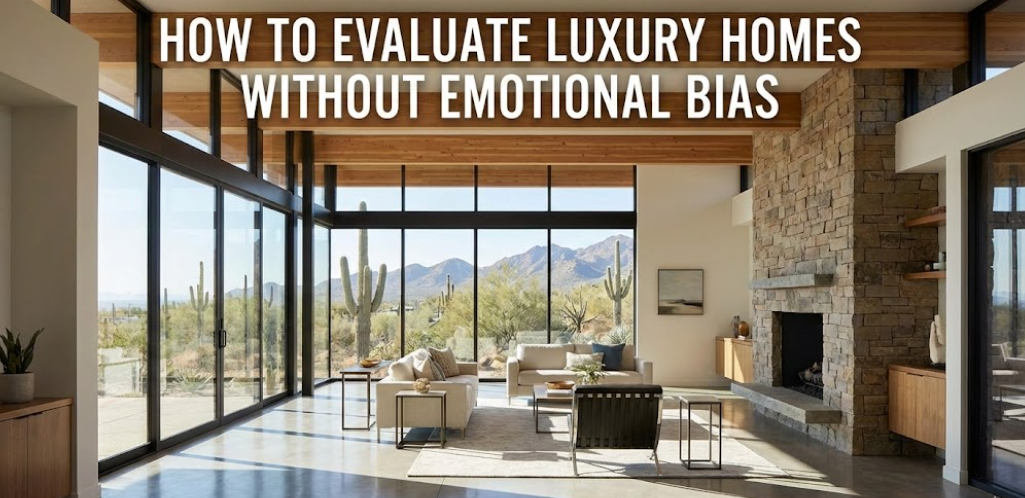
Luxury real estate purchases are emotional by nature — lifestyle, legacy, status, and comfort all play a role. But when emotions drive the decision instead of informing it, buyers risk overpaying, compromising on fundamentals, or regretting the purchase later.
In Arizona’s luxury markets like Scottsdale and Paradise Valley, the most successful buyers learn to separate emotional reaction from objective evaluation.
Mary Murphy, founder of The Murphy Group, explains:
“Emotion should confirm a decision — not make it. The smartest luxury buyers feel excited after the numbers and fundamentals make sense.”
Here’s how to evaluate luxury homes clearly, confidently, and without bias.
🧠 1. Distinguish First Impression From True Value
Luxury homes are designed to impress — dramatic entries, designer finishes, resort-style backyards.
Before forming conclusions, ask:
- Would this home still make sense without staging or décor?
- Is the appeal architectural or cosmetic?
- Does the layout function beyond the wow factor?
💬 Buyer Insight:
Emotion responds instantly. Value reveals itself only after analysis.
📍 2. Anchor on Location Before Anything Else
Location is non-negotiable — and emotional appeal cannot override it.
Evaluate:
- Street positioning (traffic, privacy, noise)
- Lot orientation and views
- Proximity to preferred amenities
- Long-term desirability of the neighborhood
A beautiful home in a compromised location rarely ages well in value.
📐 3. Break the Home Into Fundamentals
Instead of evaluating the home as a single emotional experience, separate it into components:
- Lot: size, privacy, orientation, future risk
- Structure: layout efficiency, ceiling heights, flow
- Architecture: timeless vs trend-driven
- Condition: systems, roof, mechanicals
- Flexibility: ability to adapt to future needs
This framework removes emotional shortcuts and forces clarity.
💰 4. Use Price Per Square Foot as a Reality Check — Not a Rule
Luxury homes aren’t commodities, but pricing still needs context.
Compare:
- Price per square foot to recent sales with similar attributes
- Premiums justified by views, privacy, or architecture
- Gaps driven by emotion rather than substance
💬 Pro Tip:
If pricing can’t be defended in one clear sentence, it’s likely inflated.
🧱 5. Separate Permanent Features From Changeable Ones
Emotion often overweights cosmetic elements.
Permanent:
✔ Location
✔ Lot
✔ Layout
✔ Ceiling height
✔ Structural integrity
Changeable:
✖ Paint
✖ Flooring
✖ Fixtures
✖ Landscaping style
Mary Murphy notes:
“Buy the bones, not the staging. You can change finishes — you can’t change fundamentals.”
🔍 6. Pressure-Test the Home Against Alternatives
To reduce emotional attachment, ask:
- Would I still pursue this home if a similar one appeared tomorrow?
- What would I compromise to get this property?
- Does this home outperform its competition — or just feel good today?
Comparative analysis weakens emotional distortion.
🕰️ 7. Evaluate Time-on-Market Objectively
Emotion can cause buyers to ignore signals.
Ask:
- How long has this home been available relative to peers?
- Have there been price reductions?
- What buyer segment has passed on it — and why?
Time-on-market often reveals what emotion hides.
🧮 8. Model the Exit Before the Entry
Sophisticated buyers evaluate how a home will perform before buying it.
Consider:
- Resale appeal in different market cycles
- Buyer pool depth at this price point
- Uniqueness vs liquidity balance
If exiting the home feels unclear, entering should be reconsidered.
🚦 9. Slow the Decision — Not the Process
Emotion thrives in urgency. Clarity thrives in structure.
Use:
- Written pros/cons lists
- Overnight pauses
- Second showings without staging distractions
- Third-party inspections early
Speed doesn’t cause mistakes — unstructured speed does.
🏁 Key Takeaway: Emotion Is a Signal, Not a Strategy
Luxury buyers don’t eliminate emotion — they manage it.
The best decisions occur when:
✔ Fundamentals justify the price
✔ Location aligns with lifestyle
✔ Flexibility supports long-term use
✔ Emotion confirms — not overrides — logic
Mary summarizes it best:
“The right luxury home should feel exciting and defensible. When both align, confidence follows.”
📲 Looking for Objective Guidance in Arizona’s Luxury Market?
The Murphy Group helps luxury buyers evaluate homes with clarity, data, and long-term perspective — so emotion enhances the experience without driving costly mistakes.
If you’re buying in Scottsdale, Paradise Valley, or surrounding luxury communities, start your search with confidence at www.mgsells.com

Mary Murphy
Team Leader | The Murphy Group - AZ | eXp Luxury | PLACE
or another way