

Categories
Arizona Luxury, Arizona Real Estate, Scottsdale Luxury Real Estate, private home elevator, luxury home buying guide, Paradise Valley Luxury, Paradise Valley Real Estate, North Scottsdale real estate, Arizona Estate HomesPublished November 11, 2026
Buying an Arizona Luxury Home With a Private Elevator: What Buyers Should Evaluate

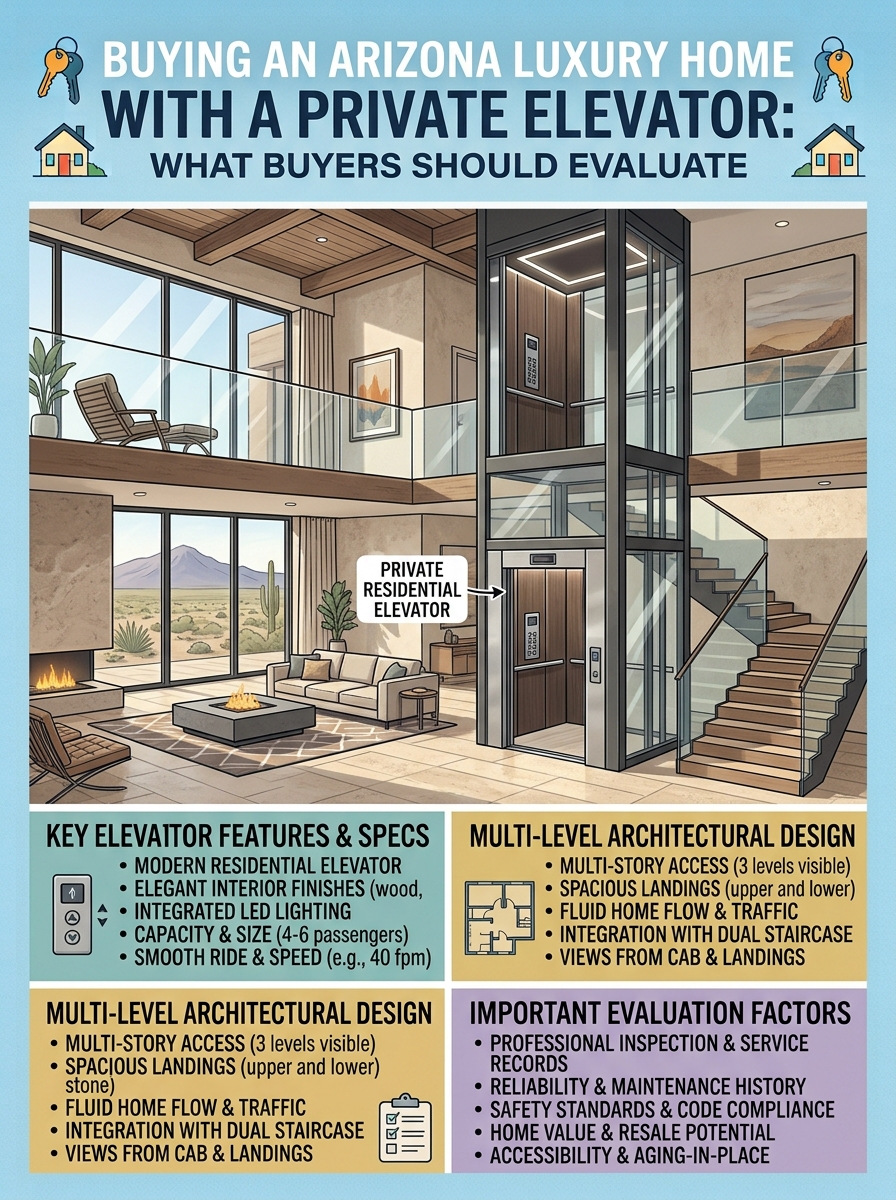
A private elevator can be one of the most convenient features in a luxury home. Beyond its visual appeal, it can make moving between floors easier, improve accessibility, and support a more comfortable living experience as household needs change over time.
In Arizona's luxury real estate market, elevators may be found in expansive custom homes, multi-level hillside properties, contemporary residences, and estates designed around distinctive architectural layouts. For buyers exploring properties in Scottsdale, Paradise Valley, North Scottsdale, or the East Valley, this feature can offer practical advantages that go well beyond convenience.
However, a private elevator is also a mechanical system that requires ongoing attention. Its condition, installation history, maintenance requirements, safety features, and long-term operating costs deserve the same careful evaluation as other major components of a property.
A beautifully designed elevator does not automatically mean it is reliable, properly maintained, or suitable for every household.
Before purchasing an Arizona luxury home with a private elevator, buyers should understand what they are acquiring and what responsibilities may come with ownership.
1. Understand the Type of Elevator Installed
Not all residential elevators operate in the same way. The technology used can influence the elevator's performance, maintenance needs, space requirements, and potential repair expenses.
Common residential elevator systems include:
- Hydraulic elevators: These use fluid pressure to move the elevator car. They may require a machine room or designated equipment space, depending on the design.
- Traction elevators: These use a motor-driven pulley and counterweight system to move the elevator car.
- Machine-room-less elevators: These are designed to reduce or eliminate the need for a separate machine room, depending on the system.
- Pneumatic vacuum elevators: These use air pressure differences to move a cabin through a vertical shaft.
Each system has different installation and service considerations.
Buyers should request the elevator's manufacturer, model, installation date, system type, and available technical documentation. Knowing exactly what is installed makes it easier to understand the property's maintenance history and identify qualified service providers.
It is also worth confirming whether the elevator system is still supported by its manufacturer and whether replacement components remain available.
2. Review the Elevator's Installation and Service History
An elevator may look pristine on the outside while having mechanical components that need attention.
Before moving forward with a purchase, ask for documentation showing when the elevator was installed, who performed the installation, and whether it has received regular professional maintenance.
Useful records may include:
- Original installation documentation
- Manufacturer information and operating manuals
- Service and maintenance agreements
- Records of routine inspections, where applicable
- Repair invoices and replacement-part records
- Documentation of previous malfunctions
- Records of major upgrades or modernization work
A consistent maintenance history can provide valuable insight into how the system has been cared for.
If documentation is incomplete, buyers should not automatically assume the elevator is in poor condition. However, the missing records should be treated as an important due diligence issue.
An independent evaluation by a qualified residential elevator professional can help establish the system's current condition.
3. Arrange a Professional Elevator Inspection
A standard home inspection may identify visible concerns, but buyers should not assume that it includes a comprehensive evaluation of specialized elevator equipment.
A separate inspection by a qualified elevator technician is a practical step when purchasing a home with a private elevator.
Depending on the system, the evaluation may examine:
- Elevator operation and travel between floors
- Door operation and interlocks
- Control panels and operating buttons
- Emergency stop and communication systems
- Safety mechanisms
- Electrical and mechanical components
- Elevator shaft and accessible equipment areas
- Unusual sounds, vibration, or inconsistent movement
- Evidence of wear, damage, or deferred maintenance
The technician should also identify any components that may require repair, adjustment, or replacement.
Buyers should request a written report explaining the elevator's observed condition, recommended work, and any concerns that could affect safe operation.
This evaluation should complement, rather than replace, the property's broader home inspection.
4. Evaluate Safety Features and Emergency Systems
Safety is one of the most important considerations when evaluating a private elevator.
Modern residential elevator systems may include several safety features, but the exact configuration depends on the manufacturer, model, installation date, and applicable requirements.
Buyers should ask the elevator professional to evaluate the availability and condition of features such as:
- Door interlocks that help prevent operation when doors are not properly secured
- Emergency stop controls
- Emergency lighting
- Alarm or communication systems
- Backup lowering or emergency rescue provisions, where applicable
- Door obstruction protection
- Appropriate safety mechanisms for the installed system
It is particularly important to understand what happens if the elevator stops between floors or loses power.
Ask whether the system has a battery-powered emergency lowering feature or another approved rescue arrangement. Also determine how occupants can communicate with someone outside the elevator during an emergency.
A buyer should never rely solely on the appearance of control buttons or emergency switches. A qualified technician should verify that the safety systems are present and functioning as intended.
5. Understand How the Elevator Performs During a Power Outage
Power interruptions are an important consideration for Arizona homeowners, particularly when evaluating properties with multiple levels.
An elevator that depends on household electrical service may become unavailable during a power outage unless it has an appropriate backup or emergency operation system.
Buyers should ask:
- Does the elevator have battery backup?
- Can it safely lower the elevator car during a power interruption?
- Is the system connected to a whole-home generator?
- If a generator is installed, is the elevator compatible with it?
- Are there special operating procedures during an outage?
- What happens if backup power is unavailable?
It is important to distinguish between emergency lowering and full elevator operation.
A backup system may allow the elevator to move to a designated floor and release occupants without supporting normal operation throughout an extended outage.
If the property includes a generator or backup power system, have the relevant professionals confirm that the equipment is compatible and that the elevator's electrical requirements have been considered.
6. Consider Arizona's Heat and the Location of Elevator Equipment
Arizona's climate makes equipment placement an important part of property evaluation.
Some elevator systems have machinery, electrical components, or control equipment located in designated spaces that may be affected by surrounding temperatures, ventilation, dust, and environmental conditions.
Buyers should pay attention to where the elevator's equipment is installed.
Consider the following:
- Is the equipment located in a conditioned or unconditioned area?
- Does the space have adequate ventilation?
- Is there visible dust accumulation or evidence of moisture?
- Are electrical components protected from environmental exposure?
- Is the equipment room accessible for professional servicing?
- Does the manufacturer specify temperature or environmental operating limits?
For properties with equipment located in garages, utility rooms, or other areas exposed to changing temperatures, ask the elevator technician whether the installation environment is appropriate.
The goal is not to assume that Arizona's heat will damage an elevator. Rather, buyers should verify that the equipment is installed and maintained under conditions consistent with its manufacturer's requirements.
7. Inspect the Elevator Shaft and Surrounding Construction
The elevator itself is only one part of the installation. The shaft, doors, landings, and surrounding construction also deserve attention.
A residential elevator requires a properly designed vertical space that accommodates the equipment and allows it to operate as intended.
During due diligence, buyers should ask their inspector or elevator professional to examine accessible areas for:
- Visible cracking or damage around the shaft
- Signs of moisture intrusion
- Unusual gaps or alignment issues around landing doors
- Damage to surrounding walls or flooring
- Evidence of previous repairs or modifications
- Obstructions that may affect access to equipment
The inspection should also consider whether the elevator installation appears consistent with available construction plans and documentation.
If the home has undergone renovations or additions, ask whether the elevator system or surrounding structure was affected.
Any uncertainty involving structural modifications, fire-rated construction, or building requirements should be reviewed by the appropriate qualified professional.
8. Evaluate the Number of Floors and Elevator Capacity
A private elevator should be suitable for the way the home is designed and how the household intends to use it.
Consider how many floors the elevator serves and whether it provides convenient access to the areas that matter most.
For example, a multi-level home may have an elevator serving the main living floor, bedroom level, and lower-level entertainment area. Another property may have an elevator that only connects two floors.
Buyers should verify:
- The number of stops served
- The elevator's rated weight capacity
- The interior dimensions of the elevator car
- Door opening dimensions
- Whether furniture or mobility equipment can fit
- Whether the elevator provides access to the garage or other important areas
Capacity is especially important if the elevator will be used to transport large household items, mobility devices, or multiple occupants.
Do not assume that an elevator's exterior dimensions reflect its usable interior space. Review the manufacturer's specifications and, if necessary, measure the cabin and door openings.
9. Consider Accessibility and Long-Term Household Needs
For some buyers, the greatest value of a private elevator is the flexibility it provides as household needs evolve.
A home with stairs may be comfortable today but less convenient later due to mobility changes, injuries, aging, or the needs of visiting family members.
An elevator can make multiple levels more accessible, but it does not automatically make an entire property accessible.
Consider whether the elevator connects the areas that would need to be reached regularly, including:
- Primary bedroom and bathroom
- Main living and dining areas
- Kitchen
- Garage or parking area
- Guest accommodations
- Outdoor living spaces, where applicable
Also evaluate the space immediately outside each elevator landing.
A narrow hallway, several steps, or an inaccessible bathroom may limit the practical benefits of the elevator.
Buyers planning for long-term accessibility should evaluate the entire circulation and layout of the property, not just the presence of an elevator.
10. Understand Ongoing Maintenance and Operating Costs
A private elevator is not a maintenance-free luxury feature.
Like other mechanical systems, it requires periodic professional servicing. The frequency and cost depend on the elevator type, manufacturer recommendations, usage, age, and condition.
Potential ownership expenses may include:
- Routine maintenance visits
- Repairs to mechanical or electrical components
- Door and control-system adjustments
- Replacement of worn parts
- Emergency service calls
- Modernization or equipment upgrades
- Applicable inspections or compliance-related work
Ask the seller whether a current maintenance agreement exists and whether it can be transferred to the new owner.
It is also helpful to obtain an estimate from a local elevator service company for expected routine maintenance and any outstanding work.
A buyer should consider both immediate expenses and the possibility of larger repairs over the property's ownership period.
11. Investigate Replacement Parts and Service Availability
A private elevator can become a significant inconvenience if it stops working and the necessary replacement parts are difficult to obtain.
This is especially worth investigating when the property has an older elevator or a system from a manufacturer with limited local service support.
Ask the seller or elevator technician:
- Is the manufacturer still operating?
- Is the specific model still supported?
- Are replacement parts readily available?
- Are qualified technicians available in the area?
- Are there known discontinued components?
- Would the system require modernization to remain serviceable?
For a luxury property in Scottsdale, Paradise Valley, or another part of the Phoenix metropolitan area, buyers should identify service providers who are qualified to work on the specific elevator system.
A general contractor or handyman should not be treated as a substitute for a qualified elevator professional.
12. Check Permits, Approvals, and Applicable Requirements
Buyers should also review the available documentation associated with the elevator's installation and any major modifications.
Depending on the property's jurisdiction, installation date, and scope of work, relevant records may include permits, inspection documentation, approvals, and contractor information.
Ask the seller for available records and verify them with the appropriate local building department when necessary.
If the elevator was added after the original construction of the home, pay particular attention to whether the work was properly documented.
This is also an opportunity to determine whether later renovations affected the elevator shaft, electrical connections, landing areas, or other related components.
Requirements can vary by location and installation circumstances, so buyers should avoid relying on assumptions based solely on the age or appearance of the system.
13. Consider How the Elevator Affects Daily Living and Resale Appeal
A private elevator can be an attractive feature, particularly in a multi-level luxury residence.
It may appeal to buyers who value convenience, accessibility, and the ability to move between floors without relying entirely on stairs.
However, its value depends on the property's overall design and the needs of its likely future buyers.
Consider whether the elevator:
- Connects the home's most frequently used living areas
- Is positioned conveniently within the floor plan
- Operates quietly and smoothly
- Has an attractive and well-maintained interior
- Fits naturally into the home's architectural design
- Has a documented maintenance history
An elevator that is thoughtfully integrated into the property may contribute to its overall appeal.
On the other hand, an aging system with uncertain service history or expensive repair needs could become a concern during a future sale.
Buyers should view the elevator as one component of the home's overall value rather than assuming that its presence automatically increases resale value.
14. Ask the Right Questions Before Making an Offer
Before purchasing a luxury home with a private elevator, buyers should gather as much information as possible from the seller and relevant professionals.
Here are useful questions to include in the due diligence process:
About the installation
- When was the elevator installed?
- Who installed it?
- What manufacturer and model is it?
- How many floors does it serve?
- Is the original installation documentation available?
About its condition
- When was it last professionally serviced?
- Are there known operating problems?
- Have major components been replaced?
- Is a separate elevator inspection available?
- Are there outstanding repairs or recommended upgrades?
About safety and operation
- What emergency systems are installed?
- How does the elevator respond to a power outage?
- Is there a documented emergency rescue procedure?
- Are all safety features functioning properly?
About ownership costs
- Is there an active maintenance agreement?
- What is the estimated annual maintenance expense?
- Are replacement parts readily available?
- Are there any anticipated modernization costs?
Getting clear answers can help buyers understand the elevator's condition and make a more informed purchasing decision.
The Murphy Group Arizona Perspective
A private elevator can add an important level of convenience to a luxury home, but its value should be considered in the context of the entire property.
As Mary Murphy of The Murphy Group Arizona explains:
“Luxury is not simply about having impressive features. It is about understanding how those features support the way you live. When evaluating a home with a private elevator, buyers should look beyond the design and consider its condition, reliability, maintenance history, and long-term practicality.”
For buyers exploring multi-level homes in Scottsdale, Paradise Valley, North Scottsdale, and the East Valley, the elevator should be evaluated alongside the property's layout, construction, mechanical systems, and overall ownership considerations.
A well-maintained elevator can support everyday convenience for years. Understanding its condition before closing helps buyers approach ownership with greater confidence.
The Bottom Line: Look Beyond the Luxury Feature
A private elevator can make an Arizona luxury home more convenient, accessible, and adaptable to changing household needs.
However, buyers should evaluate more than its appearance and smooth operation during a showing. The elevator's installation history, professional inspection results, safety systems, power-outage capabilities, maintenance requirements, service availability, and potential repair costs all deserve attention.
The most important step is to include a qualified elevator professional in the due diligence process.
When buyers understand the condition and responsibilities associated with this specialized feature, they can make a more informed decision about whether the property is the right fit for their lifestyle and long-term plans.
Explore Arizona Luxury Real Estate With The Murphy Group Arizona
If you're considering a luxury home in Scottsdale, Paradise Valley, North Scottsdale, or the East Valley, The Murphy Group Arizona can help you look beyond the listing photos and consider the property, neighborhood, and long-term ownership experience.
From private elevators and accessibility features to mechanical systems, property condition, and everyday functionality, a thoughtful approach to due diligence can help you make a more informed decision.
Explore Arizona luxury real estate with The Murphy Group Arizona and discover your next exceptional property.
Website: www.mgsellsarizona.com

Mary Murphy
Team Leader | The Murphy Group - AZ | eXp Luxury | PLACE
or another way