

Categories
Leased Equipment, Arizona Luxury, Arizona Lifestyle, Arizona Real Estate, Scottsdale Real Estate, Paradise Valley Luxury, Paradise Valley Real Estate, North Scottsdale homes, North Scottsdale real estate, East Valley Luxury, East Valley real estate, East Valley, Solar Panel Leases, Real Estate Due DiligencePublished October 20, 2026
When a Luxury Property Includes Leased Equipment: What Buyers Need to Know Before Closing

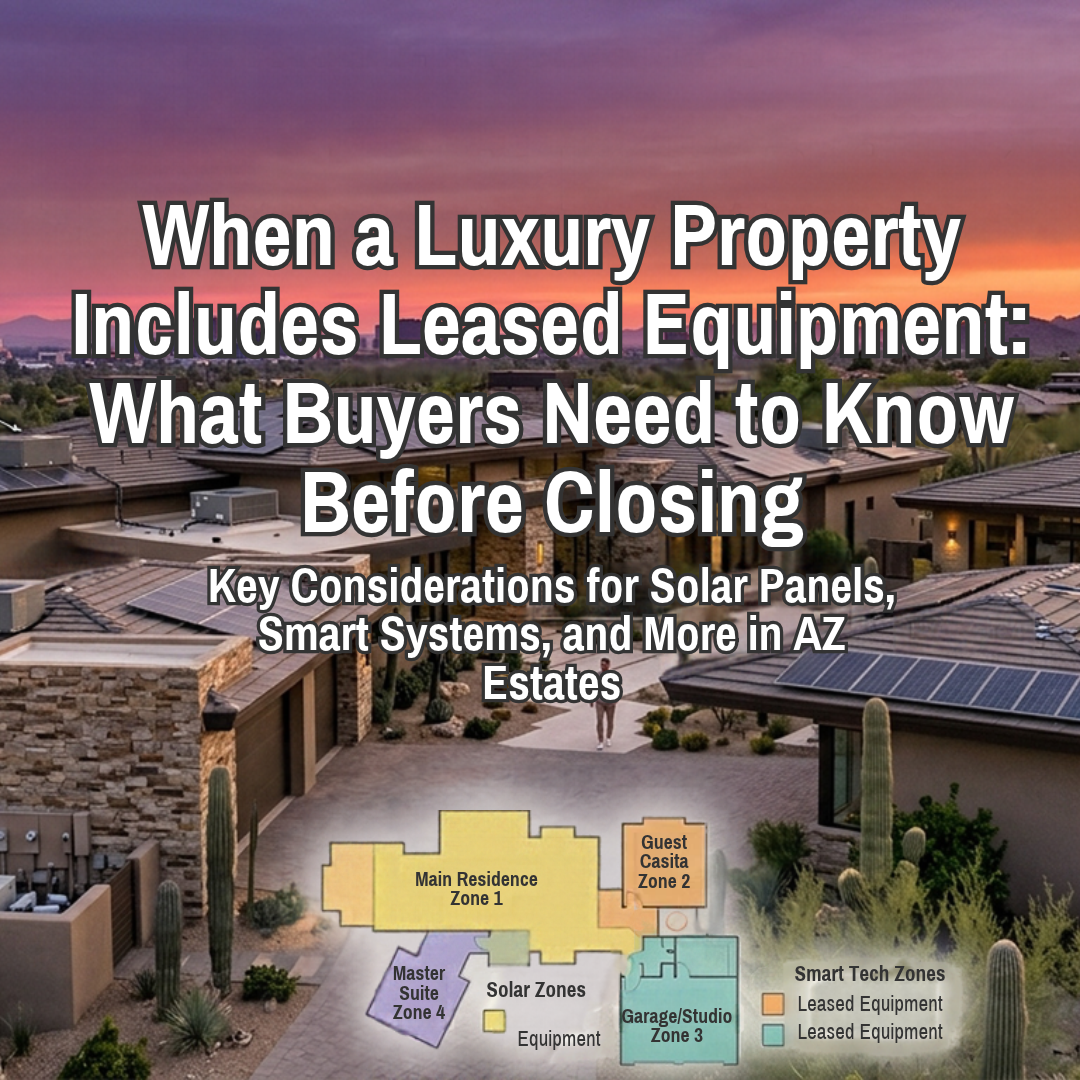
An Arizona luxury property can offer more than an impressive home, expansive outdoor living areas, and carefully designed interiors. It may also include modern equipment and specialized systems that make everyday living more convenient.
Solar panels may help generate electricity. A whole-home water filtration system may improve water quality. Smart-home technology may connect lighting, security, and climate controls. Other properties may feature leased security equipment, water softeners, backup power systems, or specialized appliances.
These features can make a home more attractive, but there is an important detail buyers should investigate before closing: not every piece of equipment installed on a property is necessarily owned by the seller.
Some equipment may be leased, financed, subject to a service agreement, or governed by a separate contract. Depending on the arrangement, the buyer may need to assume ongoing payments, obtain approval from a provider, negotiate a buyout, or confirm that the equipment will be removed before the sale is completed.
For luxury buyers, this distinction matters because equipment-related agreements can affect monthly expenses, closing requirements, property value, and the responsibilities that come with ownership.
Does the solar system belong to the seller or a leasing company? Is a security system tied to a long-term monitoring contract? Does the water treatment equipment have a remaining lease balance? Can the agreement be transferred to the buyer? What happens if the buyer does not want the equipment?
A luxury home's installed features should be evaluated alongside the contracts, payment obligations, and ownership rights associated with them.
Here's what buyers should investigate before purchasing a luxury property with leased equipment in Scottsdale, Paradise Valley, North Scottsdale, or the East Valley.
1. Identify Which Equipment Is Owned, Leased, or Financed
One of the first steps in evaluating a luxury property is determining who legally owns the equipment installed throughout the home.
A property may contain a combination of seller-owned appliances, leased systems, financed equipment, and items covered by ongoing service agreements.
These arrangements are not interchangeable.
- Owned equipment: The seller generally owns the equipment and may transfer it with the property, subject to any applicable legal restrictions.
- Leased equipment: A third-party provider may retain ownership while the homeowner makes payments under a lease.
- Financed equipment: The seller may own the equipment subject to a loan or other financing obligation, potentially secured by a lien or another interest.
- Service agreements: The homeowner may own the equipment but pay a provider for maintenance, monitoring, or other services.
- Subscription-based systems: Certain smart-home features or services may depend on recurring subscriptions that do not necessarily transfer automatically.
The distinction can affect what is included in the sale and what the buyer may be expected to pay after closing.
Start by asking the seller for a list of equipment that is leased, financed, or covered by a continuing agreement.
Review the purchase contract and seller disclosures to determine how these items are addressed.
Do not assume that an item is included free and clear simply because it is permanently installed or prominently featured in the listing.
2. Investigate Solar Panel Leases and Power Purchase Agreements
Solar energy systems are among the most important leased assets to investigate when buying an Arizona luxury home.
A solar installation may be owned outright, financed through a loan, leased from a provider, or covered by a power purchase agreement (PPA).
Under a solar lease, the homeowner generally pays for the use of the equipment. Under a PPA, the homeowner typically pays for electricity generated by the system according to the agreement's terms. The specific obligations depend on the contract.
Before proceeding, request the complete agreement and determine:
- How much time remains on the contract
- Whether payments are fixed or subject to increases
- Whether the agreement can be transferred to a new owner
- Whether the provider requires buyer approval or credit qualification
- Whether a transfer fee or other charge applies
- Whether the seller can buy out the agreement
- Whether the system has a separate equipment warranty
- Whether the agreement includes production guarantees or other performance provisions
Also ask for available electricity bills and solar production records.
These documents can help you understand how the system has performed, but historical savings should not be treated as a guarantee of future results.
A solar installation may be attractive, but the financial benefit depends on factors such as electricity rates, system performance, contract pricing, utility billing rules, and household energy use.
If the system is leased, evaluate the contract's obligations rather than focusing solely on the panels' appearance or advertised energy savings.
3. Determine Whether the Lease Must Be Transferred Before Closing
A seller's existing equipment agreement does not automatically establish that the buyer must accept it.
The required process depends on the contract, the purchase agreement, and any applicable legal requirements.
Some providers permit transfers after the buyer completes an application. Others require credit approval, administrative documentation, or additional fees. Certain agreements may offer a buyout option or require another arrangement before the transaction can be completed.
Ask the seller and the equipment provider to explain the transfer process in writing.
Confirm:
- Whether the provider permits a transfer to the buyer
- Whether the buyer must meet specific eligibility requirements
- What documentation is needed
- Whether approval must be obtained before closing
- Whether fees apply
- Whether the provider has a defined transfer timeline
- Whether the seller remains liable if the transfer is incomplete
If you do not want to assume the lease, investigate the alternatives early.
Depending on the agreement, the seller may be able to pay off or buy out the contract, negotiate another arrangement with the provider, or remove the equipment if permitted and agreed upon.
Do not leave these questions until the final days before closing. Delays in obtaining approval or resolving an equipment agreement can complicate an otherwise straightforward transaction.
The goal is to establish exactly what happens to the agreement before you become responsible for the property.
4. Review the Remaining Payments and Total Contract Cost
A relatively small monthly equipment payment may seem manageable when viewed in isolation.
However, the remaining obligation can become significant when the contract extends for several years or includes scheduled payment increases.
Before purchasing, review the complete payment schedule rather than relying on a seller's estimate of the monthly expense.
For each leased item, identify:
- The current monthly or annual payment
- The number of payments remaining
- Any scheduled increases
- Transfer or administrative fees
- Maintenance charges not included in the lease
- Early termination or buyout costs
- Any additional payments required under the agreement
For example, an equipment lease with a $180 monthly payment and six years remaining would involve $12,960 in scheduled payments if the payment remained unchanged and all 72 payments were due. This is an illustrative calculation, not a quote or an estimate of any particular property's obligations.
That amount should not automatically be treated as the equipment's market value or the buyer's total cost. The agreement may contain additional terms, benefits, or costs that affect the actual financial picture.
Compare the expected payments with the cost of purchasing equivalent equipment, maintaining an owned system, or choosing another available option.
For a luxury estate, reviewing these obligations alongside property taxes, insurance, utilities, and maintenance expenses can provide a more complete picture of long-term ownership costs.
5. Investigate Leased Security Systems and Smart-Home Technology
Luxury properties often include sophisticated security systems, surveillance equipment, access controls, and integrated smart-home features.
Some equipment may be owned by the seller, while other components may be provided under a lease or subscription agreement.
A system may include:
- Security panels and sensors
- Cameras and video doorbells
- Smart locks and access controls
- Alarm monitoring equipment
- Home automation hubs
- Remote access services
- Integrated lighting or climate controls
Determine which components physically belong to the property and which depend on an ongoing service contract.
A seller may own the cameras but pay a separate company for monitoring. Alternatively, a provider may own the control panel and other hardware under a service agreement.
Ask whether the equipment can be transferred, whether new subscriptions are required, and whether any proprietary hardware must remain with the provider.
Also verify how administrator access, account credentials, and device ownership will be transferred securely.
If the current system is integrated with other home features, determine whether canceling a service would affect functions such as remote access, automated lighting, or notifications.
Do not assume that the entire smart-home system will continue operating exactly as it did under the seller's account.
6. Examine Water Softeners, Filtration Systems, and Other Specialized Equipment
Some Arizona luxury homes include whole-house water filtration, reverse osmosis, water softeners, or other treatment equipment.
These systems may be owned by the homeowner or supplied under a rental agreement that includes maintenance and periodic servicing.
A leased system may offer convenience, particularly if the provider handles routine maintenance. However, the buyer should understand the contract's duration, payment requirements, and cancellation provisions.
Ask the seller:
- Who owns the installed equipment?
- How much remains on the contract?
- Does the agreement include filters, servicing, or replacement components?
- Can the agreement be transferred?
- Are there early termination charges?
- Is the equipment necessary for another installed system?
- Are service records available?
Also investigate the equipment's actual condition and suitability for the home's water supply.
A lease payment does not necessarily mean that all repairs, consumables, or service calls are included.
If the system is important to your intended use of the property, consider having it inspected by an appropriately qualified professional.
You should understand both the physical condition of the equipment and the financial terms governing its continued use.
7. Review Backup Generators, Batteries, and Other Energy Equipment
Some luxury estates feature backup generators, battery storage systems, or other equipment designed to support energy resilience.
These systems may be especially relevant to buyers who value continuity of power for security systems, refrigeration, communications, home offices, or selected household equipment.
However, buyers should establish whether the equipment is owned, leased, financed, or subject to a separate maintenance agreement.
For battery storage or solar-connected equipment, determine whether the system operates independently, works with an existing solar installation, or relies on a particular service provider.
For backup generators, investigate the ownership arrangement and the maintenance obligations associated with the equipment.
Ask for available documentation covering:
- The equipment's installation and warranty
- Maintenance and service history
- Remaining lease or financing obligations
- Transfer requirements
- Battery condition or generator operating history
- Compatibility with the home's electrical system
- Any service subscriptions or monitoring requirements
A leased battery may involve a different contractual arrangement from leased solar panels, even when the systems operate together.
If several energy-related agreements are involved, review them as a group so you can understand the combined payments, responsibilities, and transfer requirements.
8. Understand Equipment Removal and Property Damage Risks
Not every buyer wants to assume an existing lease.
If the seller intends to remove leased equipment before closing, the parties should clarify what can be removed, who is responsible for the work, and how the property must be restored.
Equipment removal can involve more than disconnecting a device.
Depending on the installation, it may leave roof penetrations, electrical connections, plumbing openings, mounting hardware, wall damage, or other areas requiring repair.
Before agreeing to removal, consider:
- Whether the equipment can legally and safely be removed
- Whether the provider must perform or approve the work
- Whether permits or inspections are required
- Who pays for removal and restoration
- Whether roofing, electrical, or plumbing repairs are necessary
- Whether the property's appearance and function will be restored
- Whether the removal affects warranties on adjoining systems
For example, removing a rooftop solar installation may require coordination with the provider and a qualified roofing professional to address mounting points and weatherproofing.
Similarly, removing a security panel or smart-home controller may affect other connected devices.
The purchase agreement should clearly address the intended outcome, including responsibility for removal, repairs, costs, and any required documentation.
Have significant work evaluated by qualified professionals rather than assuming that the seller's proposed removal plan will leave the property in satisfactory condition.
9. Check for Liens, UCC Filings, and Other Recorded Interests
Leased and financed equipment can involve legal interests that affect the transaction.
Depending on the agreement and equipment, a provider or lender may have contractual rights, a security interest, or another claim that requires attention before closing.
For buyers, the key issue is understanding whether any recorded or contractual interest could affect ownership, transfer, refinancing, or future sale of the property.
Ask the appropriate professionals to investigate whether the equipment arrangement involves:
- A lien against the property
- A security interest in the equipment
- A recorded financing statement
- A contractual obligation that survives closing
- A requirement for payoff or release documentation
- Restrictions affecting transfer or removal
In the United States, a Uniform Commercial Code (UCC) financing statement may be used to give notice of a security interest in personal property. Its presence does not, by itself, establish that a claim is valid, enforceable against the buyer, or a lien on the real estate.
The legal effect depends on the underlying documents, applicable law, and facts of the transaction.
A title company and qualified real estate attorney can help determine what searches, releases, or other documentation are appropriate.
Do not assume that every equipment lease creates a property lien, but do not overlook the possibility of an unresolved recorded interest.
Resolving these questions before closing can help prevent complications during the transfer or a future sale.
10. Confirm Whether the Equipment Is Included in the Purchase Agreement
A luxury listing may advertise solar panels, smart-home technology, water treatment equipment, or a backup power system as part of the property's features.
However, marketing language alone may not fully establish who owns the equipment or whether the buyer will receive it free of additional obligations.
Review the purchase agreement and any relevant addenda to determine how the equipment is treated.
The documents should address, as applicable:
- Which equipment is included in the sale
- Which items are excluded
- Whether leased equipment will transfer
- Whether the buyer must assume an agreement
- Whether the seller must pay off an obligation
- Whether removal is required
- Who is responsible for transfer fees
- What happens if the provider denies the transfer
- What documentation must be delivered before closing
If the equipment is a significant part of the property's appeal, consider having the terms reviewed by your real estate agent, title company, or attorney as appropriate.
Avoid relying exclusively on verbal assurances that a lease is transferable or that a provider will approve a buyer.
Written confirmation can help clarify the parties' responsibilities and reduce the likelihood of misunderstandings.
11. Evaluate Warranties, Service Plans, and Repair Responsibilities
One reason sellers may choose leased equipment is that certain arrangements include maintenance, technical support, or warranty coverage.
However, the scope of those benefits varies considerably.
A lease may cover the equipment itself but exclude damage caused by improper installation, external events, or other circumstances. A separate service plan may cover routine maintenance but not major repairs.
Before accepting an agreement, identify exactly which responsibilities remain with the provider and which become yours.
Ask:
- Does the warranty remain valid after transfer?
- Who handles repairs and service calls?
- Are replacement parts included?
- Are there annual maintenance requirements?
- Does the provider guarantee response times?
- Are emergency visits subject to additional fees?
- Are there conditions that could void coverage?
- What happens if the provider discontinues the service?
Also consider the provider's availability and the practical difficulty of obtaining service for specialized equipment.
For integrated systems, confirm that the replacement owner can access the necessary technical support and documentation.
A contract that appears convenient may still leave the buyer responsible for meaningful costs.
Understanding the division of responsibility can help you decide whether the existing arrangement is worth retaining.
12. Determine Whether the Equipment Agreement Affects Financing or Insurance
Equipment-related contracts may also require consideration during the mortgage and insurance process.
The impact depends on the type of agreement, the lender's requirements, the equipment's ownership, and the specific terms involved.
For example, a lender may request additional documentation concerning leased solar equipment, payment obligations, or any recorded interests associated with the installation.
An insurer may also need accurate information about certain equipment, particularly where the installation affects the roof, electrical system, or replacement-cost considerations.
Before closing, disclose relevant agreements to your mortgage lender, title company, and insurance professional as appropriate.
Confirm whether any additional documents, approvals, or changes to coverage are necessary.
Do not assume that an equipment lease will automatically prevent financing or create an insurance problem. Equally, do not assume that the agreement is irrelevant simply because the equipment is included in the home's marketing materials.
Early communication can help identify requirements while there is still time to address them.
13. Consider the Impact on Resale and Future Buyers
An equipment agreement that seems manageable today may affect how you market the property in the future.
When you eventually sell, prospective buyers may ask the same questions you are asking now: Who owns the equipment? How much remains on the agreement? Can the contract be transferred? Are there buyout charges?
Some buyers may appreciate an existing solar lease or maintenance agreement if its terms fit their needs.
Others may prefer a home without additional contractual obligations.
The impact on resale depends on the equipment, contract terms, system performance, market conditions, and buyer preferences. There is no universal rule that leased equipment will increase or decrease a property's value.
Before accepting a long-term agreement, consider:
- How many years remain on the contract
- Whether payments can increase
- Whether future buyers must qualify for transfer
- Whether the agreement includes buyout options
- Whether the equipment is likely to remain useful
- Whether the contract could complicate refinancing or resale
- Whether the system provides a measurable benefit relative to its cost
Keep all transfer documents, service records, and payment information organized throughout ownership.
Clear documentation can make it easier to explain the arrangement to future buyers and respond to their due diligence questions.
14. Compare Your Options Before Committing to the Purchase
Once you understand the equipment and its agreement, compare the available options.
Depending on the contract and the seller's willingness to negotiate, possible approaches may include assuming the lease, requiring the seller to satisfy an obligation, negotiating a buyout, or arranging for equipment removal.
Each option has different financial and practical consequences.
Option 1: Assume the existing agreement
This may be appropriate when the equipment is useful, the payments are reasonable, and the provider approves the transfer. Review the complete contract before accepting the obligation.
Option 2: Negotiate a seller-paid payoff or buyout
If the agreement permits it, the seller may be able to resolve the obligation before closing. Confirm the exact payoff amount and obtain the required release or transfer documentation.
Option 3: Negotiate a purchase-price adjustment
The parties may consider the equipment agreement when negotiating the overall transaction. Any adjustment should reflect the property's market value, the actual contract terms, and the parties' agreement rather than an assumed dollar-for-dollar deduction for remaining payments.
Option 4: Arrange for equipment removal
This may be appropriate when the buyer does not want the equipment, provided the contract permits removal and the parties clearly address the costs, timing, and restoration work.
Not every option will be available for every agreement.
Before deciding, obtain the provider's written requirements and consult the appropriate real estate, title, tax, or legal professional when needed.
The best arrangement is the one that fits your intended use of the property and makes the associated financial and legal responsibilities clear.
A Murphy Group Arizona Perspective
“A luxury home's value extends beyond its visible features. Buyers should also understand the agreements attached to the property, especially when installed equipment involves ongoing payments, transfer requirements, or future service obligations. Reviewing these details before closing can help buyers make a more informed decision about the complete ownership experience.”
— Mary Murphy, The Murphy Group Arizona
For buyers exploring luxury real estate in Arizona, leased equipment does not automatically make a property less desirable. The important step is understanding what is included, what remains payable, and what responsibilities will transfer to the next owner.
The Bottom Line
A luxury property with leased equipment can offer modern conveniences, energy-related features, security technology, and specialized systems that enhance everyday living.
However, those features may come with contracts that extend beyond the closing date.
Before making an offer or completing your purchase, identify which items are owned, leased, financed, or covered by service agreements. Review remaining payments, transfer requirements, buyout options, warranties, removal provisions, and any relevant recorded interests.
Confirm how the equipment will be treated in the purchase agreement and involve your real estate agent, title company, lender, or attorney when the terms require further review.
Most importantly, evaluate the equipment's practical value alongside its contractual obligations.
The best luxury purchase is not simply a home with impressive technology and modern amenities. It is a property whose features, agreements, and long-term costs align with your expectations.
Explore Arizona Luxury Real Estate With The Murphy Group Arizona
If you're considering a luxury home in Scottsdale, Paradise Valley, North Scottsdale, or the East Valley, The Murphy Group Arizona can help you look beyond the listing photos and consider the property, neighborhood, and long-term ownership experience.
From leased solar panels and smart-home systems to property infrastructure, energy efficiency, privacy, and lifestyle considerations, a thoughtful approach to due diligence can help you make a more informed decision.
Explore Arizona luxury real estate with The Murphy Group Arizona and discover your next exceptional property.
Website: www.mgsellsarizona.com

Mary Murphy
Team Leader | The Murphy Group - AZ | eXp Luxury | PLACE
or another way