

Categories
luxury home buying guide, Multiple Property Parcels, Scottsdale Luxury Real Estate, Scottsdale elevated estates, Paradise Valley Luxury, Paradise Valley Real Estate, Real Estate Due Diligence, North Scottsdale homes, North Scottsdale real estate, East Valley, East Valley Luxury, East Valley real estatePublished October 21, 2026
What Luxury Homebuyers Should Know About Arizona Properties With Multiple Parcels

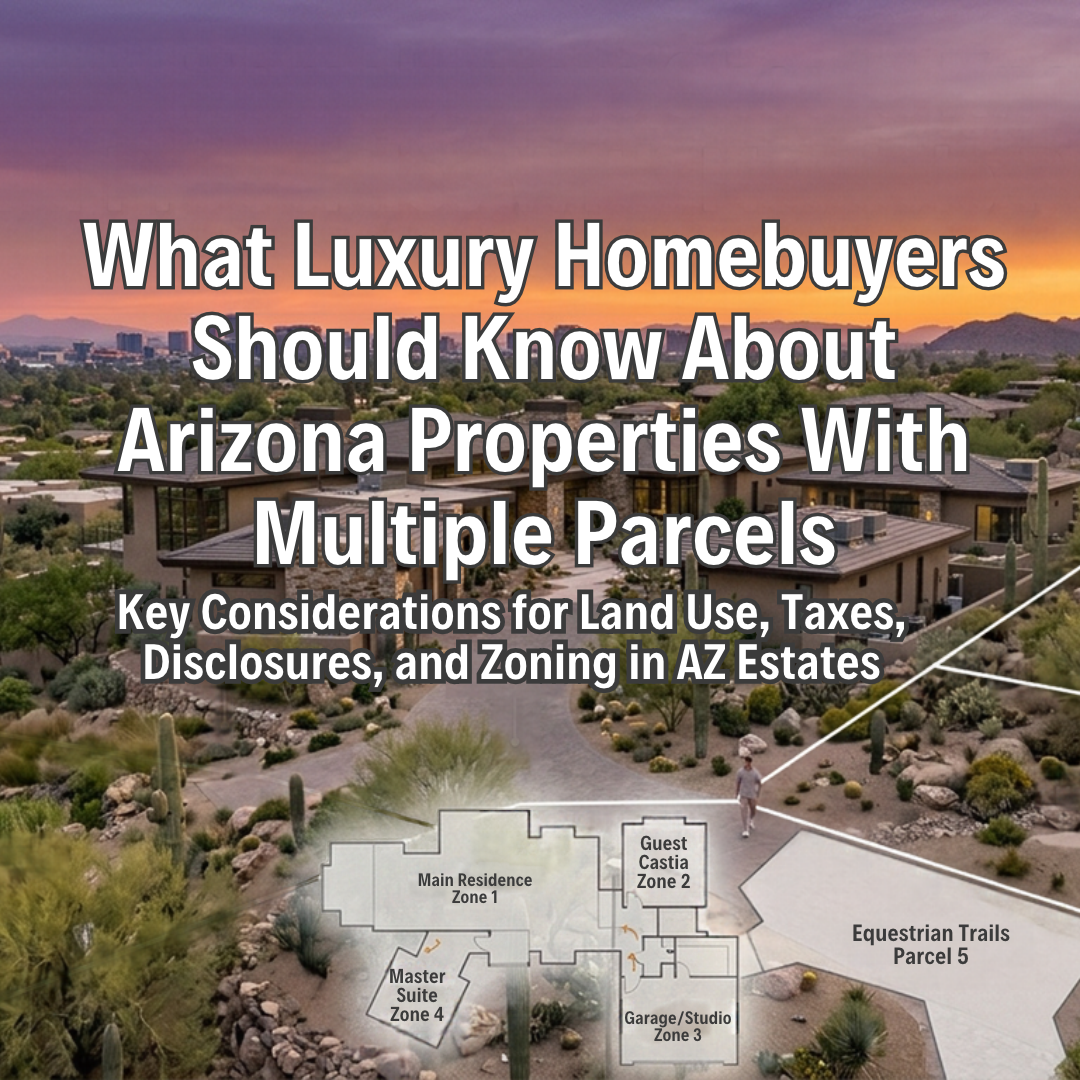
Imagine discovering an Arizona luxury estate that offers more than an impressive residence. The property includes expansive grounds, an additional adjoining lot, a private guesthouse, and extra land that creates a greater sense of privacy and flexibility.
For luxury homebuyers, a property with multiple parcels can offer exciting possibilities. Additional land may provide room for future improvements, expanded outdoor living, greater separation from neighboring properties, or the opportunity to preserve a property's distinctive character.
However, a luxury estate that appears to function as one property may consist of several legally separate parcels. Each parcel may have its own legal description, tax records, zoning considerations, easements, and development limitations.
In Arizona, where luxury properties range from established residential lots to expansive custom estates, understanding how these parcels are legally configured is an important part of the purchasing process.
Whether you're considering a sprawling estate in Paradise Valley, a custom property in Scottsdale, a North Scottsdale residence with adjoining land, or a luxury home in the East Valley, evaluating the entire property can help you understand what you're buying and how the land may support your long-term plans.
1. Understand What Multiple Parcels Mean for Your Purchase
A property with multiple parcels consists of two or more separately identified pieces of real estate that may be owned by the same individual or entity.
For example, a luxury residence may occupy one parcel while an adjoining lot provides additional landscaping, recreational space, or room for a future improvement. Although the parcels may function together as one estate, they may remain legally distinct.
This distinction matters because owning adjoining parcels does not automatically mean they can be combined, developed, or sold together without considering applicable requirements.
Before purchasing, establish exactly what the seller is offering.
Ask the following questions:
- How many separate parcels are included in the sale?
- What is the legal description of each parcel?
- Does the same owner hold title to every parcel?
- Are all parcels contiguous, or are they separated by a road or another property?
- Are all parcels explicitly included in the purchase agreement?
- Are any parcels subject to separate restrictions, easements, or ownership arrangements?
Do not rely solely on the listing description, property photographs, or a single street address to determine the extent of the estate.
Request the assessor parcel numbers, commonly known as APNs, and have the title company verify the legal descriptions and ownership records.
For buyers exploring properties in Maricopa County, the Maricopa County Assessor's Office provides parcel information that can help establish which properties are associated with the transaction.
The goal is to confirm that every portion of the land you expect to own is included in the purchase and that you understand its legal status before moving forward.
2. Review Property Boundaries and Obtain a Survey When Needed
A luxury estate may feature extensive landscaping, perimeter walls, long driveways, detached structures, and outdoor amenities that make the entire property appear unified.
However, visible landscaping and fencing do not necessarily establish the legal boundaries of the land.
A driveway may cross from one parcel into another. A guesthouse could be located on a separate lot, or an outdoor feature may sit close to a boundary that is not obvious during a property tour.
These details become especially important when buyers plan to renovate, construct additional improvements, or change how different portions of the estate are used.
During due diligence, consider reviewing:
Legal descriptions: Compare the recorded descriptions of each parcel with the property being marketed.
Boundary lines: Determine whether the boundaries are clearly established and whether a professional survey is necessary.
Existing improvements: Confirm the location of the main residence, guesthouse, garage, pool, walls, and other structures in relation to parcel lines.
Potential encroachments: Investigate whether fences, driveways, landscaping, or structures extend across boundaries or into neighboring properties.
Access routes: Identify whether a driveway or pathway crosses another parcel and determine how that access is legally established.
Recorded documents: Review relevant plats, deeds, easements, and title records for information that may affect the property.
If the available records are unclear or the property has substantial improvements near parcel boundaries, consult a licensed surveyor.
A survey can help clarify the physical configuration of the land, although legal questions about ownership, easements, or boundary disputes may require advice from a qualified real estate attorney.
Understanding the boundaries early can help prevent complications when planning improvements or deciding how the property should be maintained.
3. Determine Whether the Parcels Can Be Legally Combined
Some buyers purchase multiple adjoining parcels with the intention of creating one larger estate. Others want to simplify property records or explore construction opportunities that may depend on how the land is configured.
However, purchasing adjoining lots under the same ownership does not automatically combine them into one legal lot for every purpose.
The process depends on the property's location, applicable regulations, recorded documents, zoning, and intended use.
For example, a buyer considering a substantial addition that crosses a parcel boundary may need to investigate whether the parcels must be legally combined or whether another approved arrangement is possible.
Before assuming consolidation is available, ask:
- Are the parcels eligible to be combined under the applicable rules?
- Are recorded deeds or other legal documents required?
- Would existing easements or restrictions affect the process?
- Would consolidation change how setbacks or other zoning standards apply?
- Are approvals required from the city or county?
- Could combining the parcels affect future development or resale options?
In Maricopa County, parcel-combination procedures can involve legal documentation and requirements beyond simply changing assessor records. Requirements may differ depending on the jurisdiction and the intended use of the property.
Buyers can review Maricopa County's guidance on combining or splitting property parcels and consult the appropriate local planning department.
If consolidation is central to your plans, confirm its feasibility before relying on it as part of your purchasing decision.
4. Investigate Zoning and Future Development Potential
One of the attractions of buying a luxury property with additional land is the possibility of expanding the estate.
A buyer may envision a guesthouse, detached garage, private gym, sport court, outdoor entertainment area, or another residence. However, the amount of land available does not automatically determine what can legally be built.
Each parcel must be evaluated in light of the applicable zoning rules, development standards, recorded restrictions, and infrastructure requirements.
A separate parcel may have a different zoning classification or development limitations from the parcel containing the main residence. Even adjoining lots under common ownership may require additional review before a proposed project can proceed.
Before purchasing, investigate the following:
Permitted uses: Determine which residential and accessory uses are allowed on each parcel.
Building setbacks: Review the required distances between structures and applicable property boundaries.
Minimum lot requirements: Confirm whether each parcel satisfies applicable minimum lot size, width, and other development standards.
Building height and coverage: Understand restrictions that could affect the size and placement of future improvements.
Additional residences: Do not assume that a separate parcel automatically allows a guesthouse or another dwelling.
Subdivision potential: If you hope to divide or sell a parcel in the future, confirm whether that is legally and practically possible.
Existing improvements: Check available permits and approvals for guesthouses, garages, pools, and other structures.
The Arizona Department of Real Estate's Property Buyer's Checklist provides useful guidance for buyers evaluating property, zoning, and potential surrounding uses.
For luxury buyers, the important question is not simply how much land comes with the home. It is whether the land can support the lifestyle, improvements, and future plans they have in mind.
5. Examine Access, Driveways, and Easements
Access is an important consideration when purchasing an estate with multiple parcels.
Although the property may appear to have one continuous driveway or entrance, the legal arrangements governing that access may involve several parcels or recorded easements.
For example, a driveway serving the main residence could cross an adjoining lot. A neighboring property might have documented access rights across part of the estate, or a utility company could hold an easement that affects future construction.
These arrangements can influence privacy, maintenance responsibilities, development plans, and the way the property can be used.
During due diligence, review the title commitment and relevant recorded documents to determine whether the property has appropriate legal access and whether any rights held by others affect the land.
Pay particular attention to:
- Driveways that cross parcel boundaries.
- Recorded ingress-and-egress easements.
- Shared roads or private-driveway maintenance agreements.
- Utility easements for water, electricity, sewer, or telecommunications.
- Drainage easements and associated infrastructure.
- Access rights held by neighboring property owners.
- Restrictions that may affect gates, fencing, walls, or landscaping.
If access to one parcel depends on another parcel included in the purchase, verify how that arrangement is documented and whether it will remain effective after closing.
Likewise, do not assume that a gate or perimeter wall establishes exclusive control over every area of the estate. Recorded rights and easements may affect access even when the property appears completely enclosed.
A careful review with the title company and, where appropriate, a real estate attorney can help clarify these issues before they become ownership complications.
6. Understand Property Taxes and Assessment Records
Owning multiple parcels can mean managing multiple assessor records and understanding how each parcel contributes to the overall cost of ownership.
Depending on the property and county, parcels may have separate identification numbers, valuation records, and tax bills. Their assessed values and tax treatment may also differ according to their characteristics, classification, and applicable local tax rates.
Do not assume that the tax information shown for the main residence represents the full cost of owning every parcel included in the estate.
Request current property tax information for each parcel and confirm that the records correspond to the land being purchased.
Review the following:
Annual property taxes: Determine the current tax amount associated with each parcel.
Assessed values: Compare the assessment records with the property's configuration and intended use.
Special assessments: Investigate any applicable charges or obligations associated with the property.
Classification: Confirm that the recorded property classification is consistent with the parcel's actual circumstances.
Outstanding questions: Ask about any known assessment discrepancies or pending tax matters that may affect the transaction.
Future ownership costs: Consider how taxes on additional land will affect your total annual property expenses.
For properties in Maricopa County, buyers can consult the Maricopa County Assessor's Office for parcel and assessment information. Buyers elsewhere in Arizona should consult the appropriate county assessor.
If the estate includes vacant land, rental use, or unusual ownership arrangements, a qualified tax professional can help clarify the relevant considerations.
The goal is to evaluate the financial responsibilities of the entire property rather than focusing only on the main residence.
7. Verify Utilities and Infrastructure for Every Parcel
A large estate may appear to function as one property even when its parcels have different utility and infrastructure arrangements.
The main residence may have established water, sewer, and electrical connections, while an adjoining parcel may be vacant or lack the services needed for future construction.
Another parcel may contain a detached building that depends on utilities routed through the main lot.
These differences can become important if you plan to build additional structures, use a separate part of the estate independently, or change the property's layout.
During due diligence, examine the following:
Water service: Confirm the source of water and whether additional connections or service arrangements are needed.
Sewer and septic systems: Determine which structures are connected to public sewer or rely on private wastewater systems. Verify applicable permits and capacity where relevant.
Electricity: Establish whether each parcel has its own electrical service or depends on infrastructure located on another parcel.
Drainage: Understand how runoff moves across the property and whether drainage infrastructure or easements may affect future improvements.
Internet and telecommunications: Check service availability if additional land is intended for a home office, guest accommodation, or other use requiring reliable connectivity.
Irrigation: Identify which areas are served by existing irrigation systems and whether any infrastructure crosses parcel boundaries.
For vacant or undeveloped parcels, contact the relevant utility providers and permitting authorities to confirm service availability, connection requirements, and potential costs.
Nearby infrastructure does not necessarily mean that a new connection is available, approved, or affordable.
Understanding these details before closing can help you estimate the true cost of making the additional land useful.
8. Review HOA Rules, Deed Restrictions, and Recorded Agreements
Some Arizona luxury properties are located in communities governed by homeowners associations or subject to recorded covenants, conditions, and restrictions. Other properties may have deed restrictions or private agreements affecting individual parcels.
These documents can limit how the land may be used, even when a proposed improvement appears reasonable.
For example, restrictions may address additional residences, accessory structures, fencing, landscaping, recreational amenities, rental activity, or architectural design.
When multiple parcels are involved, verify which rules and restrictions apply to each one.
Request and review relevant documents, including:
- HOA declarations, bylaws, and architectural guidelines, where applicable.
- Recorded deed restrictions and covenants.
- Easements and maintenance agreements.
- Shared access or private-road agreements.
- Available approvals for existing structures.
- Agreements affecting drainage, irrigation, or shared infrastructure.
Do not assume that adjoining parcels have identical restrictions simply because they are owned by the same seller or marketed as one estate.
If a particular improvement is central to your plans, seek written clarification from the appropriate association or authority before relying on the assumption that it will be permitted.
This step is especially important for buyers considering substantial renovations, detached structures, or changes to the property's existing layout.
9. Evaluate Insurance, Liability, and Maintenance Responsibilities
Additional land can bring additional ownership responsibilities.
A parcel with mature landscaping, a private road, detached structures, recreational amenities, or undeveloped desert terrain may require different maintenance and risk-management considerations from the parcel containing the main residence.
Before closing, speak with an insurance professional familiar with luxury homes and properties with multiple parcels.
Confirm that the proposed coverage accurately reflects the property configuration, buildings, accessory structures, and intended uses. Ask whether vacant land, detached improvements, private roads, or other features require separate coverage or specific policy provisions.
Also consider the ongoing maintenance needs of the entire estate.
These may include:
- Landscaping and vegetation management.
- Irrigation system repairs.
- Boundary walls, gates, and fencing.
- Private driveway or road maintenance.
- Drainage channels and runoff management.
- Pest control and routine inspections.
- Maintenance of detached buildings and recreational areas.
For properties with undeveloped land, discuss appropriate vegetation management and wildfire-risk considerations with qualified local professionals and your insurer.
If a parcel will remain vacant or see limited use, determine how it will be maintained and whether additional inspections or services will be necessary.
A property that offers more land may also require more time, money, and coordination to maintain. Understanding these responsibilities helps buyers make a more realistic assessment of the ownership experience.
10. Consider Resale Appeal Without Assuming a Guaranteed Premium
Multiple parcels can make a luxury property distinctive, particularly when the additional land provides privacy, usable outdoor space, or room for future improvements.
However, owning more land does not automatically guarantee a higher resale price or mean that each parcel can be sold independently.
The property's future marketability depends on factors such as location, parcel size, zoning, access, utilities, recorded restrictions, and the preferences of prospective buyers.
Consider your long-term ownership goals before deciding how the parcels should be managed.
Keeping the entire estate together: If privacy, security, and uninterrupted outdoor space are your priorities, maintaining the parcels as one ownership package may make sense. Verify that the legal and physical configuration supports your intended use.
Preserving the option to sell a parcel separately: If you may eventually sell a portion of the land, investigate whether it can be transferred independently. Review access, zoning, utilities, easements, restrictions, and any required approvals.
Planning future improvements: If the additional land is intended for a guesthouse, recreational amenity, or other project, confirm feasibility and estimate costs before assuming that the improvement will enhance resale appeal.
Maintaining flexibility: A property with clear records, understandable access arrangements, and practical uses for its land may be easier for future buyers to evaluate.
Before making major changes, consult a real estate professional familiar with the local luxury market and the appropriate legal or land-use specialists.
The objective is to understand the property's realistic options rather than assume that additional land will necessarily increase its value or provide a future financial return.
11. Ask the Right Questions Before Making an Offer
A luxury estate with multiple parcels deserves a dedicated due-diligence review.
Before moving forward, request available documentation for every parcel and identify any questions that need to be resolved before closing.
Your checklist should include:
- Legal descriptions and parcel identification numbers for every parcel.
- Confirmation that all intended parcels are included in the purchase agreement.
- Title commitments and recorded exceptions.
- Boundary surveys or other relevant survey information, where appropriate.
- Verification of legal access and review of easements.
- Zoning information and confirmation of permitted uses.
- Feasibility review for proposed construction or parcel consolidation.
- Property tax and assessment records for every parcel.
- Utility service information and infrastructure arrangements.
- HOA rules, deed restrictions, and other recorded agreements.
- Available permits and documentation for existing buildings and improvements.
- Insurance requirements and ongoing maintenance considerations.
- Professional estimates for any necessary repairs, upgrades, or infrastructure work.
Not every property will have all these documents readily available, and missing records do not automatically make an estate unsuitable. However, unresolved questions may require additional investigation before you can confidently assess the property.
The level of due diligence should reflect the complexity of the estate. A fully developed property with two adjoining residential lots may require a different review from an estate involving vacant land, private access roads, or plans for future construction.
Your real estate agent can help coordinate the property-related questions, while title professionals, surveyors, attorneys, tax advisers, and land-use specialists can address matters requiring their specific expertise.
A Murphy Group Arizona Perspective
For buyers exploring luxury real estate in Scottsdale, Paradise Valley, North Scottsdale, and the East Valley, a property with multiple parcels can offer an appealing combination of space, privacy, and flexibility.
However, the real value of that arrangement depends on understanding how the parcels work together legally and practically.
Mary Murphy and The Murphy Group Arizona encourage buyers to look beyond the total acreage advertised in a listing and consider what the land actually provides. Are the boundaries clear? Does each parcel have appropriate access? Are there restrictions that could affect future improvements? Do the property's legal configuration and infrastructure support the buyer's plans?
These questions are particularly important when a purchase involves a custom estate, additional vacant land, detached guest accommodations, or the possibility of future development.
A property can be visually impressive while still requiring careful investigation of its underlying land configuration. Reviewing parcel records, title documents, zoning, utilities, and maintenance obligations early can help buyers make decisions based on verified information rather than assumptions.
The right property is one that supports your lifestyle today while providing a clear understanding of the opportunities and limitations associated with the land.
The Bottom Line:
Buying an Arizona luxury home with multiple parcels may provide additional space, privacy, and potential long-term flexibility. However, those benefits depend on the legal status of each parcel and the rules governing its use.
Before committing, verify the legal descriptions, boundaries, ownership records, zoning, access, easements, taxes, utilities, restrictions, and maintenance obligations. If you plan to combine parcels, construct additional improvements, or sell a portion of the land in the future, confirm the relevant requirements with the appropriate professionals and authorities.
Just as importantly, evaluate the entire property as one ownership decision. The right estate is not simply the one with the most land, but the one whose configuration, functionality, and long-term responsibilities align with your goals.
Exploring Arizona luxury properties with additional land or distinctive ownership features?
The Murphy Group Arizona can help you explore homes and estates in Scottsdale, Paradise Valley, North Scottsdale, and the East Valley while keeping your lifestyle, property priorities, and long-term plans in focus.
Visit The Murphy Group Arizona to explore luxury real estate opportunities and take the next step toward finding a property that fits the way you want to live.

Mary Murphy
Team Leader | The Murphy Group - AZ | eXp Luxury | PLACE
or another way