

Categories
Arizona Real Estate, Arizona Luxury, Scottsdale Real Estate, Scottsdale Luxury Real Estate, Luxury lIving, Indoor Outdoor Living, North Scottsdale homes, Paradise Valley Luxury, Paradise Valley Real Estate, Luxury Home FeaturesPublished November 11, 2026
What Luxury Buyers Should Know About Arizona Homes With Retractable Glass Walls

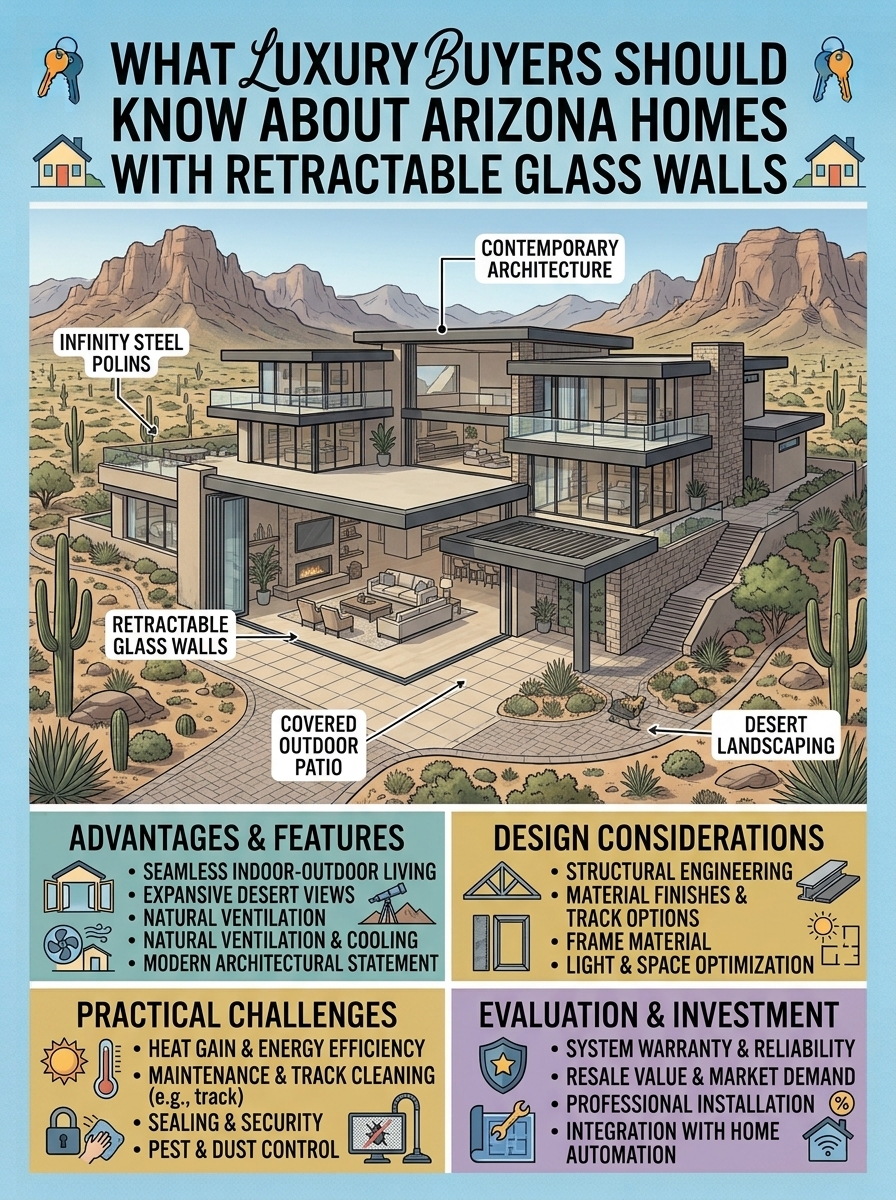
Retractable glass walls have become a defining feature of many contemporary luxury homes. Designed to open expansive sections of a wall, these systems can create a seamless connection between indoor living areas and outdoor spaces, bringing natural light, views, and a more open atmosphere into the home.
In Arizona, where outdoor living is an important part of the luxury residential experience, retractable glass walls can be particularly appealing. A residence in Scottsdale, Paradise Valley, North Scottsdale, or the East Valley may use these systems to connect a great room with a covered patio, open a dining area toward a landscaped courtyard, or frame views of the surrounding desert landscape.
However, the beauty of a retractable glass wall is only one part of the story. Its performance depends on the quality of the glass, framing, hardware, installation, weather seals, drainage, and overall design.
Arizona's intense sunshine, high summer temperatures, dust, and seasonal storms also make it important to understand how these systems perform under local conditions.
For buyers considering a luxury home with retractable glass walls, evaluating the system's functionality and long-term maintenance requirements is just as important as appreciating its architectural appeal.
1. Understand the Type of Retractable Glass Wall System
Not all retractable glass walls operate in the same way. The design, opening mechanism, panel configuration, and hardware can vary significantly.
Common systems include:
- Bi-fold glass walls: Multiple glass panels fold together and stack to one or both sides of an opening.
- Multi-slide glass walls: Large panels slide along tracks and typically stack at a designated area.
- Pocket glass walls: Panels slide into a concealed wall pocket, allowing the opening to become less visually obstructed.
- Lift-and-slide systems: Specialized hardware lifts the panels slightly from their seals before they slide, then lowers them into position when closed.
- Pivoting glass systems: Panels rotate around designated pivot points to create an opening, depending on the system design.
Each configuration has different space requirements and operating characteristics.
Buyers should ask the seller for the manufacturer, product line, installation date, and available technical specifications.
It is also worth understanding how the panels stack when fully opened. Some systems require dedicated space along the wall, while others conceal the panels within the surrounding construction.
Knowing the system type helps buyers understand its operation, maintenance needs, and potential replacement considerations.
2. Evaluate the Glass Specifications and Energy Performance
Large glass openings can bring abundant natural light into a home, but they can also influence indoor temperatures and energy consumption.
This is especially relevant in Arizona, where prolonged exposure to direct sunlight can create substantial heat gain.
Buyers should review the glass specifications rather than assuming that all large glass panels provide the same level of thermal performance.
Important details may include:
- Double-pane or triple-pane construction
- Low-emissivity (Low-E) coatings
- Solar heat gain coefficient (SHGC)
- U-factor
- Visible light transmittance
- Tempered or laminated safety glass, where specified
- Manufacturer performance ratings
The solar heat gain coefficient indicates how much solar energy passes through the glass. A lower value generally means less solar heat enters the home.
The U-factor measures how effectively the glazing assembly resists heat transfer. Lower values generally indicate better insulation performance.
However, the appropriate specifications depend on the system, orientation, climate conditions, and overall building design.
Ask for available product documentation and consider having a qualified window or glazing professional assess whether the glass is appropriate for the property's location and exposure.
3. Consider the Direction of Sun Exposure
The orientation of retractable glass walls can significantly influence comfort inside the home.
A system facing west may receive intense afternoon sunlight, while a south-facing opening can experience prolonged solar exposure depending on the season and surrounding structures.
Even a high-quality glass wall may require additional shading or solar-control strategies when positioned in a particularly exposed location.
During a property visit, consider:
- Which direction does the glass wall face?
- Does direct sunlight enter during the hottest part of the day?
- Are there exterior overhangs or covered patios?
- Is the opening shaded by trees or architectural features?
- Does the home have interior or exterior shading systems?
- Are there areas where sunlight creates noticeable glare?
If possible, visit the property at different times of the day.
A room that feels comfortable during a morning showing may experience substantially different conditions in the late afternoon.
Understanding sun exposure can help buyers evaluate whether the glass wall supports comfortable daily living throughout the year.
4. Inspect the Retractable Glass Wall's Tracks and Hardware
The tracks and operating hardware are essential to the performance of a retractable glass wall.
Large glass panels can be heavy, so the system depends on properly installed tracks, rollers, hinges, locks, and supporting components.
During a showing, observe how the panels operate.
Look for:
- Smooth and consistent movement
- Unusual resistance when opening or closing
- Grinding, scraping, or rattling sounds
- Panels that appear misaligned
- Damaged or obstructed tracks
- Worn rollers or hinges
- Locks that do not engage properly
If the system is motorized, test the controls with the seller's permission and observe whether the panels move consistently.
Do not force a panel that appears stuck or difficult to operate. Doing so could damage the hardware or create a safety concern.
For a more thorough evaluation, have a qualified glass-wall or door-system technician inspect the mechanism and identify any necessary adjustments or repairs.
5. Check the Weather Seals and Protection Against Air Leakage
Retractable glass walls need effective sealing when closed.
The quality and condition of the weather seals can influence how well the system limits air infiltration, dust entry, and water penetration.
In Arizona, this is especially important because windblown dust and seasonal weather conditions can affect homes with large exterior openings.
Buyers should examine:
- Weatherstripping around the panels
- Seals between adjoining glass sections
- Threshold seals
- Perimeter seals around the frame
- Visible gaps when the system is closed
- Signs of deterioration or compression
- Evidence of previous water or dust intrusion
Damaged seals may affect comfort and allow unwanted outdoor elements into the home.
Ask whether the seals have been replaced and whether the manufacturer recommends a particular maintenance schedule.
A qualified professional can determine whether the system closes and seals properly.
6. Understand How the System Handles Monsoon Weather
Arizona's monsoon season introduces another important consideration for homes with expansive glass openings.
Heavy rainfall, strong winds, blowing dust, and sudden storms can place additional demands on exterior door and glazing systems.
Buyers should understand how the retractable glass wall is designed to manage water and resist the environmental conditions specified for the product.
Consider asking:
- Is the system rated for the property's exposure and applicable wind conditions?
- How does the threshold manage rainwater?
- Is there exterior drainage near the opening?
- Are weep systems or other water-management features incorporated?
- Has the property experienced water intrusion around the glass wall?
- Have the seals or tracks required repairs after storms?
The surrounding patio or terrace also matters.
If the outdoor surface slopes toward the home, water may collect near the threshold during heavy rain. A properly designed drainage strategy helps manage this risk.
Buyers should ask for available installation documentation and have any concerns evaluated by a qualified professional.
7. Evaluate Threshold Design and Floor Transitions
One of the most appealing aspects of retractable glass walls is the ability to create a nearly continuous transition between indoor and outdoor spaces.
Some luxury homes feature flush or low-profile thresholds that visually connect interior flooring with exterior patios.
Although this design can be attractive, buyers should understand how the threshold manages water, debris, and everyday movement.
Evaluate:
- The height difference between interior and exterior flooring
- The condition of the threshold
- Drainage channels near the opening
- Signs of water staining or moisture
- Potential trip hazards
- Accessibility for household members and guests
A flush transition requires thoughtful design and appropriate water management.
Buyers should not assume that a visually seamless floor connection means there is no risk of water entering the home.
Ask the seller or an appropriate professional how the threshold is designed to handle rainfall and routine cleaning.
8. Consider Dust, Debris, and Cleaning Requirements
Arizona's desert environment can introduce dust, fine particles, and debris into exterior tracks and moving components.
When accumulated, this material may affect how smoothly panels operate and how effectively the system seals.
Regular maintenance may involve:
- Cleaning the tracks
- Removing dust and debris from drainage channels
- Cleaning glass surfaces
- Inspecting weatherstripping
- Checking rollers and hinges
- Cleaning exterior frame components
- Following manufacturer guidance for lubrication
Buyers should ask whether the seller has followed a regular cleaning and maintenance schedule.
It is also important to understand which cleaning products are appropriate for the glass, coatings, frame finishes, and hardware.
Using unsuitable products or abrasive materials may damage certain surfaces.
A system that requires specialized maintenance should be considered as part of the home's ongoing ownership responsibilities.
9. Review the Frame Materials and Finish
The framing surrounding retractable glass panels contributes to the system's structural performance, appearance, and durability.
Common frame materials include aluminum, steel, and other engineered materials, depending on the manufacturer and product design.
Each option has different considerations.
- Aluminum: Often used because it is relatively lightweight and can support large panel configurations. Thermal performance depends on the frame design and whether thermal breaks are incorporated.
- Steel: Can provide a distinctive architectural appearance and support certain large-format designs, but the finish and corrosion protection should be evaluated.
- Other engineered systems: May use specialized materials or combinations designed to meet particular performance and aesthetic requirements.
Buyers should inspect the frame for scratches, finish deterioration, corrosion, dents, and visible damage.
For properties with dark-colored frames exposed to direct sunlight, it is also worth asking about the manufacturer's recommendations for cleaning and finish maintenance.
The frame should be evaluated as part of the complete glazing assembly rather than as a purely decorative element.
10. Determine Whether the System Is Manual or Motorized
Retractable glass walls may be operated manually or through a motorized system.
Manual systems can offer straightforward operation, while motorized systems may provide additional convenience, particularly when the panels are large or heavy.
If the property has a motorized system, buyers should investigate:
- The motor and operating mechanism
- Wall-mounted or remote controls
- Integration with home automation
- Backup operation during power interruptions
- Safety sensors or obstruction protection, where applicable
- Service and maintenance records
- Availability of replacement components
Ask whether the motorized system is connected to a centralized smart-home platform and whether that integration will transfer to the new owner.
It is also helpful to understand whether the system can be operated manually if the motor or electrical supply fails.
A demonstration during the property showing can reveal whether the panels operate consistently and whether the controls are intuitive.
11. Evaluate Privacy and Security
Retractable glass walls can create an impressive connection between indoor and outdoor living areas, but extensive glazing also changes how a property handles privacy and security.
Buyers should consider how visible the interior is from neighboring properties, nearby streets, or surrounding outdoor areas.
Useful features to evaluate include:
- Locking mechanisms
- Multi-point locking systems, where provided
- Security integration
- Exterior lighting
- Surveillance coverage
- Window treatments or automated shades
- Landscaping that supports privacy
- The location of outdoor entertaining areas
Large glass panels may also require more deliberate security planning than conventional walls.
Ask the seller whether the glass-wall system is integrated with the home's security system and whether the locking hardware has been professionally maintained.
For properties with extensive glazing facing a pool, courtyard, or outdoor entertaining area, buyers should also consider how privacy changes when the panels are fully open.
12. Understand the Relationship Between Glass Walls and HVAC Performance
A retractable glass wall can change how indoor and outdoor spaces interact, particularly when the system spans a large opening.
When closed, the glass assembly forms part of the home's exterior envelope. When open, the indoor space becomes directly connected to outdoor conditions.
This can influence how the home's heating and cooling systems perform.
Buyers should consider:
- Whether the HVAC system was designed around the large glass opening
- Whether the room experiences uneven temperatures
- Whether certain areas receive excessive afternoon heat
- Whether automated shades or exterior shading are installed
- Whether the system is typically kept closed during peak summer conditions
A large opening may also influence air distribution when the glass wall is open.
If indoor comfort is a priority, consider having an HVAC professional evaluate the property's cooling capacity and the relationship between the glazing, room layout, and mechanical systems.
The presence of a retractable glass wall should not automatically be viewed as a problem. The important question is whether the home's overall design accounts for it.
13. Review Installation Records and Previous Repairs
Even a premium glass-wall system depends on correct installation.
The framing, supporting structure, track alignment, waterproofing, and surrounding finishes all need to work together.
Buyers should request available documentation, including:
- Manufacturer and model information
- Original installation records
- Product specifications
- Warranty documents
- Maintenance agreements
- Repair invoices
- Records of panel or hardware replacement
- Documentation of any modifications
If the system was installed as part of a renovation, ask whether the surrounding structural opening was modified.
A qualified professional can help determine whether the installation appears consistent with the manufacturer's requirements and whether any visible concerns need further investigation.
Incomplete documentation does not necessarily mean the system is defective, but it can make future maintenance and warranty questions more difficult.
14. Understand Warranty Coverage and Replacement-Part Availability
Retractable glass walls are specialized products, and repair options may depend on the manufacturer and specific model.
Before purchasing, buyers should determine whether the system remains covered by a transferable warranty.
Ask:
- Is the original warranty still active?
- Does coverage transfer to a new owner?
- Are the glass panels covered separately from the hardware?
- What is the warranty period for the motorized components?
- Are service providers available locally?
- Can replacement rollers, locks, seals, and tracks still be obtained?
Some manufacturers offer different warranty periods for glass, frame finishes, hardware, and operating mechanisms.
Buyers should review the actual warranty documentation rather than relying on general statements from the seller.
If the system is older or discontinued, replacement-part availability becomes particularly important.
15. Consider the Long-Term Value of Indoor-Outdoor Living
Retractable glass walls can be a defining architectural feature in an Arizona luxury home.
They can create a more open living environment, provide expansive views, and connect interior spaces with covered patios, outdoor kitchens, pools, and landscaped courtyards.
However, their contribution to a property's appeal depends on the quality of the design and how well the system supports everyday living.
Consider whether the glass wall:
- Connects naturally to the main living areas
- Opens toward an attractive and functional outdoor space
- Frames meaningful views
- Provides adequate shading
- Maintains comfortable indoor conditions when closed
- Operates smoothly
- Complements the home's architectural style
A thoughtfully integrated system can enhance the overall experience of the property.
However, buyers should avoid assuming that the presence of retractable glass walls automatically increases resale value. Their appeal will depend on the home's location, design, condition, and the preferences of future buyers.
Questions Luxury Buyers Should Ask Before Purchasing
Before making an offer on an Arizona home with retractable glass walls, consider asking the seller the following:
About the system
- What manufacturer and model are installed?
- When were the glass walls installed?
- Are they bi-fold, multi-slide, pocket, or another configuration?
- Are they manual or motorized?
About performance
- What are the glass specifications?
- Are Low-E coatings or other solar-control features included?
- How does the system perform during direct afternoon sunlight?
- Are there any known air or water leakage issues?
About maintenance
- When were the tracks and hardware last serviced?
- Have the seals or rollers been replaced?
- Are there any operating problems?
- Are maintenance records available?
About weather protection
- Has water ever entered around the glass wall?
- How is the threshold designed to manage rainwater?
- Is exterior drainage properly maintained?
- Has the system been evaluated for the property's exposure?
About ownership
- Is the warranty transferable?
- Are replacement parts available?
- Are qualified local service providers available?
- Are there anticipated repairs or upgrades?
These questions can help buyers move beyond the visual appeal of the system and understand its condition, performance, and ownership requirements.
The Murphy Group Arizona Perspective
Retractable glass walls can transform the experience of a luxury home, especially in Arizona, where indoor and outdoor living spaces often play an important role in the property's design.
However, the most impressive glass wall is not necessarily the one with the largest opening. Its real value comes from how effectively it combines architectural design, comfort, functionality, and reliable operation.
As Mary Murphy of The Murphy Group Arizona explains:
“A beautiful home should feel as comfortable as it looks. Features like retractable glass walls can create an incredible connection between indoor and outdoor living, but buyers should also understand how those systems perform in everyday conditions and what it takes to maintain them.”
For buyers exploring properties in Scottsdale, Paradise Valley, North Scottsdale, and the East Valley, evaluating the glazing, hardware, weather protection, and overall installation can help provide a more complete understanding of the home.
A well-designed system should complement the lifestyle the property promises while remaining practical to operate and maintain.
The Bottom Line: Look Beyond the Expansive Glass Opening
Retractable glass walls can bring natural light, expansive views, and a seamless indoor-outdoor experience to an Arizona luxury home.
They can also introduce important considerations involving solar heat gain, glass specifications, track maintenance, weather seals, drainage, security, and HVAC performance.
Before purchasing, buyers should evaluate the entire system rather than focusing only on how impressive it looks during a showing.
Reviewing installation records, understanding the manufacturer's specifications, and arranging a professional inspection when needed can help identify potential concerns before closing.
When the glass system is properly designed, installed, and maintained, it can become a valuable part of the home's overall living experience.
Explore Arizona Luxury Real Estate With The Murphy Group Arizona
If you're considering a luxury home in Scottsdale, Paradise Valley, North Scottsdale, or the East Valley, The Murphy Group Arizona can help you look beyond the listing photos and consider the property, neighborhood, and long-term ownership experience.
From retractable glass walls and indoor-outdoor living features to solar exposure, energy performance, weather protection, and property maintenance, a thoughtful approach to due diligence can help you make a more informed decision.
Explore Arizona luxury real estate with The Murphy Group Arizona and discover your next exceptional property.
Website: www.mgsellsarizona.com

Mary Murphy
Team Leader | The Murphy Group - AZ | eXp Luxury | PLACE
or another way