

Categories
North Scottsdale Market Update, Arizona Luxury, Arizona Real Estate, Paradise Valley Luxury, Paradise Valley Real Estate, Scottsdale Real Estate, Scottsdale Luxury Real Estate, East Valley, East Valley Luxury, East Valley real estatePublished September 28, 2026
What Luxury Buyers Should Ask About a Home’s Original Builder and Construction Team

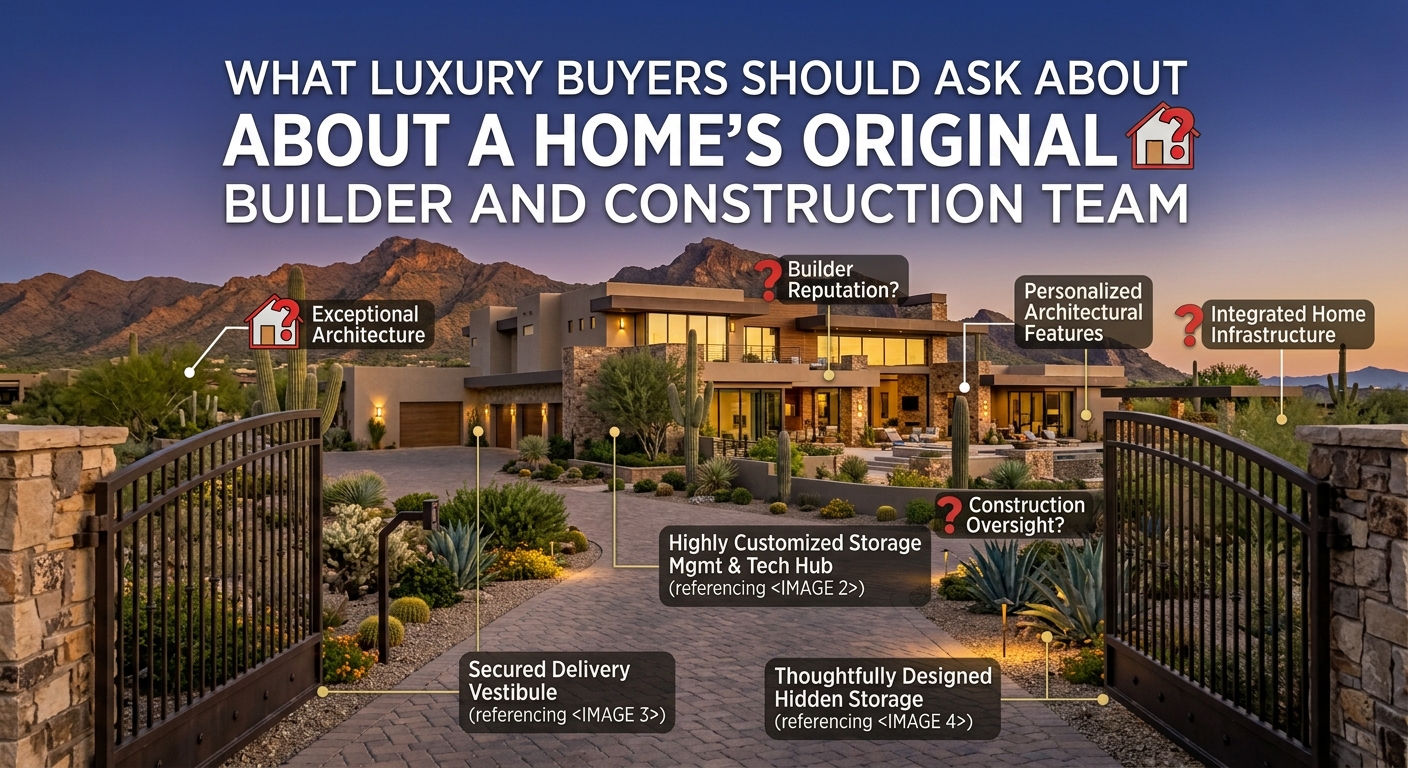
When buyers walk into a luxury home, attention naturally goes toward what they can see.
The architecture.
The finishes.
The kitchen.
The views.
The landscaping.
The entertaining spaces.
But there is another part of the property worth investigating:
Who actually built it?
In a luxury home, the original builder and construction team can provide valuable context about how the property came together, what systems were installed, which materials were selected, and how the home may have been maintained over time.
This doesn't mean a recognizable builder automatically guarantees quality.
Nor does an unfamiliar name automatically indicate a problem.
Instead, the builder's identity can become one piece of a much larger due-diligence picture.
For buyers considering a high-value Arizona property, understanding the home's construction history can help reveal details that aren't obvious during a traditional showing.
🏗️ 1. Start With the Original Builder
One of the first questions to ask is simple:
Who built the home?
Depending on the property, the answer may be a recognized luxury builder, a custom residential contractor, a development company, or a team assembled specifically for the project.
Knowing the original builder can help buyers understand the home's construction background.
It may also help identify:
- Original project records
- Construction documentation
- Warranty information
- Subcontractors
- Architectural plans
- Specialty trades
- Renovation history
The goal isn't to judge the home based solely on the builder's name.
It is to establish a starting point for research.
📐 2. Ask Who Designed the Home
The builder is only one part of the construction team.
A luxury estate may involve:
- Architect
- Interior designer
- Landscape architect
- Structural engineer
- Civil engineer
- Pool designer
- Lighting designer
- Technology integrator
- Specialty contractors
Understanding who contributed to the original project can provide valuable context about the property's design philosophy.
It can also help identify which professionals might have documentation or knowledge about specialized features.
🧱 3. Ask What Was Custom-Built
Not every luxury home is constructed in exactly the same way.
Some are heavily customized from the beginning.
Others may use a more standardized architectural framework with upgraded finishes and features.
Buyers may want to understand which components were specifically designed for the property.
That could include:
- Structural elements
- Custom cabinetry
- Windows and doors
- Roofing
- Stonework
- Pool features
- Landscaping
- Mechanical systems
- Smart-home infrastructure
The more specialized the home, the more useful its construction history may become.
📋 4. Ask Whether Original Plans Are Available
Original plans can be extremely useful to future homeowners.
They may help show:
- Floor-plan configuration
- Structural walls
- Plumbing locations
- Electrical layouts
- Mechanical systems
- Room dimensions
- Original additions
- Service areas
Even if a buyer has no immediate plans to remodel, these documents can become valuable years later.
Before purchasing, ask whether the current owner has retained any original architectural or construction documentation.
🔧 5. Find Out Who Handled Major Systems
Luxury estates can contain complex systems that require specialized knowledge.
Ask who originally installed or managed:
- HVAC
- Electrical
- Plumbing
- Pool equipment
- Irrigation
- Security
- Home automation
- Audio/video
- Specialty lighting
If documentation exists, it can provide a clearer picture of the property's infrastructure.
It may also make future service and repairs easier.
🏠 6. Ask About Major Renovations Since the Original Construction
The original builder tells only part of the story.
A property may have changed substantially since it was first completed.
Ask:
What has been renovated?
And:
Who performed the work?
A luxury home may have undergone:
- Kitchen renovations
- Bathroom updates
- Room additions
- Structural modifications
- Pool renovations
- Landscape redesign
- Roof replacement
- HVAC replacement
- Technology upgrades
Understanding what is original and what has been changed helps buyers evaluate the property more accurately.
🔍 7. Determine Whether the Original Construction Has Been Modified
Renovations can sometimes interact with the original design in important ways.
For example, a later remodel may have changed:
- Drainage
- Electrical capacity
- Plumbing
- HVAC distribution
- Structural loads
- Exterior water management
- Indoor-outdoor transitions
This is one reason buyers should distinguish between the home's original construction and subsequent modifications.
The construction team that built the original home may not have been involved in later work.
📑 8. Ask About Construction Documentation
Depending on the age and history of the property, documentation may include:
- Plans
- Specifications
- Product information
- Invoices
- Warranties
- Inspection records
- Maintenance records
- Renovation documents
Not every property will have a complete archive.
But whatever documentation exists can be useful during due diligence.
The absence of records isn't necessarily evidence of a construction problem.
It simply means buyers may need to rely more heavily on other forms of verification.
🛠️ 9. Ask Whether Warranties Still Exist
Some components of a luxury home may have separate manufacturer or contractor warranties.
These can potentially relate to:
- Roofing
- Windows
- Appliances
- HVAC
- Pool equipment
- Solar equipment
- Specialty systems
- Technology
The availability and transferability of warranties vary.
Buyers should therefore ask for the actual documentation rather than assuming coverage exists.
🌵 10. Arizona Construction Requires Attention to the Environment
Arizona homes operate in a demanding climate.
Heat, intense sunlight, monsoon conditions, landscaping, irrigation, and large temperature swings can all influence how a property performs over time.
For a luxury estate, buyers may want to understand how the original construction addressed the property's environment.
Questions can include:
- How was exterior water managed?
- What materials were selected for outdoor exposure?
- How are major mechanical systems maintained?
- What irrigation infrastructure was installed?
- How are roofs and exterior surfaces maintained?
- Are there specialized landscape or drainage considerations?
The answers can help buyers understand the property's ongoing maintenance requirements.
💧 11. Ask About Drainage and Water Management
Luxury properties often contain significant landscaping and hardscaping.
They may also have pools, patios, retaining features, courtyards, and large roof areas.
Water management therefore deserves attention.
Ask about:
- Original drainage design
- Grading
- Roof drainage
- Irrigation
- Pool drainage
- Areas that have experienced previous water issues
A property can look immaculate while still having a complicated water-management system.
Understanding how that system works is part of responsible due diligence.
🪟 12. Ask About Windows, Doors, and Exterior Materials
Luxury homes often incorporate extensive glass and custom exterior materials.
These features can contribute significantly to the home's appearance and comfort.
But they can also require specialized maintenance.
Ask:
- Who supplied the windows and doors?
- Are replacement components readily available?
- Are there records for major repairs?
- What materials were used on exterior elevations?
- Are there maintenance requirements?
Knowing the original specifications can be especially useful if components eventually need replacement.
⚙️ 13. Ask How Accessible the Mechanical Systems Are
A sophisticated home may contain sophisticated infrastructure.
But sophistication doesn't necessarily equal convenience.
During due diligence, consider whether major systems are reasonably accessible for inspection and maintenance.
This can include:
- HVAC equipment
- Electrical panels
- Water systems
- Pool equipment
- Technology infrastructure
- Irrigation controls
A system that is easy to service may be much less disruptive to maintain than one hidden behind difficult-to-access spaces.
👷 14. Ask Who the Original Subcontractors Were
In custom luxury construction, the builder may work with a network of specialized trades.
That could include:
- Cabinetmakers
- Stone fabricators
- Finish carpenters
- Tile specialists
- Window installers
- Pool contractors
- Landscape professionals
- Technology integrators
If the current owner has retained a list of these companies, it can become a useful resource.
Future repairs or replacements may benefit from knowing who originally supplied or installed a particular component.
🗂️ 15. Ask the Current Owner What They Learned After Moving In
Sometimes the most useful construction information isn't found in a formal document.
It comes from ownership experience.
Ask:
What required the most maintenance?
Which systems have been replaced?
What would you change about the original design?
Were there any recurring issues?
Which contractors have been especially helpful?
Are there any systems that require unusual maintenance?
These conversations can reveal practical information that doesn't appear in a listing description.
🕰️ 16. The Age of the Home Changes the Questions
A newer luxury home may have different documentation and warranty considerations than an older estate.
For a newer property, buyers may focus heavily on:
- Original warranties
- Construction records
- Installed systems
- Builder documentation
- Recent inspections
For an older property, buyers may need to focus more heavily on:
- Replacements
- Renovations
- Maintenance history
- Updated systems
- Current condition
- Changes from the original design
The construction history should therefore be considered in the context of the home's age.
🔄 17. A Builder's Reputation Is Only One Piece of the Puzzle
It can be tempting to assume that a famous builder automatically means a better property.
That conclusion isn't warranted without examining the individual home.
Construction quality can be influenced by:
- Site conditions
- Materials
- Subcontractors
- Project management
- Maintenance
- Renovations
- Modifications
- Age
- Ownership history
The builder's name can provide useful context.
It should not replace an independent inspection and property-specific due diligence.
🔎 18. Ask Questions That Connect the Past to the Future
The most useful construction questions aren't only historical.
They can help you understand future ownership.
For example:
Who built this?
can lead to:
How was it built?
which can lead to:
How is it maintained?
and eventually:
What will it take to maintain it going forward?
That progression can help buyers think beyond the initial impression of the property.
✨ 19. The Construction Team Can Become Part of the Home's Story
Luxury homes often have stories behind them.
A custom residence may have been created around a specific vision.
A renowned architect may have shaped the design.
A builder may have developed a specialized construction approach.
An artisan may have created the cabinetry.
A landscape designer may have shaped the grounds.
These details aren't necessarily what determine whether a buyer should purchase the property.
But they can provide valuable context about how the home came together.
💬 A Murphy Group Perspective
“When you're purchasing a luxury home, you're not only buying the finished product. You're also inheriting the systems, craftsmanship, modifications, and maintenance history behind it. Understanding who built the home and how it has evolved can help you ask better questions during due diligence.”
— Mary Murphy, The Murphy Group
The builder's name can be a useful starting point.
But the more important investigation is the story behind the name.
Who designed it?
Who built it?
Who maintained it?
What has changed?
And what documentation remains?
📊 The Bottom Line
A luxury home's original builder and construction team can provide valuable clues about the property's history—but they are only one part of a comprehensive evaluation.
Before purchasing, buyers can benefit from understanding:
- Who built the property
- Who designed it
- Which systems were installed
- What documentation remains
- What has been renovated
- Who performed later work
- Which warranties may remain
- How the property has been maintained
Most importantly, buyers should evaluate the individual property, not simply the reputation of the builder.
A name can provide context.
Documentation provides evidence.
And a thorough property-specific inspection and due diligence process can help connect the two.
Because in luxury real estate, the story behind the walls can be just as important as what is displayed in front of them.
📲 Explore the Details Behind Arizona Luxury Properties
If you're searching for a luxury home in Scottsdale, Paradise Valley, North Scottsdale, or the East Valley, The Murphy Group can help you look beyond the finishes and understand the broader story of a property—from architecture and construction history to renovations, systems, functionality, and long-term ownership considerations.
The most important questions aren't always visible during the first showing.
Sometimes, they begin with one simple question: “Who built this home?”

Mary Murphy
Team Leader | The Murphy Group - AZ | eXp Luxury | PLACE
or another way