

Categories
Arizona Luxury, Arizona Lifestyle, Arizona Real Estate, Scottsdale Luxury Real Estate, Scottsdale Real Estate, Scottsdale Housing Market, Paradise Valley Luxury, Paradise Valley Real Estate, North Scottsdale homes, North Scottsdale real estate, East Valley, East Valley Luxury, East Valley real estate, Real Estate Due Diligence, luxury home buying guide, home due diligence, Home Buying Tips, moving to Arizona, Luxury Property Due DiligencePublished October 21, 2026
What Happens When an Arizona Luxury Home Has an Unusual Property Access Arrangement?

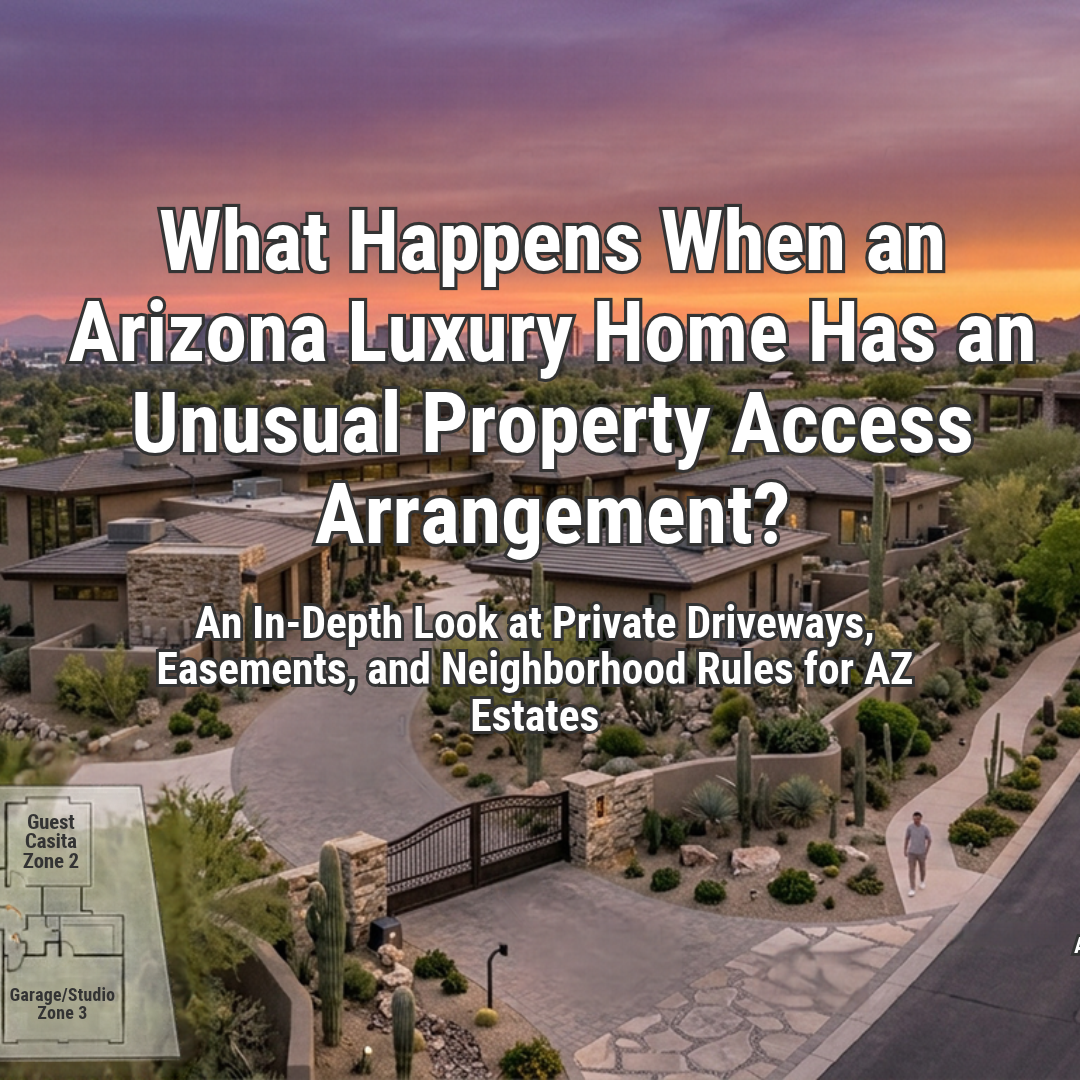
An Arizona luxury estate may offer expansive grounds, mountain views, a secluded setting, and the privacy many high-end buyers want. But sometimes, reaching the property is more complicated than following a driveway from the street to the front entrance.
The home may sit behind another property, share a private driveway with a neighboring estate, depend on a recorded access easement, or use a private road maintained by multiple owners. In rural or less densely developed areas, access may involve longer roads, gates, or agreements that are not immediately obvious during a property tour.
These arrangements are not necessarily problems. In some cases, they provide practical access to secluded properties and support the layout of a larger estate. However, buyers need to understand exactly how access works, who has the right to use it, and what obligations come with ownership.
In Scottsdale, Paradise Valley, North Scottsdale, and the East Valley, unusual property access can affect privacy, maintenance expenses, future improvements, emergency access, and the property's overall marketability.
Before purchasing a luxury home with a nonstandard access arrangement, buyers should look beyond the physical road and determine whether the legal rights, recorded documents, and practical conditions support the way they intend to use the property.
1. What Qualifies as an Unusual Property Access Arrangement?
Most buyers expect a home to have a driveway that connects directly to a public street. Some properties, however, rely on more complicated arrangements.
These may include:
- Shared driveways: Two or more neighboring properties use the same driveway or entrance.
- Private roads: The route to the home is not maintained as an ordinary public street and may be subject to private maintenance agreements.
- Access easements: A property has a legal right to cross another parcel to reach a road or other destination.
- Flag lots: A parcel has a narrow access strip connecting the main portion of the property to a public road.
- Gated private communities: Access may be controlled by gates, community rules, or shared infrastructure.
- Access across multiple parcels: The route may cross land with different owners or involve several recorded rights.
- Long rural access routes: A home may depend on an extended private road or an arrangement involving neighboring landowners.
Each arrangement raises different questions. A shared driveway may primarily involve maintenance and everyday coordination, while an easement across another parcel may require careful review of the legal documents defining the access rights.
The important distinction is that a road that physically reaches a property does not, by itself, establish that the owner has an adequate legal right to use it. The Arizona Association of REALTORS® has specifically cautioned buyers about properties that appear accessible but lack clearly established legal access. (See its guidance on closing escrow without legal access.)
2. Legal Access Versus Physical Access
One of the most important questions is whether the property has both physical and legal access.
Physical access means there is a route a person can actually travel. Legal access concerns whether the property owner has the necessary rights to use that route.
For example, a luxury home may have a well-maintained driveway that crosses a neighboring parcel. The current owner may have used it for years, and the route may appear to be an established part of the property. However, if the legal basis for that use is unclear, a future disagreement could create complications.
Buyers should establish how the property connects to a public road and identify the legal documents supporting that connection. Depending on the circumstances, those documents may include a recorded easement, deed provisions, a private road agreement, or other legally recognized rights.
Do not assume that a neighbor's informal permission is equivalent to a permanent, transferable property right. Likewise, long-standing use should not be treated as conclusive proof that the access arrangement is legally secure.
If the title commitment identifies an access exception, exclusion, or unresolved issue, ask the title company and a qualified Arizona real estate attorney to explain its implications before closing.
The objective is to understand whether the access arrangement adequately supports the intended use of the estate and whether the relevant rights can be insured under the proposed title policy.
3. Understanding Access Easements
An easement generally gives someone a defined right to use part of another property for a specific purpose. For luxury homebuyers, an access easement may allow vehicles and pedestrians to travel across another parcel to reach the home.
However, not every easement grants the same rights.
The document may specify the location of the access route, its permitted uses, the properties that benefit from it, and any limitations or maintenance obligations. Some arrangements may address utilities alongside access, while others may be restricted to a particular route or purpose.
Buyers should determine whether the easement covers the access they actually need. For example, a route that permits pedestrian access may not necessarily provide the vehicle access required for everyday residential use.
It is also important to establish whether the legal description and recorded documents clearly identify the properties and the area covered by the easement. Ambiguous or incomplete documentation can create uncertainty about where the right applies and what it permits.
Request copies of the recorded easement documents referenced in the title commitment. Review them with the title company and, when necessary, an attorney familiar with Arizona real estate law.
An easement should be evaluated based on its actual language and legal effect, not merely on how the driveway appears during a showing.
4. Shared Driveways and Neighbor Relationships
A shared driveway may be convenient, but it introduces an additional layer of coordination between neighboring owners.
Before purchasing, establish exactly which properties use the driveway and whether the arrangement is documented in a recorded agreement. Determine whether the shared portion includes the entrance, the full length of the driveway, a turnaround area, or other paved surfaces.
Consider everyday situations that could affect the property's use:
- A neighbor parks near the entrance or blocks part of the driveway.
- A delivery vehicle needs additional turning space.
- Construction equipment must reach the property.
- Guests or service providers need access during a gathering.
- A gate or access-control device requires repair.
- One owner wants to widen, repave, or alter the shared route.
The relevant agreement may address some of these situations, but buyers should not assume that every possible dispute has already been resolved.
It is also useful to observe how the arrangement functions in practice. Is the driveway wide enough for the vehicles the household expects to use? Can vehicles pass or turn around where necessary? Does the route create privacy concerns because neighbors or their visitors pass close to the home?
A shared driveway is not automatically a disadvantage. The key is understanding the arrangement and determining whether its practical limitations are acceptable.
5. Private Road Maintenance and Ownership Costs
A private road can be an important part of a property's infrastructure, particularly when the estate is set back from a public street or located in a less densely developed area.
However, buyers need to understand who maintains the road and how the associated costs are allocated.
Depending on the arrangement, responsibility may fall on an individual owner, several neighboring owners, a homeowners association, or another entity established by an agreement. The existence of a private road does not automatically tell buyers who must pay for repairs.
Ask for documentation addressing maintenance responsibilities, cost-sharing formulas, repair approvals, and any reserve funds or existing assessments. If multiple properties use the road, determine whether each owner has a defined obligation to contribute.
Potential expenses may include:
- Resurfacing or repairing pavement.
- Grading or maintaining an unpaved road.
- Repairing drainage features and erosion damage.
- Maintaining gates and access-control systems.
- Clearing debris after storms.
- Repairing damage caused by heavy vehicles or construction.
- Addressing road deterioration associated with regular use.
The condition of the road also matters. A route that looks acceptable during dry weather may reveal drainage, erosion, or surface problems after heavy rain.
For a long private road, buyers may benefit from an inspection by a qualified professional who can evaluate its condition and identify potential repair needs.
Understanding these obligations before closing can help buyers budget realistically and avoid unexpected disputes over who pays for future work.
6. Privacy, Security, and Gate Access
Privacy is often an important consideration when buying an Arizona luxury estate. A property with a private entrance or a long driveway may provide separation from the street, but the actual level of privacy depends on how access is arranged.
A shared route may bring neighbors, visitors, contractors, or delivery vehicles closer to the home than buyers initially expect. An easement crossing part of the estate may also permit others to travel through a defined area.
Buyers should review the access documents to understand who may use the route and for what purposes. They should then compare those rights with the property's physical layout.
If the estate has a gate, determine who controls it, how authorized visitors gain entry, and who maintains the equipment. Ask whether access codes, remote controls, or other credentials must be transferred after closing.
A gate should not be assumed to eliminate another party's valid access rights. Depending on the governing documents and applicable law, a property owner may be restricted from blocking or unreasonably interfering with authorized use.
Also consider whether the gate allows practical access for deliveries, service providers, and emergency responders. The details depend on the property and its location, so any uncertainty should be addressed with the appropriate professionals.
The goal is to understand both the privacy the estate offers and the access rights that may continue after the purchase.
7. Emergency Access and Everyday Convenience
A property's entrance may look attractive without being particularly practical.
Long driveways, narrow access lanes, steep grades, tight turns, and limited turnaround areas can affect how easily residents and visitors reach the home. These details become more important when considering larger vehicles, frequent deliveries, construction work, or accessibility needs.
Buyers should evaluate whether the route can accommodate the vehicles they expect to use and whether there is sufficient space for vehicles to turn around safely.
Where a long or narrow access route is involved, ask the appropriate local authority or qualified professional about applicable emergency-access requirements. Do not assume that the presence of a gate or a paved road means the property automatically meets every applicable standard.
Buyers may also want to confirm whether the access route is usable throughout the conditions reasonably expected at the property. For example, drainage issues, washouts, debris, or deteriorating surfaces can affect a private road even when the main home remains in excellent condition.
If emergency access or road suitability is a concern, consult the relevant fire or emergency authority, local jurisdiction, and qualified professionals rather than relying solely on the seller's description.
8. Property Boundaries, Surveys, and Encroachments
Unusual access arrangements can make property boundaries more consequential.
A driveway may run close to a boundary line, cross a neighboring parcel, or occupy an area subject to a recorded easement. Landscaping, retaining walls, gates, fences, and other improvements may also be located near the access route.
A current survey, when available and appropriate, can help buyers understand the relationship between the legal parcel, driveway, access easements, and visible improvements.
Compare the survey with the title documents and the actual property layout. If the driveway appears to extend beyond the area described in an easement, or a gate or wall seems to obstruct a recorded route, seek clarification before proceeding.
Other questions worth investigating include whether:
- The access route is located where the recorded documents indicate.
- Any improvements encroach on neighboring land.
- The driveway crosses more than one parcel.
- A planned addition or landscaping project could interfere with access.
- The access arrangement affects the placement of future gates, walls, or other improvements.
A survey does not, by itself, resolve every legal question. However, it can help identify physical conditions that require further review by the title company, surveyor, or real estate attorney.
9. Title Insurance and Recorded Documents
The title commitment is a key source of information when evaluating unusual property access.
It identifies matters the title company has found that may affect ownership and explains the conditions and exceptions associated with the proposed title insurance policy. Depending on the property, relevant documents may include easements, rights-of-way, private road agreements, restrictions, and other recorded interests.
Buyers should review the documents referenced in the commitment rather than relying exclusively on a summary or the property's listing description.
Pay particular attention to exceptions relating to legal access. A property may be physically reachable, yet the proposed title policy may not provide the coverage a buyer expects for access-related problems.
The Arizona Association of REALTORS® recommends reviewing title documents and investigating exceptions that may affect a purchase. Its due diligence guidance also discusses the importance of examining recorded easements and other documents affecting the property.
Ask the title company to explain what access-related matters are covered, excluded, or unresolved. If the proposed coverage is unclear or insufficient for your needs, consult a qualified Arizona real estate attorney before the transaction proceeds.
Title insurance is not a substitute for understanding the underlying documents. Buyers should determine what rights exist and what risks remain rather than assuming the policy resolves every possible access issue.
10. Future Improvements and Property Resale
An unusual access arrangement may affect how easily a buyer can improve, use, or eventually sell an estate.
For example, a planned guesthouse, detached garage, expanded parking area, or new gate may depend on access rights that are narrower than the buyer expects. Construction vehicles may need to cross a neighboring parcel, and changes to a shared driveway may require agreement from other parties.
Buyers should establish whether the current access arrangement can support foreseeable projects. This may involve reviewing the easement's permitted uses, checking applicable zoning and permitting requirements, and determining whether any additional approvals or agreements are necessary.
Resale considerations also deserve attention. Future buyers may ask the same questions about access rights, road maintenance, privacy, and title insurance. Clear documentation can make the arrangement easier to understand, while unresolved disputes or ambiguous rights may complicate a future transaction.
The impact on marketability depends on the specific property, its location, the nature of the access arrangement, and the expectations of potential buyers. An unusual entrance does not automatically reduce value, just as an impressive private driveway does not automatically increase it.
The important point is to understand how the arrangement affects the estate's practical use and whether the relevant rights and responsibilities are clearly documented.
11. Questions to Ask Before Making an Offer
Before purchasing an Arizona luxury home with an unusual access arrangement, buyers should seek clear answers to several questions.
About legal rights
- Does the property have documented legal access to a public road?
- Is access based on an easement, private road agreement, deed provision, or another arrangement?
- Which properties benefit from or are burdened by the access rights?
- Are there limitations on vehicle use, maintenance, gates, or improvements?
About ownership and expenses
- Who owns the driveway or private road?
- Who is responsible for routine maintenance and major repairs?
- Are costs shared with neighboring owners or an association?
- Are there existing disputes, assessments, or unresolved maintenance issues?
About daily use
- Can residents, guests, delivery vehicles, and service providers use the route as expected?
- Does the entrance provide adequate turning space and practical vehicle access?
- Are there privacy concerns associated with shared access?
- How are gates, access codes, and other security systems managed?
About the transaction
- What access-related exceptions appear in the title commitment?
- Does the proposed title insurance policy address legal access as expected?
- Is a survey available, and does it show the access route and relevant improvements?
- Should an attorney, surveyor, title specialist, or other professional review the arrangement before closing?
The answers should be supported by the relevant documents wherever possible. Verbal explanations can be useful starting points, but they should not replace the review of recorded rights and written agreements.
A Murphy Group Arizona Perspective
At The Murphy Group Arizona, evaluating a luxury estate means looking beyond its architecture, views, and amenities to understand how the property functions in everyday life.
An unusual access arrangement may be perfectly workable when the legal rights are clear, the road is maintained appropriately, and the arrangement suits the owner's expectations. However, buyers should understand any limitations before committing to a purchase.
For estates in Scottsdale, Paradise Valley, North Scottsdale, and the East Valley, it is worth examining access alongside other property considerations, including privacy, outdoor improvements, parking, security, and future plans for the home.
Mary Murphy and The Murphy Group Arizona can help buyers identify questions to raise during the purchasing process and coordinate with appropriate professionals when further investigation is needed. Legal interpretations, title coverage, survey findings, and engineering matters should be confirmed by the qualified professionals responsible for those areas.
A careful review can help buyers make decisions based on the property's complete ownership experience rather than its appearance alone.
The Bottom Line
When an Arizona luxury home has an unusual property access arrangement, the most important issue is understanding how the access works both legally and practically.
A shared driveway, private road, gated entrance, or access easement does not automatically make a property a poor investment. The arrangement may work well when the rights are clearly documented, responsibilities are understood, and the route supports the property's intended use.
Before purchasing, review the title commitment and recorded documents, investigate maintenance obligations, evaluate the physical access route, and obtain professional advice about any unresolved concerns. Confirming these details early can help prevent costly surprises and make it easier to assess whether the estate meets your needs.
If you're exploring luxury homes in Scottsdale, Paradise Valley, North Scottsdale, or the East Valley, The Murphy Group Arizona can help you look beyond the listing photos and evaluate the details that matter when choosing a property.
Explore Arizona luxury real estate at www.mgsellsarizona.com to discover properties and learn more about finding a home that fits your lifestyle and long-term priorities.

Mary Murphy
Team Leader | The Murphy Group - AZ | eXp Luxury | PLACE
or another way