

Categories
Scottsdale Luxury Real Estate, Scottsdale Housing Market, Paradise Valley Luxury, Paradise Valley Real Estate, North Scottsdale homes, luxury home buying guide, Arizona Property Surveys, Real Estate Due Diligence, Property Encroachments, Easements and Property Rights, East Valley Luxury, East Valley real estatePublished October 13, 2026
The Luxury Property Boundary Dispute: What Buyers Should Verify Before Closing

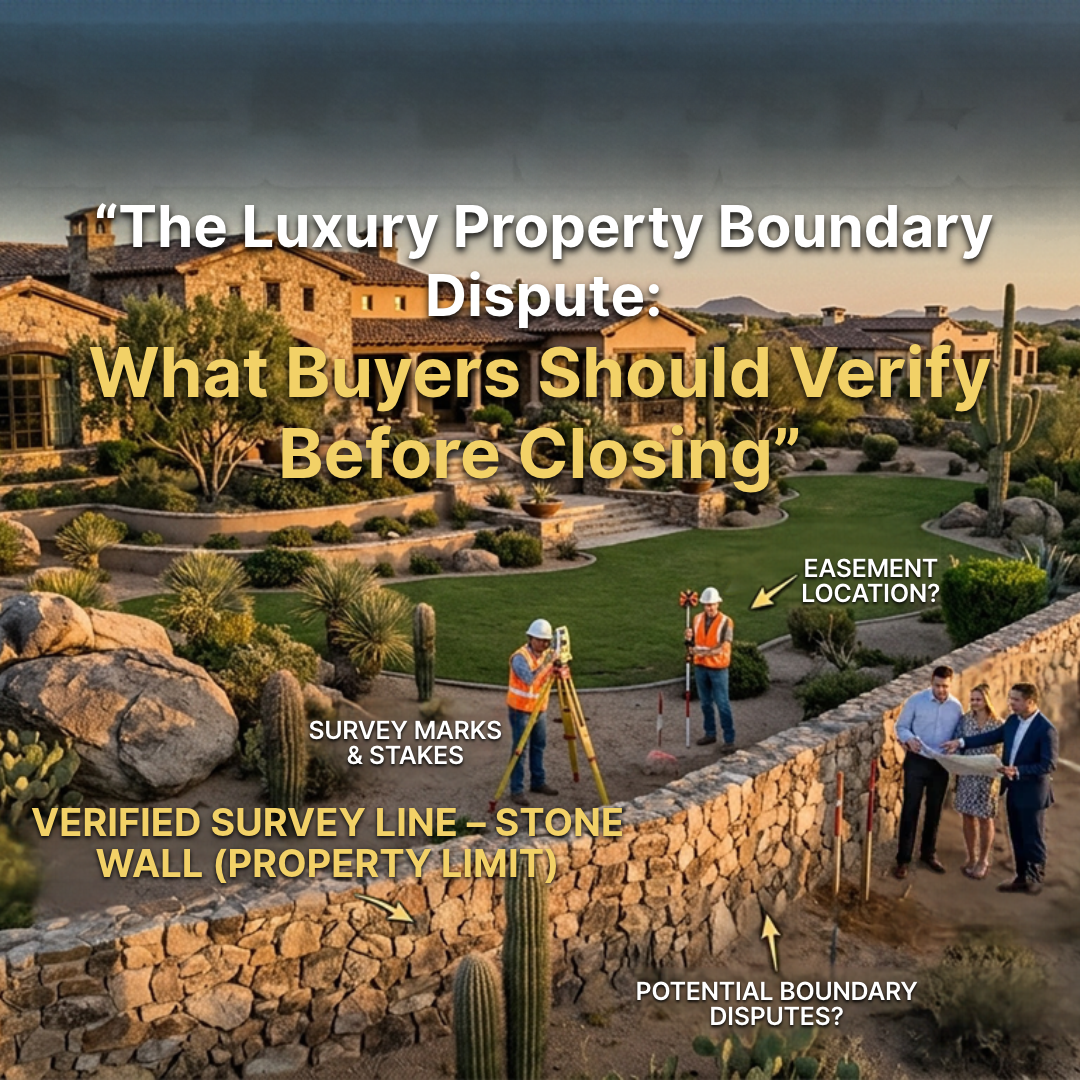
Imagine finding the Arizona luxury property you've been searching for.
The home offers expansive desert views, generous acreage, mature landscaping, a private pool, and the kind of seclusion that makes the property feel like a personal retreat. A long driveway leads to the residence, while stone walls, decorative fencing, and established landscaping create a sense of privacy and exclusivity.
Everything appears to be exactly what you want.
Then, during due diligence, you discover that a portion of the driveway may extend onto neighboring land. A boundary fence does not appear to match the recorded property lines. A neighboring owner claims that part of the landscaped yard belongs to them. Or an existing wall, gate, or outdoor structure may cross a property boundary.
Suddenly, the purchase involves more than the home's architecture, location, and amenities.
Who legally owns the disputed area? Does the existing survey accurately reflect the property's boundaries? Are there recorded easements or access rights? Could the dispute affect your plans for a guesthouse, pool expansion, landscaping, or additional privacy features? Would purchasing the property expose you to legal expenses or future disagreements with a neighbor?
These questions deserve careful attention before closing, particularly when a luxury property includes substantial acreage, private access roads, extensive outdoor improvements, or structures close to neighboring parcels.
A property's apparent boundaries are not always the same as its legally established boundaries. Before purchasing a luxury home, buyers should understand exactly what land they are acquiring, what rights affect that land, and whether any unresolved disputes could interfere with ownership.
Here's what Arizona luxury buyers should investigate before making a major property investment.
1. Understand Exactly Where the Property Boundaries Are
The first step is determining the actual boundaries of the parcel being purchased.
A property's visible features can create the impression of a clear boundary. Fences, retaining walls, rows of trees, driveways, and landscaping may appear to separate one property from another. However, these features do not necessarily establish the legal property line.
For example, a stone wall may have been constructed years ago without a current survey. A previous owner may have planted trees beyond the parcel boundary, or a driveway may have been installed partly on neighboring land.
These arrangements can remain unnoticed until a property changes hands or a neighbor challenges the existing use.
Before closing, ask:
- Where are the legally described boundaries of the property?
- Does the existing survey identify the boundary lines and relevant improvements?
- Are fences, walls, gates, and driveways positioned within the parcel?
- Are there any known disagreements with neighboring owners?
- Has a previous owner relocated a fence or altered a boundary feature?
- Does the physical layout appear consistent with the legal description in the purchase documents?
If the boundaries are uncertain, consider obtaining a current boundary survey prepared by an appropriately licensed Arizona land surveyor.
The purpose is to establish a reliable understanding of the land included in the purchase rather than relying solely on visual indicators or the seller's recollection.
2. Obtain and Review a Current Property Survey
A property survey can be one of the most useful tools in investigating a potential boundary dispute.
For a luxury property, this is particularly important when the parcel includes acreage, irregular lot lines, private roads, detached structures, extensive landscaping, or improvements near neighboring land.
Ask the seller for any existing survey, including documents prepared when the property was purchased, developed, subdivided, or improved.
Review the survey with a qualified professional and determine whether it adequately addresses the questions relevant to your purchase.
Depending on the property's circumstances, the survey may help identify:
- Recorded boundary lines and dimensions
- Property corners and monuments
- Building locations relative to the parcel boundaries
- Fences, walls, and other visible improvements
- Driveways and access features
- Certain recorded easements or rights-of-way shown in the survey materials
- Potential encroachments involving neighboring properties
An older survey may still provide valuable information, but it may not reflect every subsequent improvement or change in site conditions.
Likewise, a survey does not automatically resolve every legal question involving ownership, easements, or disputed rights.
If a boundary discrepancy appears, ask the surveyor to explain what the measurements establish and whether additional research or professional review is necessary.
The goal is to identify discrepancies before closing, when you still have an opportunity to investigate their significance and discuss appropriate next steps.
3. Investigate Encroachments on the Property
An encroachment occurs when a structure or improvement extends across a property boundary or otherwise occupies land without the necessary rights.
In Arizona luxury real estate, encroachments can involve more than fences.
A neighboring property's retaining wall may extend onto the parcel being purchased. A driveway may cross the boundary to reach a garage. Tree branches, irrigation features, pool decking, outdoor kitchens, or other improvements may occupy space beyond the owner's legal property line.
Encroachments can also work in the opposite direction. A wall, shed, paved area, or landscaping feature belonging to the property being purchased may extend onto a neighbor's land.
During due diligence, investigate whether any of the following features may cross a boundary:
- Fences, gates, and masonry walls
- Driveways and private access roads
- Pools, spas, and surrounding decking
- Detached garages, workshops, or guest structures
- Retaining walls and drainage improvements
- Irrigation systems and landscaping installations
- Outdoor entertainment areas and permanent structures
Ask the seller whether any encroachments have been identified and whether written agreements, permissions, or legal proceedings address them.
A physical encroachment does not automatically establish who owns the affected land or whether the arrangement is legally permitted.
The appropriate response depends on the facts, applicable law, recorded documents, and any existing agreements.
Before proceeding, determine whether the issue can be resolved, whether a formal agreement is appropriate, or whether the discrepancy presents a risk that requires legal advice.
4. Review the Legal Description and Recorded Property Documents
The legal description identifies the land associated with the transaction. It should be reviewed alongside the survey, title commitment, deed information, and other relevant property records.
Do not rely exclusively on the street address, assessor's parcel map, or online property listing to establish the exact extent of ownership.
These resources serve different purposes and may not independently resolve a boundary disagreement.
For Arizona buyers, the county recorder's office is an important source of recorded documents affecting real property. Depending on the county and the property's history, relevant records may include deeds, recorded plats, easements, rights-of-way, and other instruments affecting the parcel.
Before closing, ask your title professional or real estate attorney to help identify and review the relevant records.
Pay attention to:
- The legal description in the current deed
- Recorded subdivision plats, if applicable
- Documents establishing easements or rights-of-way
- Boundary agreements or related recorded instruments
- Documents associated with prior subdivisions or lot-line changes
- Recorded notices or other instruments relevant to a known dispute
If the legal description in the purchase documents differs from an earlier deed, survey, or other material record, request clarification before proceeding.
The objective is to understand whether the documents consistently describe the parcel being sold and whether additional investigation is necessary.
5. Understand the Difference Between Property Lines and Easements
A boundary dispute and an easement issue are not necessarily the same thing.
A boundary dispute concerns where a property's legal limits lie or who has rights to a disputed area. An easement generally gives someone a defined right to use another person's land for a particular purpose, subject to the applicable terms and law.
For example, an Arizona luxury estate may include a driveway that crosses an adjoining parcel under an access easement. A utility company may have recorded rights affecting a section of the property. A drainage easement may limit how a particular area can be used.
These arrangements can affect privacy, construction plans, maintenance responsibilities, and future development.
Ask your title professional to identify relevant easements and review the underlying documents where necessary.
Important questions include:
- Who benefits from each easement?
- Which part of the property is affected?
- What uses are permitted?
- Who is responsible for maintenance?
- Does the easement allow vehicle access or utility work?
- Could the easement affect proposed construction or landscaping?
- Are there restrictions on gates, walls, or other improvements?
A property may be legally owned by one person while another party has specific rights to use part of it.
For luxury buyers who value privacy, controlled access, and exclusive outdoor spaces, understanding these rights is especially important.
Do not assume that purchasing the land means you can exclude everyone else from every portion of the parcel.
6. Investigate Disputes Involving Fences, Walls, and Landscaping
Fences and walls often create the visual impression of a property boundary, but their placement may reflect historical convenience rather than a verified legal line.
A fence may have been installed before neighboring parcels changed ownership. A wall may have been built to accommodate grading or landscaping rather than to mark the actual boundary. Mature trees and hedges may also have grown along a line that was never formally established.
In some cases, neighboring owners may have relied on the existing arrangement for many years without disagreement.
That history can become relevant if ownership changes and someone questions the location or use of the disputed area.
Ask the seller:
- Who installed the fence or wall?
- Was a survey completed before installation?
- Is there documentation showing the intended boundary?
- Has a neighbor ever objected to the placement?
- Have the parties signed any written agreement?
- Have there been repairs, replacements, or relocations?
If the dispute involves an established fence, wall, or landscaped area, have the relevant location evaluated by a qualified surveyor.
Where a legal claim may arise from long-term possession, use, or an informal arrangement, consult an Arizona real estate attorney.
Legal concepts such as adverse possession and prescriptive easements involve specific requirements and cannot be established merely by pointing to an old fence or longstanding use.
The important point is to distinguish the visible arrangement from the legal rights, if any, that support it.
7. Pay Particular Attention to Acreage and Estate-Style Properties
Boundary due diligence becomes especially important when purchasing a luxury home on a large parcel.
Acreage can include features that are difficult to assess from a casual walkthrough, such as remote fence lines, private roads, drainage channels, utility corridors, detached buildings, or irregular boundaries along undeveloped land.
A listing may describe the property as offering a particular acreage figure, but buyers should confirm that the acreage and legal parcel configuration align with the transaction documents.
For properties with substantial land, investigate:
- The parcel's recorded dimensions and legal description
- Whether the property consists of one parcel or several
- Whether all advertised acreage is included in the sale
- Whether fences and access roads follow the recorded boundaries
- Whether neighboring owners use any part of the land
- Whether any portion is subject to easements or rights-of-way
- Whether proposed improvements would cross parcel lines
This can be especially relevant for estates with guesthouses, equestrian facilities, extensive gardens, detached garages, or additional land intended for future development.
If multiple parcels are being sold together, verify how each parcel is described and whether the transaction includes all the land represented in the listing.
A larger property offers more space and flexibility, but it can also create more opportunities for overlooked boundary and access issues.
8. Confirm Access Rights for Driveways and Private Roads
Access is an important consideration for luxury homes with long driveways, gated entrances, shared private roads, or secluded locations.
A driveway may appear to provide direct access to a public road while actually crossing neighboring property. Alternatively, a neighbor may use a portion of the property's driveway under an existing agreement.
These arrangements should be investigated before closing.
Ask whether the property's access is entirely within its boundaries or depends on a recorded easement, private-road agreement, or other documented right.
Questions to consider include:
- Does the property have legally documented access to a public road?
- Does the driveway cross another parcel?
- Does a neighboring owner have rights to use the driveway?
- Who maintains and repairs a shared private road?
- Are there cost-sharing obligations?
- Can a gate or access-control system be installed?
- Are emergency and service vehicles able to reach the property under the applicable access arrangements?
The physical existence of a driveway does not, by itself, establish a permanent legal right to use the land beneath it.
If access depends on another parcel, have the relevant documents reviewed to understand the scope, duration, and responsibilities associated with that access.
For a secluded estate, unresolved access questions can affect daily convenience, privacy, future improvements, and potentially the property's marketability.
9. Review the Title Commitment for Potential Boundary-Related Risks
Title review is an essential part of property due diligence, but buyers should understand what a title commitment does and does not establish.
A title commitment identifies the requirements for issuing a title insurance policy and lists matters that may affect coverage. It may identify recorded easements, exceptions, restrictions, or other interests affecting the property.
However, a title commitment is not a substitute for a boundary survey or a complete investigation of every physical condition on the land.
An encroachment may not be obvious from the recorded documents alone. Likewise, a dispute may involve facts or claims that require additional investigation.
Ask your title professional to explain:
- Which easements and exceptions affect the property
- Whether any known boundary-related documents appear in the records
- What the proposed title policy covers and excludes
- Whether a survey or additional documentation is recommended
- Whether a known dispute could affect title or insurability
- Whether additional endorsements or coverage options may be available
Title insurance coverage varies by policy, endorsements, exceptions, and the circumstances of the claim. Do not assume that a standard owner's policy will automatically cover every boundary dispute or encroachment.
If a known dispute exists, disclose it to the relevant professionals and obtain a clear explanation of the potential coverage limitations before closing.
10. Investigate Prior Complaints, Agreements, and Legal Proceedings
A seller may be aware of a boundary disagreement that does not appear in the listing or ordinary property records.
The disagreement could involve a neighbor's objection to a fence, a disputed driveway, an alleged encroachment, or competing interpretations of the property's legal description.
Ask the seller to disclose known boundary disputes and provide available supporting documents.
Relevant information may include:
- Written communications with neighboring owners
- Notices or demands concerning an alleged encroachment
- Boundary or access agreements
- Survey reports prepared in response to a dispute
- Attorney correspondence
- Pending or resolved legal proceedings
- Agreements involving the relocation or removal of improvements
Where appropriate, consult your real estate professional or attorney about the seller's disclosures, applicable contractual obligations, and any additional records that should be requested.
Do not assume that the absence of a lawsuit means the property is free from a dispute. Many disagreements begin informally and may not appear in public records.
Likewise, a neighbor's allegation does not automatically mean that the neighbor has a valid legal claim.
The objective is to establish what is known, identify what remains contested, and determine whether the available evidence supports proceeding with the purchase.
11. Evaluate How a Boundary Dispute Could Affect Future Improvements
A luxury home may meet your current needs while leaving room for future changes.
You might plan to expand a swimming pool, build a detached guesthouse, install a larger garage, add a privacy wall, or redesign the landscaping.
An unresolved boundary issue can complicate these plans, especially if an existing improvement sits close to a disputed line or a neighboring owner claims rights over the intended construction area.
Before purchasing, identify the locations of planned improvements and compare them with the available survey and recorded documents.
Consider asking:
- Is the proposed building area entirely within the parcel?
- Are there easements or setback requirements affecting the site?
- Would the improvement cross a disputed boundary?
- Could construction interfere with a neighbor's access rights?
- Are drainage or retaining-wall issues involved?
- Would additional permits or professional reviews be required?
A boundary survey can help establish physical dimensions, but zoning, building setbacks, easements, and other development requirements should be investigated separately.
If your plans depend on a disputed area, resolve the uncertainty before treating that space as available for construction.
A property should be evaluated not only for the way it functions today, but also for whether its legal and physical boundaries support the ownership plans you have in mind.
12. Understand the Potential Financial Consequences
A boundary dispute can introduce costs that extend well beyond the price of a survey.
The financial consequences depend on the nature of the dispute, the value of the affected land, the improvements involved, and whether the parties can reach an agreement.
Potential expenses may include:
- A new boundary survey
- Additional title research
- Legal consultations and representation
- Negotiation or mediation
- Relocation or removal of an encroaching improvement
- Fence, wall, or driveway modifications
- Construction delays
- Engineering or drainage assessments
- Additional title-related expenses
In some cases, the issue may be resolved through clarification of the boundary or a mutually acceptable written agreement. In others, the parties may disagree over ownership, access, or responsibility for improvements.
A resolution should not be assumed until the relevant facts, legal rights, and costs have been assessed.
Ask qualified professionals to help estimate the potential financial impact before deciding how the issue should affect your purchase decision.
For a luxury property, even a relatively small area of disputed land can have broader implications if it affects a main driveway, a pool, a privacy wall, or an important portion of the estate's usable grounds.
13. Determine Whether the Dispute Can Be Resolved Before Closing
Discovering a boundary discrepancy does not automatically mean you must abandon the purchase.
The appropriate next step depends on the severity of the issue and the evidence available.
Some discrepancies may result from outdated measurements or misunderstandings about the placement of a fence. Others may involve genuine disagreement over ownership, access rights, or longstanding use.
Before closing, determine what would be required to address the concern.
Depending on the circumstances, possible next steps may include:
- Obtaining a current boundary survey
- Reviewing deeds, plats, and recorded instruments
- Requesting clarification from the seller
- Consulting an Arizona real estate attorney
- Negotiating a written agreement between the relevant owners
- Investigating whether a boundary-line adjustment is legally available
- Determining whether improvements need to be relocated
- Reviewing the implications for title insurance
Any boundary-line adjustment, easement, or other formal arrangement should be evaluated for applicable legal, recording, zoning, and other requirements.
If a neighboring owner must participate in the resolution, do not assume that the issue can be settled without that person's cooperation where legally necessary.
Document any agreed resolution appropriately and confirm that it addresses the actual concern.
The objective is to avoid purchasing a property based on the expectation that an unresolved issue will eventually disappear.
14. Protect Your Position Through the Purchase Agreement and Due Diligence Deadlines
The timing of boundary investigations matters.
Once you are under contract, review the purchase agreement with your real estate professional and understand the applicable inspection periods, document-review obligations, notice requirements, and closing deadlines.
Do not assume that every agreement automatically provides the same rights or remedies when a boundary dispute is discovered.
Depending on the contract and circumstances, you may need to act within a specific period to raise an objection, request additional documentation, negotiate a resolution, or evaluate whether to proceed.
Organize the investigation early enough to allow time for professional review.
Your due diligence team may include:
- A qualified Arizona land surveyor
- A title professional
- An Arizona real estate attorney
- A real estate agent familiar with the transaction
- An engineer or other specialist, if structures or drainage are involved
Keep copies of the survey, title documents, seller disclosures, relevant correspondence, and professional findings.
If the investigation identifies a material concern, discuss the available options with your attorney and real estate professional before the applicable deadlines expire.
A clear process helps you make decisions based on documented facts rather than pressure to close before the issue is understood.
15. Know When to Reconsider the Purchase
Not every boundary dispute is a dealbreaker, but some may introduce risks that are inconsistent with your plans or tolerance for uncertainty.
For example, a minor fence discrepancy may be manageable if the boundary is clearly established and the parties can agree on a resolution.
By contrast, a dispute involving the property's only practical access route, a substantial portion of the advertised acreage, or a major structure may require more extensive investigation.
Before proceeding, consider whether:
- The legal boundary has been adequately established
- The affected land is important to the property's intended use
- The dispute could restrict access or future development
- A proposed resolution is documented and enforceable
- The title insurer has explained relevant coverage limitations
- The potential legal and financial costs are acceptable
- The issue could affect future resale or marketability
A seller's willingness to negotiate can be helpful, but it does not replace a clear understanding of the legal position.
Likewise, a proposed settlement should not be treated as final until the required parties have agreed and the necessary documentation has been completed.
If the remaining uncertainty is significant, consult your attorney about your contractual options before deciding whether to proceed.
The goal is not to eliminate every conceivable property risk. It is to understand the material risks well enough to make a confident and informed purchase decision.
A Murphy Group Perspective
“A luxury property should be evaluated as a complete ownership experience. Beyond the home itself, buyers need to understand the land, access, improvements, and property rights that shape how they can use and enjoy the estate. Identifying boundary concerns early can help buyers make informed decisions before closing.”
— Mary Murphy, The Murphy Group
For Arizona luxury buyers, the value of a property extends beyond its architectural features and location. The land itself, the rights associated with it, and the certainty of ownership are also important parts of the investment.
A careful review of surveys, recorded documents, easements, and known disputes can help buyers identify questions that deserve attention before they take ownership.
The Bottom Line
Buying a luxury home with a potential boundary dispute in Arizona requires more than confirming the property's appearance and advertised acreage.
Before closing, investigate:
- Property boundaries: Confirm the parcel's legal description and establish whether the visible boundaries match the available records.
- Property surveys: Review existing surveys and obtain updated professional measurements when necessary.
- Encroachments: Investigate fences, walls, driveways, pools, and other improvements that may cross property lines.
- Recorded documents: Review deeds, plats, easements, rights-of-way, and relevant county records.
- Access rights: Confirm that the property has appropriate legal access and understand any shared-driveway obligations.
- Title insurance: Understand the policy's coverage, exceptions, and limitations concerning known or potential boundary issues.
- Dispute history: Request relevant disclosures, correspondence, agreements, and legal documents.
- Future improvements: Determine whether the boundaries and applicable restrictions support your plans for the property.
- Financial exposure: Assess the potential cost of surveys, legal work, repairs, negotiations, or other necessary measures.
- Closing deadlines: Address material concerns early and understand your contractual obligations before making a final decision.
A beautiful estate may offer everything you want in a luxury home, but the value of the investment also depends on understanding the land and the rights that come with it.
The best purchase decisions are made when buyers know not only what they are buying, but also where their ownership begins, where it ends, and what legal obligations or third-party rights affect the property.
Explore Arizona Luxury Real Estate With The Murphy Group
If you're considering a luxury home in Scottsdale, Paradise Valley, North Scottsdale, or the East Valley, The Murphy Group can help you look beyond the listing photos and consider the property, land, and long-term ownership experience.
From private estates and expansive acreage to access, outdoor amenities, property improvements, and due diligence considerations, a thoughtful approach can help you ask better questions before making a major investment.
Explore Arizona luxury real estate at mgsellsarizona.com.

Mary Murphy
Team Leader | The Murphy Group - AZ | eXp Luxury | PLACE
or another way