

Categories
Arizona Lifestyle, Arizona Luxury, Arizona Real Estate, Luxury Home Building & Buyer Guides, luxury home buying guide, moving to Arizona, Paradise Valley Luxury, Paradise Valley Real Estate, Scottsdale Real EstatePublished August 20, 2026
What Happens When a Luxury Home Has Too Much House?

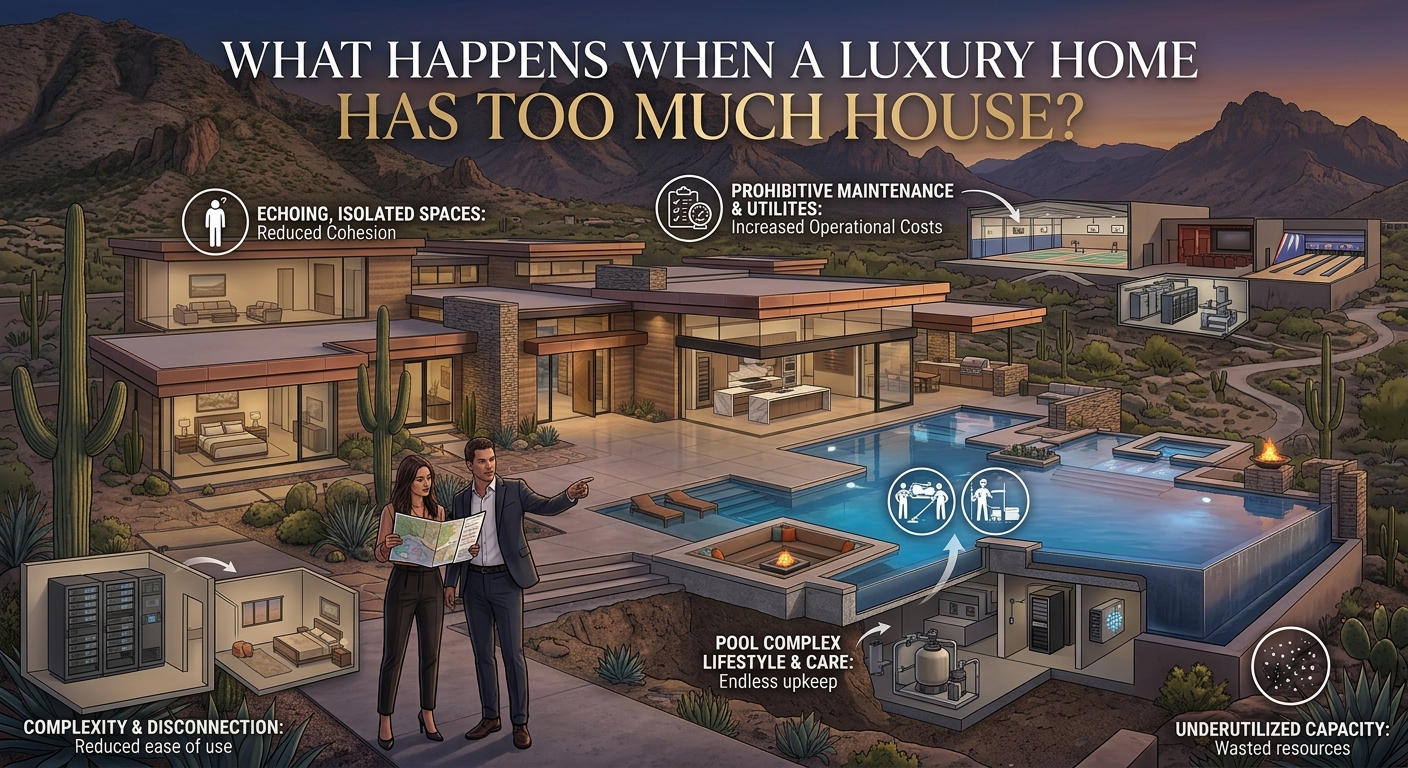
In luxury real estate, bigger can be impressive.
More bedrooms.
More bathrooms.
More entertaining space.
More garages.
More outdoor amenities.
But there is a point where more house doesn't necessarily mean more luxury.
A 10,000-square-foot home may look spectacular on paper. Yet if half the rooms are rarely used, the floor plan feels disconnected, maintenance becomes overwhelming, and the property costs significantly more to operate, the additional square footage may not improve the owner's everyday experience.
For luxury buyers in Arizona, this raises an important question:
How much house do you actually need?
As Mary Murphy of The Murphy Group explains:
"Luxury isn't simply about having more space. It's about having the right space for the way you live."
🏡 1. More Square Footage Doesn't Always Mean More Livability
Square footage is one of the easiest ways to compare homes.
But it doesn't tell you how effectively that space is designed.
Consider two properties:
Home A: 8,500 square feet with numerous oversized rooms and long hallways.
Home B: 6,500 square feet with carefully planned living areas, private bedroom suites, a functional kitchen, dedicated entertaining spaces, and strong indoor-outdoor flow.
The larger home may have more space.
But the smaller home could provide a better day-to-day experience.
Luxury buyers should evaluate usable space, not simply total space.
📐 2. The Floor Plan Can Become Too Large to Feel Connected
A large home can create physical distance between everyday spaces.
You might find yourself walking significant distances between:
- The primary suite and kitchen
- Bedrooms and living areas
- The kitchen and outdoor entertaining spaces
- The garage and main entrance
- Guest accommodations and common areas
In some oversized homes, rooms can begin to feel isolated rather than connected.
The goal isn't to eliminate space.
It's to make sure the space has a purpose.
🛋️ 3. Rooms That Rarely Get Used Can Become Expensive Decoration
Luxury homes sometimes include rooms that sound impressive in a listing:
- Formal dining rooms
- Multiple living rooms
- Game rooms
- Movie theaters
- Libraries
- Secondary offices
- Guest lounges
- Wine rooms
- Additional bedrooms
These features can be valuable when they match the owner's lifestyle.
But if they remain empty most of the year, the buyer is effectively paying for space that provides little everyday utility.
Before purchasing, ask:
How often will I realistically use this room?
🧹 4. More House Means More Maintenance
Every additional square foot requires some level of upkeep.
That can include:
- Cleaning
- HVAC servicing
- Window maintenance
- Flooring care
- Painting
- Plumbing
- Electrical systems
- Landscaping
- Pool maintenance
- Roof maintenance
And in Arizona, outdoor spaces can add another layer of ongoing care.
A larger property can therefore create a larger ownership responsibility.
The purchase price is only one part of the financial equation.
☀️ 5. Energy Costs Can Scale With the Home
Arizona's climate makes energy efficiency particularly important.
A larger home may require more:
- Cooling
- Heating
- Lighting
- Water
- Pool equipment operation
The exact impact depends on the home's construction, insulation, windows, HVAC systems, orientation, and energy-efficiency features.
That's why buyers shouldn't assume that two luxury homes with similar prices will have similar operating costs.
A closer look at the home's systems can reveal a very different ownership experience.
🌵 6. Outdoor Space Can Become Another Property to Manage
A large backyard can be spectacular.
But consider what comes with it.
A luxury property might include:
- Multiple patios
- Large pools
- Outdoor kitchens
- Fire features
- Extensive landscaping
- Putting greens
- Sport courts
- Water features
- Guest structures
These amenities can create an extraordinary lifestyle.
But they also require maintenance.
The right question isn't:
"How many outdoor amenities does this home have?"
It's:
"Which outdoor amenities will actually improve my lifestyle?"
🛏️ 7. Too Many Bedrooms Can Reduce Practicality
A large bedroom count can look attractive to buyers.
But consider your actual needs.
Do you regularly host overnight guests?
Do you need multiple private offices?
Do you have children who require separate suites?
Do you expect multigenerational living?
Will the additional rooms eventually serve another purpose?
Unused bedrooms aren't necessarily a problem—but they can represent space that adds cost without adding meaningful value to your daily life.
🚪 8. Privacy Can Work Both Ways
Large homes often provide more privacy.
But an enormous floor plan can also create an unexpected issue:
The occupants may rarely interact.
One person may be in the primary suite while another is in a distant living area.
For some buyers, that separation is desirable.
For others, it can make the home feel disconnected.
Luxury design should support the owner's preferred balance between privacy and togetherness.
🏠 9. Bigger Homes Can Have a Smaller Buyer Pool
When it eventually comes time to sell, an exceptionally large home may appeal to a narrower group of buyers.
The pool of buyers who specifically want:
- 10,000+ square feet
- Multiple guest suites
- Extensive grounds
- Numerous specialized rooms
- Large-scale maintenance
may be smaller than the pool interested in a more manageable luxury property.
This doesn't mean a large home is a poor investment.
It simply means buyers should understand that specialized properties can have specialized demand.
💰 10. Price Per Square Foot Doesn't Tell the Whole Story
Luxury buyers sometimes focus heavily on price per square foot.
But this metric can be misleading when comparing properties with very different designs.
Two homes might have similar price-per-square-foot figures while offering dramatically different:
- Lots
- Views
- Architecture
- Finishes
- Outdoor spaces
- Privacy
- Locations
- Renovation levels
The goal shouldn't be to purchase the most square footage for the money.
It should be to determine which characteristics justify the overall price.
🏔️ 11. Don't Sacrifice the Lot for More House
This is especially important in Arizona luxury real estate.
A buyer may have the choice between:
A larger home on an ordinary lot
or
A slightly smaller home on exceptional land.
The second property could offer:
- Better mountain views
- Greater privacy
- More usable outdoor space
- Better orientation
- Golf-course frontage
- Preserve adjacency
- Greater separation from neighboring homes
Square footage can sometimes be added or redesigned.
A location and exceptional lot are much harder to replicate.
🌅 12. Views Can Matter More Than Additional Rooms
Imagine having a choice between an additional 1,000 square feet and an unobstructed mountain view.
Which feature contributes more to the experience?
The answer depends on the buyer.
But for many luxury properties, the relationship between the home and its surroundings is one of the defining characteristics of the property.
A well-positioned home can make its surroundings part of the architecture.
🧱 13. Architectural Quality Can Outperform Quantity
Luxury isn't necessarily measured by how much material was used.
It can be measured by how thoughtfully the home was designed.
Look for:
- Proportion
- Natural light
- Ceiling height
- Sight lines
- Material quality
- Indoor-outdoor transitions
- Custom craftsmanship
- Functional circulation
- Relationship to the landscape
A smaller home with exceptional architecture can feel more luxurious than a much larger home with an inefficient layout.
🍽️ 14. Entertaining Space Should Match Your Lifestyle
If you frequently host large gatherings, substantial entertaining space can be a genuine advantage.
But if your typical evening involves a small dinner with family or a few friends, you may not need multiple formal entertaining zones.
Ask yourself:
What does entertaining actually look like in my life?
The answer can help distinguish between space that is genuinely useful and space that simply sounds impressive.
🧑💻 15. Today's Luxury Buyer May Need Flexible Space
The meaning of "useful space" continues to evolve.
A room that was once designed as a formal sitting area might now become:
- A home office
- A creative studio
- A fitness room
- A media space
- A wellness room
- A study
- A private workspace
Flexible rooms can sometimes provide more long-term value than highly specialized spaces.
🔧 16. Large Homes Can Have More Complex Systems
The bigger and more sophisticated the property, the more systems may be involved.
Depending on the home, buyers may encounter:
- Multiple HVAC zones
- Smart-home systems
- Advanced security
- Automated shades
- Pool technology
- Water features
- Specialty lighting
- Home theaters
- Backup power systems
These features can be wonderful.
But buyers should understand how they work, what they cost to maintain, and whether specialized service providers are required.
🧾 17. Ownership Costs Don't Stop at the Mortgage
A luxury home should be evaluated as an ongoing ownership commitment.
Consider the potential cost of:
Property taxes + insurance + utilities + maintenance + landscaping + pool care + repairs + upgrades
The larger and more amenity-rich the property, the more important it becomes to understand the full cost of ownership.
A home that fits comfortably into your lifestyle and budget can ultimately be more enjoyable than one that stretches either too far.
🏘️ 18. The Neighborhood May Put the Home in Perspective
A massive house doesn't automatically make the surrounding neighborhood more desirable.
Consider:
- Lot sizes
- Architectural consistency
- Street character
- Nearby properties
- Community amenities
- Traffic
- Privacy
- Future development
A home should be evaluated within the context of its location—not just its own walls.
🔍 19. Ask What You Are Actually Paying For
When evaluating a large luxury home, break the property down.
What percentage of the purchase price reflects:
The land?
The location?
The architecture?
The views?
The finishes?
The amenities?
The square footage?
This approach can help buyers understand whether the property's value comes from meaningful characteristics or simply from having a very large footprint.
🧭 20. Find Your "Right-Sized" Luxury
Right-sized luxury doesn't mean buying a small house.
It means finding the amount of space that supports your lifestyle without creating unnecessary complexity.
For one buyer, that might mean 4,500 square feet.
For another, it might mean 8,000.
For someone else, a larger estate may be exactly right.
There is no universal ideal.
The important question is:
Does the property give you the space you need without giving you space you don't value?
🏡 When Bigger Really Is Better
There are situations where a larger luxury home makes perfect sense.
For example, buyers who:
- Host large gatherings
- Have multigenerational households
- Frequently welcome guests
- Need multiple home offices
- Collect art or specialty items
- Require extensive storage
- Want dedicated recreation spaces
- Need private staff or guest accommodations
may genuinely benefit from a substantial home.
The issue isn't size itself.
The issue is whether the size serves a purpose.
⚖️ The Difference Between Impressive and Appropriate
An oversized home can create an immediate reaction:
"Wow."
But after the initial impression fades, a more important question emerges:
"Does this home work for me?"
That question should guide the luxury buying process.
Because the most impressive property isn't necessarily the most appropriate one.
And the most expensive home isn't automatically the home that provides the greatest lifestyle value.
💡 How to Tell If a Luxury Home Has Too Much House
Before moving forward, consider these questions:
1. How many rooms will I actually use every week?
If several spaces are likely to remain empty, reconsider whether the additional square footage is necessary.
2. How much maintenance am I comfortable managing?
Think beyond cleaning. Consider landscaping, pools, HVAC, repairs, technology, and exterior upkeep.
3. Does the floor plan feel connected?
Walk through the home as though you already live there.
4. Are the views and lot worth prioritizing?
A smaller home with exceptional land may provide a stronger overall experience.
5. Will my needs change?
Think about family growth, aging, guests, work, and lifestyle changes.
6. What will future buyers value?
Consider whether the property's size and configuration will appeal to a reasonable segment of future luxury buyers.
🧭 The Best Luxury Home Is the One That Fits Your Life
Luxury real estate isn't a competition to own the most square footage.
It's about creating an environment that supports the way you want to live.
Sometimes that means a sprawling Arizona estate with multiple guest suites, resort-style amenities, and expansive entertaining areas.
Sometimes it means a thoughtfully designed home that is significantly smaller but offers exceptional architecture, privacy, views, and outdoor living.
The best property is the one where every important space has a purpose.
💼 How The Murphy Group Helps Buyers Look Beyond Square Footage
The Murphy Group helps Arizona luxury buyers evaluate properties based on more than size and presentation.
That can include considering:
- Lot quality
- Views
- Privacy
- Floor-plan functionality
- Indoor-outdoor flow
- Architectural design
- Neighborhood characteristics
- Maintenance considerations
- Renovation quality
- Long-term lifestyle fit
As Mary Murphy explains:
"The goal isn't to find the biggest home you can buy. It's to find the home that gives you the lifestyle you actually want."
📊 The Bottom Line
A large luxury home can be extraordinary.
But more space can also mean:
👉 More maintenance
👉 Higher operating costs
👉 More complicated systems
👉 Rooms that rarely get used
👉 A more specialized buyer pool
👉 Less efficient everyday living
Before choosing the largest home that fits your budget, consider whether the additional space actually improves your lifestyle.
Because luxury isn't measured only in square feet.
It's measured in:
Comfort.
Privacy.
Design.
Views.
Functionality.
Experience.
And ultimately, how well the home fits the life you're trying to create.
The right luxury home isn't necessarily the biggest one. It's the one that gives every square foot a reason to exist.
📲 Explore Arizona Luxury Homes With a Lifestyle-First Approach
If you're considering a luxury home in Scottsdale, Paradise Valley, North Scottsdale, or another premier Arizona community, The Murphy Group can help you evaluate more than the size of the home.
From the lot and location to the floor plan, views, outdoor living, and long-term lifestyle fit, the goal is to help you understand what you're actually buying.
👉 Explore Arizona luxury real estate: www.mgsellsarizona.com

Mary Murphy
Team Leader | The Murphy Group - AZ | eXp Luxury | PLACE
or another way