

Categories
Arizona Luxury, Arizona homebuyers, Arizona Real Estate, Luxury lIving, luxury home design, luxury home buying guide, Luxury Home Building & Buyer Guides, Luxury Trends 2026, Luxury planning real estate, moving to Arizona, North Scottsdale homes, North Scottsdale real estate, Paradise Valley Luxury, Paradise Valley Real Estate, Scottsdale Luxury Real Estate, Scottsdale Real Estate, Scottsdale Housing Market, energy efficient luxury homes, solar homes Arizona, Smart home, Home Automation, home valuePublished September 1, 2026
The “Invisible” Features of a Luxury Home That Can Save Owners Money Over Time

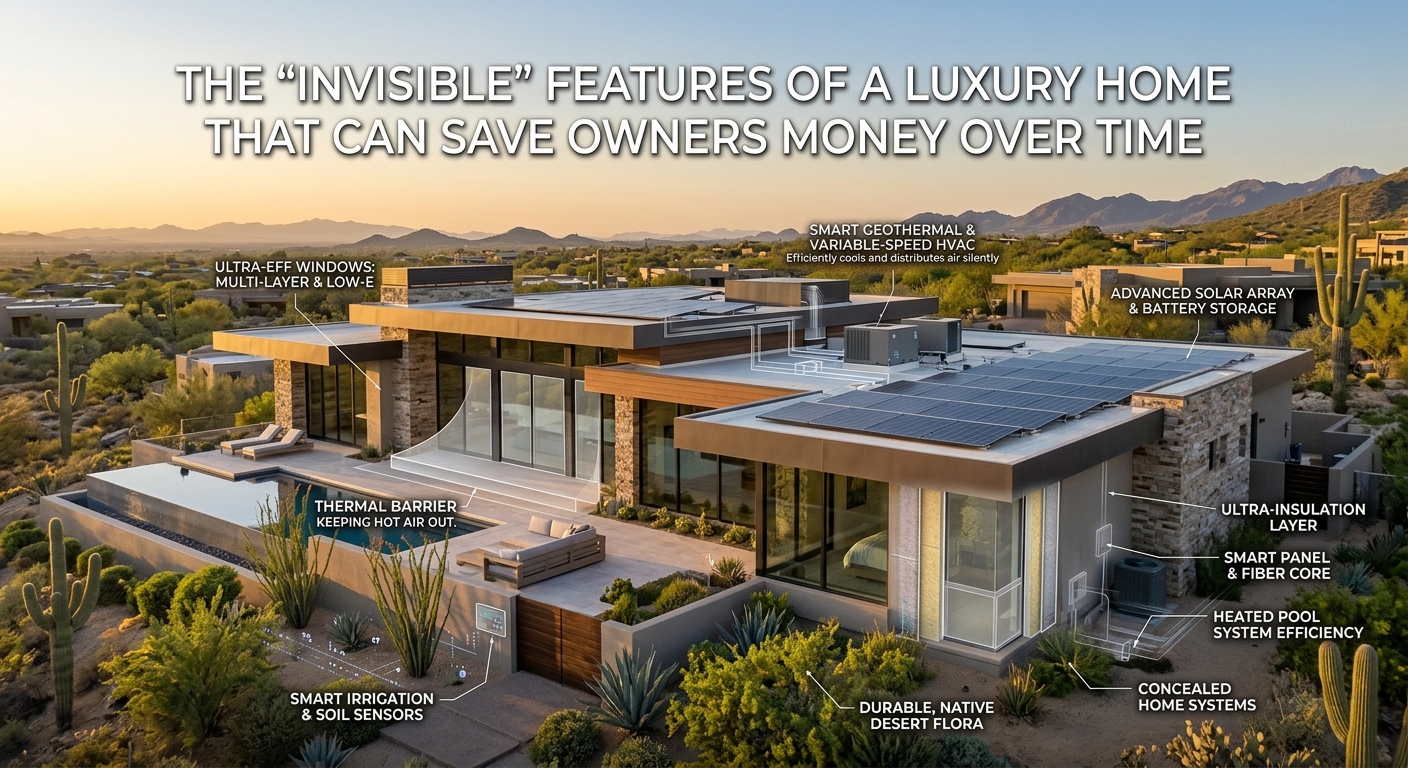
When buyers walk into an Arizona luxury home, they usually notice the things designed to impress them.
The oversized windows.
The designer kitchen.
The resort-style pool.
The dramatic architecture.
The custom finishes.
The expansive outdoor living areas.
But some of the most valuable features may be the ones buyers barely notice at all.
They may be hidden behind walls.
Under the roof.
Inside mechanical rooms.
Buried beneath the landscape.
Or quietly operating in the background every day.
These are the “invisible” features of a luxury home.
And while they may not create the same immediate visual reaction as a marble kitchen or spectacular view, they can have a meaningful effect on the long-term cost of owning the property.
Think:
Better insulation.
Efficient HVAC equipment.
Advanced irrigation controls.
Durable roofing materials.
Quality windows and doors.
Water-management systems.
Smart controls.
Well-designed infrastructure.
Low-maintenance landscaping.
These features may not photograph as beautifully as a chandelier.
But over years of ownership, they can potentially help reduce maintenance, energy, water, and replacement expenses.
As Mary Murphy of The Murphy Group explains:
"Some of the most valuable features in a luxury home aren't necessarily the ones you notice first. The systems and materials working quietly behind the scenes can have a significant impact on the ownership experience."
Important: The potential savings associated with any home feature depend on its design, age, condition, installation quality, maintenance, usage, climate, utility rates, and other factors. Buyers should have appropriate professionals evaluate major systems and obtain property-specific information before making purchasing decisions.
🏠 1. Start With the Features You Can't See
Luxury buyers are naturally drawn toward visible upgrades.
But when evaluating a property, look beyond the finishes.
Ask about:
- Insulation
- Windows
- Roofing
- HVAC equipment
- Plumbing
- Electrical infrastructure
- Irrigation
- Drainage
- Water-management systems
- Smart controls
- Solar equipment
- Backup power
- Landscaping systems
These features may not immediately affect how beautiful the house looks.
They can, however, affect how expensive it is to operate and maintain.
🌡️ 2. High-Quality Insulation Can Help Control Energy Costs
Insulation isn't glamorous.
Most buyers won't notice it during a showing.
But in Arizona, insulation can play an important role in maintaining indoor comfort.
A well-insulated home can help reduce unwanted heat transfer through the building envelope.
Look into:
- Attic insulation
- Wall insulation
- Garage insulation
- Insulated ceilings
- Insulated exterior walls
Ask when insulation was installed or upgraded and whether documentation is available.
The goal isn't simply to find "more insulation."
It's to understand whether the home was thoughtfully designed for its climate.
🪟 3. High-Performance Windows Can Be More Valuable Than They Look
Large windows are a defining feature of many luxury properties.
But the quality of those windows matters.
Energy-efficient glazing, appropriate coatings, quality frames, and proper installation can influence:
- Heat gain
- Heat loss
- Interior comfort
- HVAC demand
- Glare
- UV exposure
This becomes particularly relevant in Arizona homes with extensive glass.
A dramatic wall of windows can be beautiful.
But buyers should understand how the home manages the heat and sunlight those windows introduce.
☀️ 4. Exterior Shading Can Reduce Heat Exposure
Some of the most useful features are located outside the walls.
Consider:
- Exterior shades
- Covered patios
- Deep roof overhangs
- Architectural shading
- Pergolas
- Trellises
- Strategic landscaping
These elements can help control direct solar exposure.
In an Arizona luxury home, thoughtful shading isn't simply an aesthetic decision.
It can also contribute to comfort and energy management.
🪟 5. Motorized Shades Can Help Manage Sunlight
Motorized window coverings may initially look like a convenience feature.
But automated shades can also play a practical role.
Depending on how they're programmed, they may help manage:
- Direct sunlight
- Interior heat
- Glare
- Privacy
- Furniture exposure
For homes with extensive glass, this can become part of the property's overall environmental-control strategy.
❄️ 6. Efficient HVAC Equipment Can Affect Long-Term Ownership Costs
In Arizona, HVAC systems are among the most important mechanical components in a home.
A luxury property may contain:
- Multiple air-conditioning systems
- Variable-speed equipment
- Zoned climate control
- Smart thermostats
- Advanced filtration
- High-efficiency equipment
Don't focus only on whether the thermostat looks modern.
Find out:
How old is the equipment?
How many systems are there?
What areas does each system serve?
What maintenance has been performed?
Are replacement components readily available?
An expensive home with aging HVAC equipment can present a very different ownership profile from a similar home with newer systems.
🌬️ 7. Zoned Climate Control Can Prevent Unnecessary Cooling
Large homes don't necessarily need every area conditioned identically.
Zoned HVAC systems allow different areas to be managed independently.
This may include:
- Primary suite
- Guest rooms
- Living areas
- Offices
- Casitas
- Theater rooms
- Lower levels
When properly designed and operated, zoning can provide more control over where and when conditioned air is used.
💧 8. Water-Efficient Plumbing Fixtures Can Reduce Waste
Water is an important consideration in desert environments.
Look for efficient fixtures such as:
- Toilets
- Faucets
- Showerheads
- Irrigation equipment
- Pool systems
But don't evaluate fixtures in isolation.
The larger question is how efficiently the entire property uses water.
🌵 9. Smart Irrigation Can Be a Major Hidden Asset
A large Arizona luxury property may have extensive landscaping.
That can mean substantial irrigation requirements.
Smart irrigation systems can incorporate:
- Weather data
- Soil information
- Moisture sensors
- Automatic scheduling
- Multiple irrigation zones
- Leak detection
A sophisticated system can help prevent watering when conditions don't require it.
Ask when the irrigation system was installed, how it is programmed, and whether it has been maintained.
🌳 10. Drought-Tolerant Landscaping Can Reduce Maintenance
A spectacular landscape doesn't necessarily need to be maintenance-heavy.
Arizona properties may incorporate plants selected for the desert environment.
Depending on the landscape design, this can potentially reduce:
- Water demand
- Replacement costs
- Pruning
- Lawn maintenance
- Irrigation requirements
The key is not simply having fewer plants.
It's having a landscape designed appropriately for the property's environment and intended aesthetic.
💦 11. Drainage Systems Can Prevent Expensive Problems
Drainage is one of those features buyers rarely notice—until there is a problem.
Proper drainage helps direct water away from areas where it can cause damage.
Look at:
- Roof drainage
- Gutters where applicable
- Downspouts
- Grading
- Yard drainage
- Pool-deck drainage
- Retaining areas
In monsoon-prone Arizona conditions, water management deserves attention.
🏡 12. A Well-Designed Roof Can Protect the Property
A roof may not be the first feature buyers think about when evaluating a luxury home.
But it is one of the property's most important protective systems.
Ask about:
- Roof material
- Installation date
- Maintenance history
- Repairs
- Warranty
- Flashing
- Drainage
Different roofing materials have different expected service lives and maintenance requirements.
Understanding what is overhead can help buyers anticipate future expenses.
🧱 13. Durable Exterior Materials Can Reduce Maintenance
Luxury homes often use premium materials.
But premium doesn't automatically mean maintenance-free.
Look at the durability and maintenance requirements of:
- Stucco
- Stone
- Exterior wood
- Metal
- Concrete
- Pavers
- Exterior coatings
Ask:
How often does this material need maintenance?
How does it perform in Arizona's climate?
How readily can it be repaired or replaced?
A material's long-term practicality can matter just as much as its appearance.
🚪 14. High-Quality Doors and Hardware Can Last Longer
Doors receive constant use.
In a large luxury home, that can mean hundreds or thousands of cycles over time.
Pay attention to:
- Exterior doors
- Patio doors
- Sliding doors
- Garage doors
- Hinges
- Locks
- Hardware
Quality components can contribute to durability, but even premium products require maintenance.
🔌 15. Modern Electrical Infrastructure Can Reduce Future Upgrade Costs
Electrical infrastructure is another feature that buyers may overlook.
Consider whether the property has:
- Adequate electrical capacity
- Updated panels
- Dedicated circuits
- EV charging capability
- Generator connections
- Well-organized electrical distribution
As household technology evolves, electrical capacity can become increasingly important.
A property designed with future needs in mind may be easier to adapt.
⚡ 16. Solar Panels Can Change the Energy Equation
Solar equipment is highly visible on some properties but easy to overlook on others.
If solar is installed, determine:
- System age
- Equipment type
- Ownership structure
- Production history
- Monitoring
- Warranty coverage
- Maintenance requirements
Also determine whether the system is owned, financed, leased, or subject to another agreement.
Solar should be evaluated based on the actual property and its documentation—not simply treated as an automatic financial benefit.
🔋 17. Battery Storage Can Add Resilience
Some luxury properties include battery energy storage.
Depending on the system, batteries may provide backup power for selected loads or other purposes.
Buyers should understand:
- Battery capacity
- Installation date
- Warranty
- What circuits are backed up
- Maintenance requirements
- Replacement considerations
The value may extend beyond potential energy savings.
It can also involve convenience and resilience.
🚿 18. Tankless or Efficient Water-Heating Systems Can Matter
Water heating can represent a meaningful operating expense.
Some properties use:
- Tankless water heaters
- High-efficiency systems
- Multiple water heaters
- Recirculation systems
Ask how the system is configured.
A large luxury home may have several water-heating components, and understanding their age and maintenance history can help buyers anticipate future costs.
💧 19. Recirculation Systems Can Improve Water Efficiency and Convenience
Large properties can have long distances between water heaters and fixtures.
A properly designed recirculation system can help reduce the amount of time water runs before reaching the desired temperature.
That can improve convenience and potentially reduce unnecessary water waste.
Buyers should have the system evaluated to understand how it operates and whether it is functioning properly.
🚰 20. Leak Detection Can Help Catch Problems Early
A small plumbing leak can become an expensive repair if it goes unnoticed.
Some modern homes incorporate:
- Leak sensors
- Automatic shutoff valves
- Water monitoring
- Smart plumbing controls
These systems can potentially provide early warning when unusual water activity occurs.
For a luxury property with extensive plumbing, early detection can be particularly valuable.
🏊 21. Efficient Pool Equipment Can Reduce Operating Costs
A resort-style pool is one of Arizona luxury real estate's signature features.
But pools require ongoing energy, water, chemical, and maintenance expenses.
Look for:
- Efficient pumps
- Variable-speed pumps
- Automated controls
- Pool covers
- Efficient heating systems
- Modern filtration equipment
The pool's size isn't the only consideration.
Its equipment matters too.
🧠 22. Smart Home Automation Can Reduce Unnecessary Usage
Smart-home technology is often marketed as a lifestyle feature.
But automation can also help manage a home's resources.
Depending on the system, automation may control:
- Lighting
- HVAC
- Shades
- Irrigation
- Pool equipment
- Security
- Appliances
The key is whether the system is properly configured.
Technology that is installed but rarely used may provide less value than a simpler system that is thoughtfully programmed.
💡 23. LED Lighting Can Lower Energy Consumption
Lighting is another invisible contributor to operating costs.
Look for LED fixtures throughout:
- Interior spaces
- Exterior areas
- Landscape lighting
- Pool areas
- Garages
- Specialty spaces
Luxury estates can contain a significant number of fixtures.
Small efficiency improvements across many fixtures can matter over time.
🌙 24. Lighting Controls Can Prevent Waste
Advanced lighting controls may allow owners to:
- Schedule lights
- Create scenes
- Turn off groups of fixtures
- Automate exterior lighting
- Adjust brightness
This can improve convenience while helping avoid unnecessary lighting usage.
🧰 25. Accessible Mechanical Systems Can Reduce Maintenance Friction
One feature buyers rarely consider is how easy the home is to service.
Ask:
Can technicians easily reach the equipment?
Are mechanical rooms organized?
Are shutoff valves accessible?
Is equipment clearly labeled?
Is there adequate workspace around major components?
A system that's easy to access can be easier to maintain than one buried behind difficult-to-reach spaces.
📋 26. Good Documentation Can Save Money Too
Documentation isn't a physical feature.
But it can have enormous practical value.
Look for:
- Maintenance records
- Equipment manuals
- Warranty information
- Installation records
- Service contacts
- Replacement records
- System diagrams
Knowing when equipment was installed can prevent unnecessary guesswork.
🔧 27. Preventive Maintenance Is an Invisible Asset
A luxury home with premium systems can still become expensive if those systems aren't maintained.
Ask about maintenance for:
- HVAC
- Pool
- Irrigation
- Roof
- Plumbing
- Electrical
- Solar
- Landscaping
- Security systems
A strong maintenance history may provide useful insight into how the property has been cared for.
🏗️ 28. Quality Installation Can Matter More Than the Equipment Brand
A premium product isn't automatically a premium system.
Installation quality matters.
This can apply to:
- HVAC
- Windows
- Roofing
- Solar
- Plumbing
- Irrigation
- Smart-home systems
- Electrical equipment
Two properties can have similar equipment but very different long-term performance because of installation and maintenance.
🔍 29. Look for Signs of Deferred Maintenance
Invisible features can become liabilities when they aren't maintained.
Watch for:
- Aging equipment
- Corrosion
- Repeated repairs
- Water stains
- Damaged insulation
- Unusual system noises
- Poor drainage
- Outdated controls
- Improvised wiring
These clues may justify additional professional investigation.
💵 30. Think About Total Cost of Ownership
The purchase price is only one part of owning a luxury property.
Consider:
Purchase price
Energy costs
Water costs
Maintenance
Repairs
Replacement costs
Service contracts
=
True cost of ownership
A home with thoughtful infrastructure may offer a different long-term financial profile than a property with beautiful finishes but aging systems.
🧮 31. Don't Assume the Most Expensive Feature Is the Most Valuable
A $100,000 design upgrade may be visually spectacular.
But an upgraded HVAC system, roof, insulation, windows, or irrigation infrastructure may quietly contribute to the property's long-term performance.
That's why buyers should evaluate improvements based on:
- Useful life
- Performance
- Maintenance
- Replacement cost
- Operating impact
- Reliability
Luxury isn't only about what you can see.
🏜️ 32. Arizona's Climate Makes These Features Especially Important
Arizona homes face environmental conditions that can place significant demands on a property.
Consider:
- Extreme summer heat
- Intense sunlight
- Monsoon storms
- Dry conditions
- Water-management considerations
- Heavy HVAC demand
Features designed specifically for these conditions can potentially provide meaningful practical benefits.
🧐 An “Invisible” Luxury Home Feature Checklist
Before purchasing, consider asking about:
Energy Efficiency
- Insulation
- Windows
- HVAC
- Smart thermostats
- LED lighting
- Solar
Water Management
- Irrigation
- Leak detection
- Efficient fixtures
- Pool equipment
- Drainage
Building Protection
- Roofing
- Exterior materials
- Doors
- Windows
- Drainage
Infrastructure
- Electrical panel
- Plumbing
- Mechanical rooms
- Network infrastructure
- Equipment access
Technology
- Smart-home controls
- HVAC automation
- Irrigation automation
- Energy monitoring
- Security
Maintenance
- Service records
- Equipment age
- Warranties
- Replacement history
- Vendor information
📋 Create an Invisible Features Checklist Before Closing
A simple checklist can help buyers organize their evaluation:
| Feature | Condition | Documentation | Potential Future Cost |
|---|---|---|---|
| HVAC | ☐ | ☐ | ☐ |
| Insulation | ☐ | ☐ | ☐ |
| Windows | ☐ | ☐ | ☐ |
| Roofing | ☐ | ☐ | ☐ |
| Irrigation | ☐ | ☐ | ☐ |
| Plumbing | ☐ | ☐ | ☐ |
| Electrical | ☐ | ☐ | ☐ |
| Solar | ☐ | ☐ | ☐ |
| Pool Equipment | ☐ | ☐ | ☐ |
| Smart Home | ☐ | ☐ | ☐ |
| Drainage | ☐ | ☐ | ☐ |
| Landscaping | ☐ | ☐ | ☐ |
The purpose isn't to predict every future expense.
It's to identify the systems that could influence the property's long-term ownership experience.
💎 The Quietest Luxury Features May Be the Most Practical
Some luxury features announce themselves immediately.
A wine cellar.
A theater.
A waterfall.
A dramatic staircase.
A custom kitchen.
But other features work quietly every day.
The insulation keeps the interior comfortable.
The HVAC system manages the heat.
The irrigation system waters the landscape.
The roof protects the structure.
The drainage system moves water away.
The windows help manage sunlight.
The smart controls coordinate the property.
These features may never become conversation pieces.
Yet they can contribute to the experience of owning the home.
🏡 Luxury Should Include Performance, Not Just Appearance
A luxury property should ideally deliver more than visual impact.
It should also provide:
Comfort.
Efficiency.
Durability.
Reliability.
Convenience.
Maintainability.
This is why experienced buyers often look beyond the obvious upgrades.
The real question isn't:
"What does this house have?"
It's:
"How well does everything work together—and what will it cost to maintain?"
💼 How The Murphy Group Helps Buyers Look Beyond the Visible Features
The Murphy Group helps Arizona luxury buyers evaluate properties beyond the features that immediately capture attention.
That means encouraging buyers to consider:
- Energy efficiency
- HVAC condition
- Water management
- Roofing
- Windows
- Irrigation
- Landscaping
- Smart-home systems
- Maintenance history
- Infrastructure
- Long-term ownership costs
When specialized systems are involved, qualified professionals can help buyers evaluate equipment and identify potential maintenance or replacement considerations.
As Mary Murphy explains:
"The best luxury homes aren't just impressive when you walk through the front door. They're thoughtfully designed to perform well long after the showing is over."
📊 The Bottom Line
Some of the most financially meaningful features of a luxury home may be the ones you never notice during a showing.
Before purchasing, look beyond the obvious and ask about:
👉 Insulation
👉 Windows
👉 HVAC systems
👉 Roofing
👉 Irrigation
👉 Drainage
👉 Plumbing
👉 Electrical infrastructure
👉 Solar
👉 Pool equipment
👉 Smart-home controls
👉 Energy efficiency
👉 Maintenance history
👉 Equipment age
👉 Documentation
And remember:
Beautiful finishes create the first impression.
Well-designed infrastructure shapes the ownership experience.
Because the smartest luxury purchase isn't necessarily the home with the most visible upgrades.
It may be the home with the best systems quietly working behind the scenes.
📲 Find an Arizona Luxury Home Built for Long-Term Ownership
If you're searching for a luxury home in Scottsdale, Paradise Valley, North Scottsdale, or another premier Arizona community, The Murphy Group can help you look beyond the finishes and consider the property's systems, infrastructure, functionality, maintenance considerations, and long-term ownership experience.
👉 Start here: www.mgsellsarizona.com

Mary Murphy
Team Leader | The Murphy Group - AZ | eXp Luxury | PLACE
or another way