

Categories
Arizona Luxury, Arizona Real Estate, Scottsdale Luxury Real Estate, Scottsdale Housing Market, Paradise Valley Luxury, Paradise Valley high-end propertiesPublished February 2, 2026
How Privacy Expectations Shape Arizona Luxury Buying Decisions

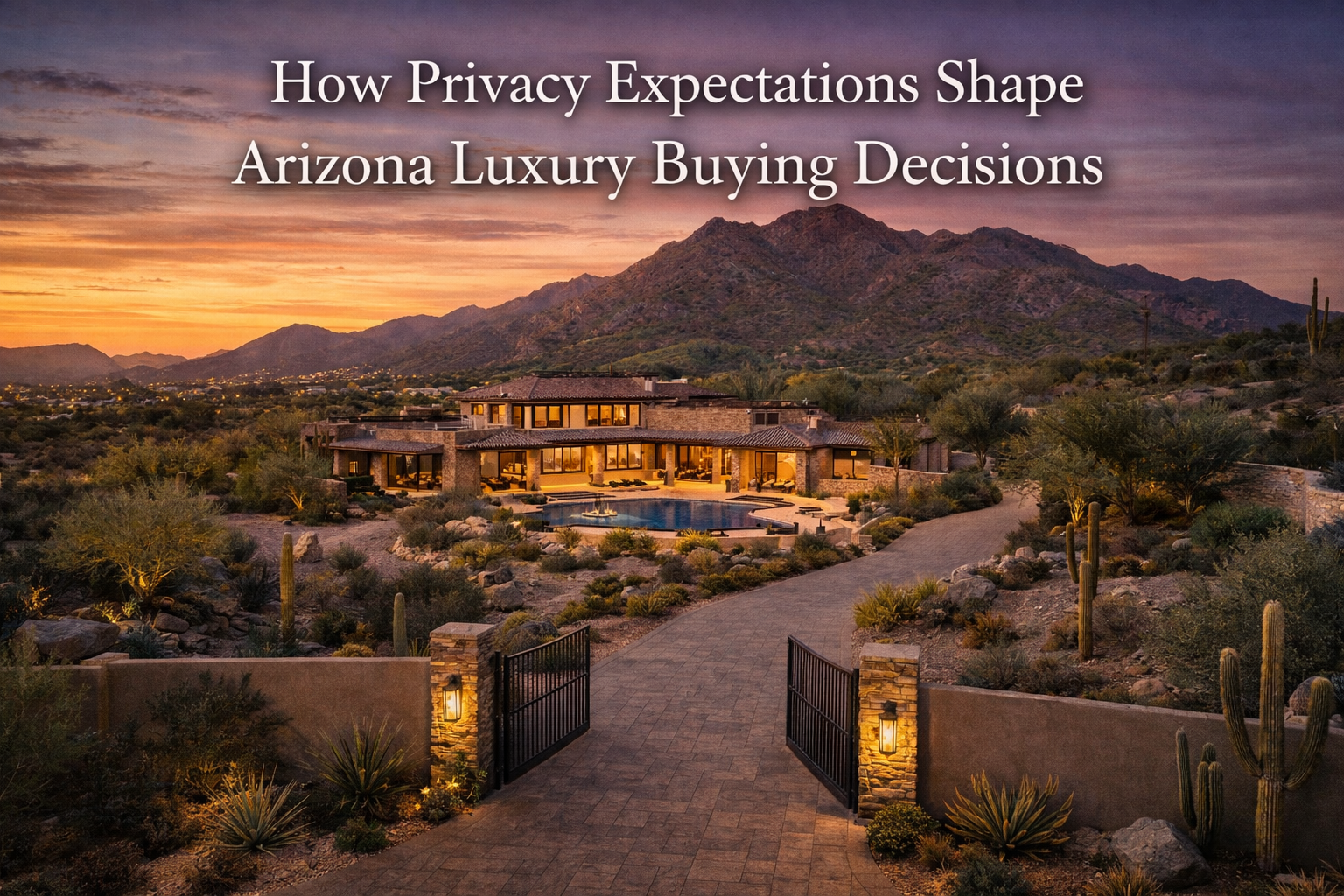
In Arizona’s high-end markets, buyers often decide whether a home is viable within minutes—based not on finishes or square footage, but on how protected, controlled, and discreet the property feels.
Mary Murphy of The Murphy Group explains:
“Luxury buyers assume beauty. What they’re really evaluating is whether the home allows them to live privately, comfortably, and without friction.”
🔒 1. Privacy Begins Before the Front Door
Luxury buyers assess privacy the moment they arrive:
- Sightlines from the street
- Distance from neighboring homes
- Gate placement and setbacks
- Ease of being seen—or not seen
If a property feels exposed on approach, buyers subconsciously downgrade it—regardless of price.
Insight: A visible home can still be luxurious, but it must feel intentional, not vulnerable.
🏜️ 2. Desert Design as a Privacy Asset
Arizona offers a unique advantage: natural privacy through terrain.
Buyers value:
- Elevation changes
- Desert washes and natural buffers
- Rock formations and mature desert landscaping
Homes that leverage the landscape feel secluded without feeling isolated.
Key Point: Privacy achieved naturally is perceived as more valuable than privacy forced through walls.
🌿 3. Outdoor Living Without Exposure
In Arizona luxury living, outdoor spaces are primary—not secondary.
Buyers evaluate:
- Pool visibility from neighbors
- Courtyard vs backyard orientation
- Outdoor kitchen placement
- Evening lighting and shadow zones
A stunning outdoor space loses appeal if it feels performative instead of personal.
Luxury Preference: Courtyards, side-yards, and inward-facing layouts consistently outperform open, exposed backyards.
🔇 4. Sound Privacy Matters as Much as Visual Privacy
High-net-worth buyers are extremely sensitive to sound:
- Road noise
- Neighbor activity
- Mechanical systems
- Echo and reflection
Silence signals control, quality, and separation from stress.
Arizona Insight: Homes near preserves, mountains, or low-density zoning often command premiums for acoustic privacy alone.
🧭 5. Neighborhood-Level Privacy Expectations
Privacy standards shift by submarket:
Scottsdale (Silverleaf, DC Ranch):
- Gated entries
- Layered setbacks
- Controlled sightlines
Paradise Valley:
- Larger lots
- Natural buffers
- Minimal visual overlap
East Valley (Chandler, Gilbert, Queen Creek):
- Strategic landscaping
- Architectural screening
- Interior courtyard design
Buyers price these differences into value—even subconsciously.
🧠 6. Privacy as a Proxy for Lifestyle Control
For luxury buyers, privacy represents:
- Freedom of movement
- Protection of family life
- Security without intrusion
- Emotional decompression
A home that compromises privacy introduces friction—and friction kills momentum.
📉 Why Privacy Gaps Kill Deals Quietly
Privacy issues rarely show up in feedback.
Instead, buyers say:
- “We’re still exploring options.”
- “It didn’t quite fit our needs.”
But what they felt was exposure, noise, or visual discomfort.
Once that feeling registers, the home is mentally disqualified.
🧭 Seller Reality Check
You can renovate kitchens.
You can update finishes.
You cannot easily fix privacy perception.
That’s why pricing, positioning, and buyer alignment must be precise from the start.
🏁 Final Takeaway
In Arizona luxury real estate, privacy isn’t about hiding.
It’s about control, calm, and confidence.
Homes that deliver it sell faster, negotiate stronger, and hold value longer.
Homes that don’t—even if beautiful—quietly lose relevance.
📲 Positioning Homes for Privacy-Conscious Buyers
From site selection to buyer matching and pricing strategy, The Murphy Group understands how privacy expectations shape real luxury decisions in Arizona.
Discover a more intentional approach to luxury buying and selling at mgsells.com
Mary Murphy
Team Leader | The Murphy Group - AZ | eXp Luxury | PLACE
or another way