

Categories
Arizona Luxury, Arizona Real Estate, Paradise Valley Luxury, Paradise Valley Real Estate, North Scottsdale homes, Luxury Home Features, East Valley, East Valley Luxury, East Valley real estate, Arizona Lifestyle, Arizona homebuyersPublished November 18, 2026
Buying an Arizona Luxury Home With a Private Elevator: What Buyers Should Evaluate

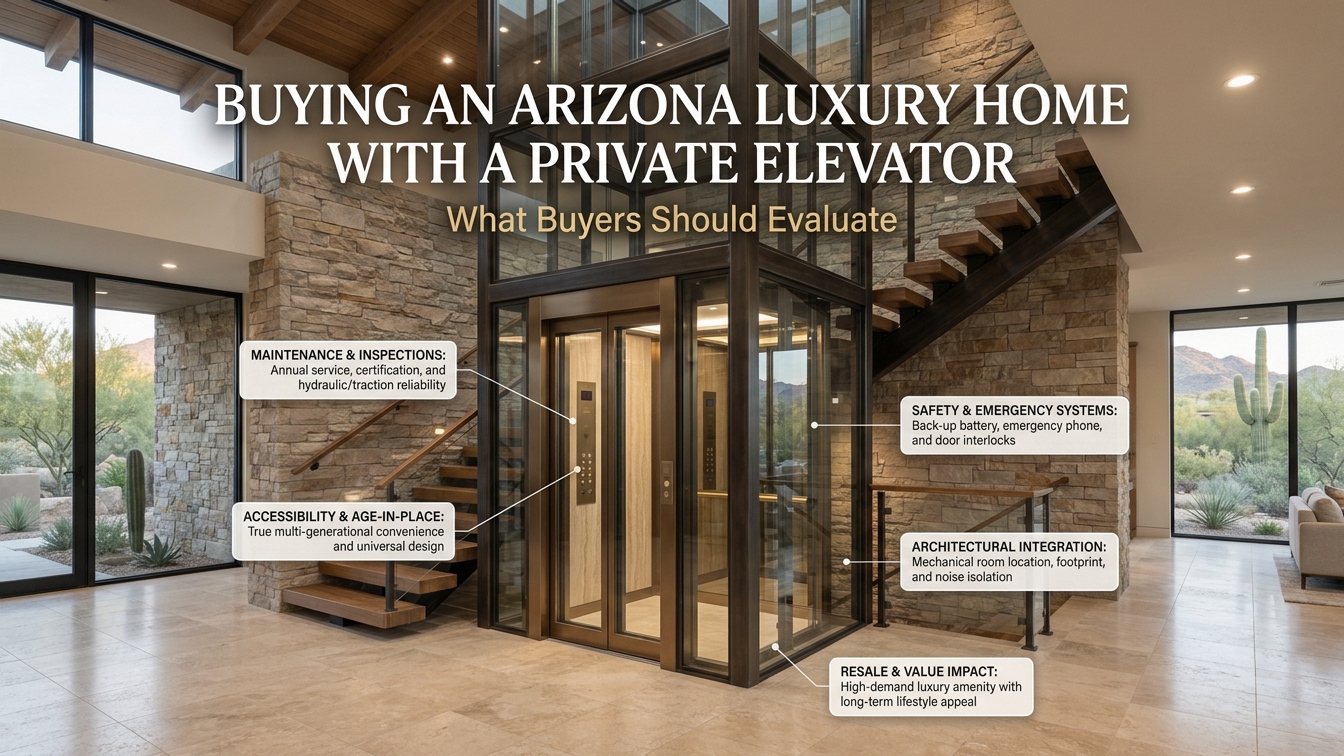
A private elevator can be one of the most practical and distinctive features of a luxury home. Beyond creating a sense of convenience and sophistication, it can make a multilevel residence more accessible, simplify everyday movement, and provide a valuable long-term feature for homeowners who want to enjoy their property comfortably as their needs change.
In Arizona's luxury real estate market, private elevators can be found in expansive custom estates, hillside residences, contemporary homes, and properties with multiple levels of living and entertaining space. In Scottsdale, Paradise Valley, North Scottsdale, and the East Valley, an elevator may connect a lower-level garage to the main living area, provide access to private bedroom suites, or link several floors of a carefully designed residence.
However, not all residential elevators are alike. Their design, capacity, operating systems, installation quality, maintenance history, and safety features can vary considerably. An elevator that looks elegant in a listing photograph may require specialized servicing, costly repairs, or upgrades that a buyer has not anticipated.
Before purchasing an Arizona luxury home with a private elevator, buyers should evaluate more than its appearance and convenience. Understanding how the system operates, how it has been maintained, and what ownership involves can help make the purchase more informed.
1. Identify the Type of Residential Elevator Installed
One of the first things buyers should establish is the type of elevator installed in the home. Residential elevators use different operating systems, and each may have distinct installation requirements, maintenance considerations, and space requirements.
Common types include:
- Hydraulic elevators: These systems use hydraulic equipment to move the elevator cab. They may require a machine room or designated equipment space, depending on the configuration.
- Traction elevators: These systems use ropes or belts and a motor-driven mechanism to move the cab. Their design and equipment requirements vary by model.
- Machine-room-less elevators: These systems are designed to reduce or eliminate the need for a separate traditional machine room, depending on the manufacturer's configuration.
- Vacuum or pneumatic elevators: These use air pressure differences to move the cab through a specially designed vertical structure.
The elevator type can affect the home's layout, equipment locations, service requirements, and future repair options.
Buyers should request the manufacturer's information, model number, installation date, and available technical documentation. They should also ask whether the elevator has undergone major upgrades or component replacements.
Knowing the system's type is an important starting point for obtaining an accurate professional inspection and estimating future maintenance costs.
2. Evaluate the Elevator's Age and Maintenance History
A private elevator is a mechanical system that requires ongoing attention. Even a relatively new installation can develop problems if it has not been maintained properly.
Before purchasing, ask the seller for available maintenance and service records. These documents can provide insight into the elevator's operating history and whether recommended servicing has been performed.
Review records for:
- Routine maintenance visits
- Repairs and replacement parts
- Electrical or control-system upgrades
- Door and safety mechanism adjustments
- Hydraulic fluid or related system servicing, where applicable
- Inspection reports and certificates
- Reported operational issues
- Previous shutdowns or recurring service calls
The elevator's age alone does not determine its condition. A well-maintained older system may be in better working order than a newer installation that has received inconsistent service.
Buyers should also ask whether the original manufacturer or a qualified service provider continues to support the model. Older equipment may have limited parts availability or require specialized technicians.
A qualified elevator professional can assess the system's current condition and identify components that may need attention.
3. Arrange a Specialized Elevator Inspection
A standard home inspection is not a substitute for an elevator-specific evaluation.
A general property inspector may be able to identify visible concerns, but a private elevator has specialized mechanical, electrical, and safety components that require appropriate expertise.
Before closing, consider arranging an inspection with a qualified elevator professional familiar with residential systems and applicable Arizona requirements.
The evaluation may include:
- Elevator movement and operating performance
- Door operation and interlocks
- Leveling accuracy at each floor
- Emergency communication equipment
- Control panels and operating buttons
- Safety mechanisms
- Electrical connections and equipment
- Machine room or machinery-space conditions
- Hoistway and pit conditions, where applicable
- Evidence of unusual noise, vibration, or wear
The inspector should also review available service records and identify any unresolved safety concerns.
If the elevator has been modified, renovated, or upgraded, ask whether the work was completed by an appropriately qualified contractor and whether required approvals and inspections were obtained.
A specialized inspection can help buyers understand whether the elevator is ready for continued use or whether repairs and additional evaluation should be part of the purchase negotiations.
4. Confirm Permits, Approvals, and Inspection Records
Documentation is particularly important when purchasing a home with a private elevator.
Buyers should determine whether the elevator was installed as part of the original construction or added through a later renovation. An installation added after the home was completed may involve structural modifications, electrical work, and changes to the property's layout.
Request available documentation, including:
- Original elevator installation plans
- Installation permits or applications
- Final inspection records
- Certificates or operating documentation, where applicable
- Records of alterations and modernization
- Electrical and structural approvals
- Contractor information
- Maintenance and inspection history
Arizona has state-level elevator safety provisions, while certain jurisdictions have their own inspection responsibilities and procedures.
For example, the City of Phoenix identifies elevator inspection services within its jurisdiction, while elevator equipment outside Phoenix is directed to the State of Arizona's elevator inspection section. Buyers should establish which authority applies to the particular property and elevator.
The applicable requirements may depend on the elevator's classification, installation date, location, and work performed.
Do not assume that a private residential elevator is exempt from all inspection or safety requirements simply because it serves one household.
5. Examine Emergency Features and Safety Systems
Safety should be one of the most important considerations when evaluating a private elevator.
An elevator must be designed and maintained to operate safely under normal conditions and provide appropriate safeguards when something goes wrong.
Buyers should ask whether the system includes and properly maintains:
- Emergency communication equipment
- Emergency lighting
- Door interlocks and safety sensors
- Emergency lowering or rescue provisions, where applicable
- Backup power or battery-supported functions, if designed into the system
- Appropriate alarm features
- Accessible emergency procedures
- Properly maintained safety controls
The exact equipment depends on the elevator's design and applicable standards.
It is also important to understand what happens during a power outage. Some systems may have emergency lowering capabilities or other backup arrangements, while others may require a different procedure.
Ask the seller or service provider to explain the emergency operation process and provide the manufacturer's instructions.
Buyers should not attempt to test emergency mechanisms themselves. These functions should be evaluated by qualified professionals.
6. Consider Arizona's Heat and the Elevator's Equipment Environment
Arizona's hot climate makes it important to examine the conditions surrounding the elevator's mechanical and electrical equipment.
Depending on the elevator design, the system may have machinery or controls located in a dedicated room, cabinet, or other designated space. If these areas are exposed to excessive heat or inadequate ventilation, the equipment may experience operating problems or require additional attention.
During due diligence, ask whether:
- The equipment area has suitable temperature management
- Ventilation is appropriate for the installed system
- Electrical components are protected from unsuitable environmental conditions
- The machinery space is clean and properly maintained
- Cooling equipment, where provided, is functioning correctly
- The manufacturer specifies particular environmental conditions
A home with a lower-level garage, hillside construction, or specialized mechanical spaces may have a different equipment arrangement from a conventional multilevel residence.
Buyers should have the elevator contractor assess whether the equipment environment is appropriate for the specific model.
7. Evaluate the Elevator's Capacity and Interior Dimensions
Not every residential elevator is designed to accommodate the same number of passengers, mobility equipment, or household items.
The elevator's rated capacity and interior dimensions should match the buyer's intended use.
Consider:
- Maximum rated load
- Interior cab width and depth
- Door opening width
- Ceiling height
- Number of floors served
- Accessibility for mobility devices
- Suitability for transporting luggage or household items
- Whether the elevator can accommodate the owner's expected needs
A compact elevator may be sufficient for everyday passenger movement but less practical for someone who expects to use a wheelchair or mobility equipment.
Buyers should not assume that a private elevator is automatically wheelchair-accessible. Door width, cab dimensions, controls, turning space, and landing arrangements all matter.
If accessibility is a priority, have the elevator and surrounding spaces evaluated against the buyer's actual requirements.
8. Inspect the Elevator Doors, Landings, and Surrounding Construction
The elevator itself is only one part of the installation. The surrounding structure also deserves careful attention.
Each floor served by the elevator should have a properly designed landing, adequate clearance, and safe access.
During the inspection, consider:
- Whether the elevator doors open and close smoothly
- Whether the cab aligns properly with each landing
- Whether the floor transitions are even
- Whether there are signs of water intrusion around the shaft
- Whether surrounding walls show cracks or unusual movement
- Whether the landing areas provide safe circulation
- Whether doors and finishes show signs of repeated impact or wear
The elevator shaft, or hoistway, is an important structural component. Buyers should ask whether any previous remodeling affected the surrounding construction.
If there are visible signs of moisture, settlement, or structural damage, a qualified contractor or structural professional may need to investigate further.
The goal is to assess the complete installation rather than focus exclusively on the cab's appearance.
9. Understand the Elevator's Power Requirements
A private elevator depends on electrical systems that must be appropriate for its equipment and intended operation.
Buyers should ask whether the elevator has a dedicated electrical supply and whether the property's electrical service can support the equipment.
Consider reviewing:
- Electrical panel capacity
- Dedicated circuits and disconnects
- Wiring and grounding
- Control-system connections
- Emergency power arrangements
- Backup battery condition, if installed
- Electrical documentation for previous upgrades
If the property has a whole-home generator, solar system, or battery storage, buyers should not automatically assume that the elevator will operate during a power interruption.
The electrician and elevator contractor should confirm whether the backup system is compatible with the elevator's electrical requirements and whether it supports the intended emergency functions.
This is especially relevant in larger estates where multiple mechanical systems may operate simultaneously.
10. Review the Ongoing Maintenance and Ownership Costs
A private elevator offers convenience, but it also creates an ongoing maintenance responsibility.
The cost of ownership can vary depending on the elevator type, age, manufacturer, usage, service arrangement, and condition of the equipment.
Potential expenses include:
- Routine service appointments
- Replacement of worn components
- Electrical and control-system repairs
- Door mechanism adjustments
- Hydraulic system servicing, where applicable
- Emergency communication maintenance
- Modernization or replacement of aging equipment
- Required inspections and associated fees, where applicable
Buyers should request a current maintenance agreement, if one exists, and ask whether it can be transferred to the new owner.
It is also worth obtaining an estimate from an elevator service company for anticipated annual maintenance and any recommended repairs.
A seller's statement that the elevator is in working condition should not replace a review of its actual service history and future maintenance needs.
11. Consider the Possibility of Future Modernization
Technology and safety expectations can change over time. A residential elevator that functions today may eventually require upgrades to its controls, doors, communication systems, or mechanical components.
Buyers should determine whether the system is approaching a stage where modernization may be advisable.
Questions to ask include:
- Is the manufacturer still supporting the model?
- Are replacement parts readily available?
- Has the control system been upgraded?
- Are the doors and operating mechanisms current?
- Has the elevator experienced recurring service issues?
- Are there recommended improvements from the current service provider?
Modernization may be more involved than replacing a visible component. Depending on the system, it can require changes to controls, wiring, machinery, or other equipment.
Understanding the elevator's modernization outlook can help buyers plan for future expenses rather than treating every repair as an unexpected event.
12. Evaluate the Elevator's Location Within the Home
A private elevator should contribute to the home's functionality, not simply serve as an impressive architectural feature.
Consider how the elevator connects the property's different living areas.
In a multilevel Scottsdale estate, for example, it may connect a lower-level garage to the main entertaining floor and upper bedroom suites. In a Paradise Valley hillside residence, it may help homeowners navigate significant changes in elevation between floors.
Consider whether the elevator provides convenient access to:
- Main living and entertaining spaces
- Primary bedroom suites
- Guest accommodations
- Home offices
- Lower-level recreation areas
- Garages and storage spaces
- Outdoor living areas, where designed for that purpose
Also consider whether the elevator's location makes sense for everyday routines. A system positioned far from the primary living areas may be less convenient than one integrated into the home's natural circulation.
Buyers should walk through each level and imagine how the elevator will be used throughout the day.
13. Assess Whether the Elevator Supports Long-Term Accessibility
For some buyers, a private elevator is primarily a luxury convenience. For others, it is an important feature that can support long-term accessibility.
A multilevel home may become more difficult to navigate as household needs change. An elevator can provide an alternative to relying exclusively on staircases, potentially allowing owners to continue enjoying more areas of the property.
However, buyers should consider accessibility beyond the elevator cab itself.
Evaluate:
- Whether elevator entrances are easy to reach
- Whether hallways and doorways provide sufficient clearance
- Whether controls are positioned conveniently
- Whether the elevator serves all essential living areas
- Whether bathroom and bedroom layouts support accessibility
- Whether exterior entrances provide suitable access
A private elevator alone does not make an entire home accessible. The property's broader layout should be considered as part of the decision.
14. Consider How the Elevator Affects Resale Appeal
A private elevator can distinguish a luxury home from other properties in its market, particularly when the system is thoughtfully integrated into the architecture.
It may appeal to buyers who prefer multilevel residences but want easier movement between floors. It can also be attractive to households with multigenerational living arrangements or long-term accessibility priorities.
However, a private elevator does not automatically increase a property's resale value by a predictable amount.
Its contribution to market appeal may depend on:
- The overall quality of the home
- The property's location
- The elevator's age and condition
- Its integration with the floor plan
- The level of demand among likely buyers
- The cost and availability of future servicing
A well-maintained elevator with clear documentation may be easier for a future buyer to evaluate than an older system with an uncertain service history.
For sellers, maintaining records and addressing known issues can help demonstrate the value and functionality of this specialized feature.
15. Look at the Entire Property, Not Just the Elevator
A private elevator can make a luxury residence more convenient, but it should be evaluated as one part of the overall property.
Buyers should still consider the home's structural condition, roof, windows, HVAC systems, plumbing, electrical service, drainage, landscaping, and other major components.
For Arizona estates, it is also important to understand the property's exposure to heat, sun, dust, and seasonal weather conditions.
If the home is located on a hillside or has multiple levels built into a sloping lot, buyers may want additional attention given to retaining walls, drainage, access, and other site-specific features.
A private elevator should complement an otherwise well-designed and properly maintained home. It should not distract buyers from other significant inspection findings.
The Murphy Group Arizona Perspective
A private elevator can be an exceptional feature in an Arizona luxury home, especially when it improves everyday convenience and supports the property's overall architectural design.
However, the most important questions often involve what buyers cannot see in the listing photographs: the condition of the machinery, the quality of the installation, the maintenance history, the safety features, and the long-term cost of ownership.
As Mary Murphy might emphasize, purchasing a luxury property means understanding how every important feature contributes to the overall living experience. A beautiful home should offer more than impressive finishes; its specialized systems should also be practical, dependable, and appropriate for the owner's needs.
For buyers considering a private elevator in Scottsdale, Paradise Valley, North Scottsdale, or the East Valley, a thorough evaluation can help distinguish a well-maintained convenience from a system that may require significant attention after closing.
The right property is one where exceptional design and everyday functionality work together.
Frequently Asked Questions
Is a private elevator worth having in an Arizona luxury home?
For buyers who prefer multilevel homes, a private elevator can provide convenience, easier movement between floors, and potential long-term accessibility benefits. Whether it is worth the additional maintenance depends on the home's layout, the buyer's lifestyle, and the condition of the elevator.
How much maintenance does a residential elevator require?
Maintenance depends on the elevator's type, manufacturer, age, usage, and condition. Buyers should request the manufacturer's maintenance recommendations and obtain a service estimate from a qualified elevator company.
Should buyers hire a separate elevator inspector?
Yes. A general home inspection does not replace a specialized elevator evaluation. A qualified elevator professional can assess the mechanical, electrical, and safety components that require specific expertise.
Do private residential elevators in Arizona require inspections?
Applicable inspection and safety requirements depend on the elevator's classification, location, installation date, and other factors. Arizona has an elevator safety program, and certain cities have their own inspection responsibilities. Buyers should confirm the requirements for the specific property with the relevant authority.
What happens to a private elevator during a power outage?
The elevator may stop operating unless it has an appropriate emergency or backup arrangement. Some systems have emergency lowering or battery-supported functions. Buyers should ask the manufacturer or service provider to explain the specific system installed in the home.
Can a private elevator accommodate a wheelchair?
Some residential elevators are designed to accommodate wheelchairs, while others have limited interior dimensions and door clearances. Buyers should verify the cab size, door opening, rated capacity, controls, and landing configuration against their accessibility needs.
Does a private elevator increase a luxury home's resale value?
It can make a property more appealing to certain buyers, especially those looking for multilevel living with added convenience or accessibility. However, its effect on resale value depends on the home's overall condition, location, design, and local buyer demand.
What documents should buyers request before purchasing a home with a private elevator?
Buyers should request available installation records, permits, inspection documentation, service reports, maintenance agreements, equipment specifications, and records of repairs or modernization. These documents can help establish the elevator's history and anticipated ownership responsibilities.
The Bottom Line
A private elevator can make an Arizona luxury home more functional, comfortable, and accessible. Whether it connects a multilevel hillside estate, a spacious contemporary residence, or a custom-built home with extensive living areas, it can be an important part of the property's overall design.
But buyers should look beyond the convenience of moving between floors. The elevator's age, operating system, inspection history, safety features, mechanical condition, electrical requirements, and maintenance costs all deserve careful evaluation.
Before purchasing, arrange a specialized elevator inspection, review the available documentation, and confirm applicable requirements with the appropriate authorities. A little additional due diligence can help prevent unexpected expenses and provide greater confidence in the property's long-term functionality.
In Scottsdale, Paradise Valley, North Scottsdale, and the East Valley, a well-designed luxury home should combine distinctive features with the practical systems that make everyday living exceptional.
Explore Arizona Luxury Real Estate With The Murphy Group Arizona
If you're considering a luxury home in Scottsdale, Paradise Valley, North Scottsdale, or the East Valley, The Murphy Group Arizona can help you look beyond the listing photos and consider the property, neighborhood, and long-term ownership experience.
From private residential elevators and multilevel floor plans to specialized home systems, accessibility features, and property maintenance considerations, a thoughtful approach to due diligence can help you make a more informed decision.
Explore Arizona luxury real estate with The Murphy Group Arizona and discover your next exceptional property.
Website: www.mgsellsarizona.com

Mary Murphy
Team Leader | The Murphy Group - AZ | eXp Luxury | PLACE
or another way