

Categories
Arizona Luxury, Arizona Real Estate, Scottsdale Real Estate, Scottsdale Housing Market, Paradise Valley Luxury, Paradise Valley Real Estate, North Scottsdale real estate, East Valley, East Valley Luxury, East Valley real estatePublished October 20, 2026
Buying an Arizona Luxury Home With a Private Art Gallery: What Collectors Should Evaluate

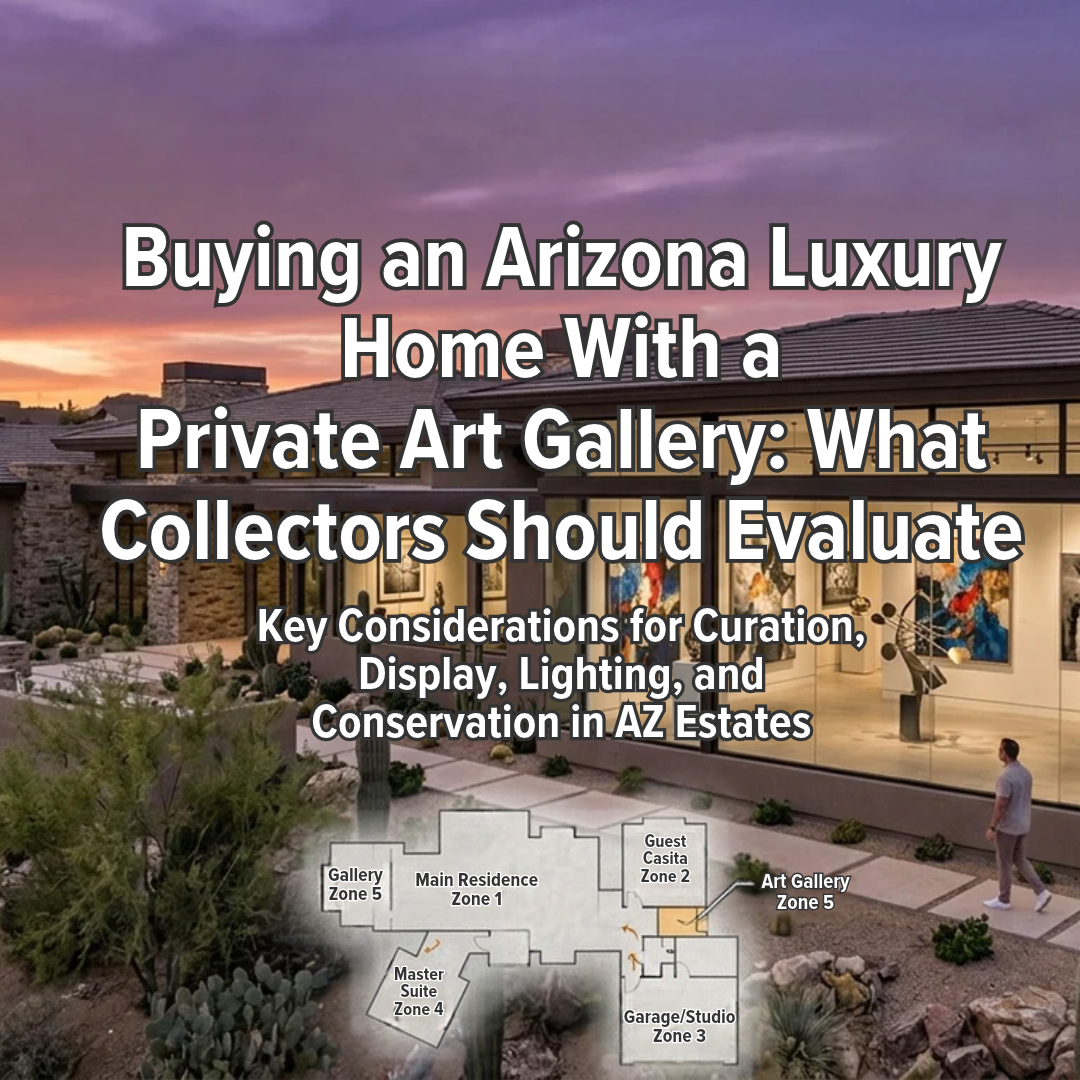
Imagine entering an Arizona luxury estate where the architecture feels like a private museum. Expansive walls showcase paintings and photography, sculptural pieces occupy carefully designed display areas, and a dedicated gallery provides an elegant setting for enjoying a personal collection.
For an art collector, this kind of residence offers more than an impressive interior. It creates an opportunity to bring personal interests, treasured acquisitions, and architectural design together in one private setting.
However, a home with a private art gallery requires a different level of evaluation than a luxury property with conventional living spaces. Artwork can be sensitive to sunlight, temperature fluctuations, humidity changes, dust, and improper handling. Security, insurance, lighting, and the room's underlying construction can also affect how effectively the property supports a collection.
In Arizona, where intense sunshine, high summer temperatures, and desert conditions can influence the indoor environment, these considerations deserve particular attention.
Whether you're exploring an estate in Scottsdale, a custom home in Paradise Valley, a contemporary residence in North Scottsdale, or a luxury property in the East Valley, understanding the gallery's design and functionality can help you make a more informed purchasing decision.
1. Evaluate the Gallery's Climate-Control Capabilities
One of the first things collectors should examine is the environmental stability of the gallery.
A conventional residential HVAC system is generally designed to maintain comfortable indoor temperatures. That does not automatically mean it can maintain the consistent environmental conditions that particular artworks may require.
Paintings, photographs, works on paper, textiles, wood-based pieces, and mixed-media installations can respond differently to changes in temperature and relative humidity. Depending on the material, repeated fluctuations may contribute to cracking, warping, fading, or other forms of deterioration.
Arizona's climate makes this an important consideration, especially in homes with substantial glass, high ceilings, or rooms exposed to direct sunlight.
Before purchasing, ask:
- Does the gallery have a dedicated HVAC zone?
- Can its temperature and humidity be monitored independently?
- Are there documented records of indoor environmental conditions?
- Does the system maintain stable conditions when the home is unoccupied?
- Is there a maintenance history for the equipment serving the gallery?
- Can the existing system accommodate the specific needs of the collection?
Do not assume that a thermostat or a recently installed air conditioner proves the room is suitable for valuable artwork. Ask an HVAC professional and a qualified art conservator to assess the space in relation to the actual collection.
For buyers planning to display sensitive or high-value pieces, the cost and feasibility of adding independent environmental controls should be considered before making an offer or finalizing a renovation budget.
2. Examine Natural Light, UV Exposure, and Gallery Lighting
Natural light can make an Arizona home feel open and inviting. Floor-to-ceiling windows, expansive glass doors, and views of the desert landscape are common attractions in luxury properties.
However, the same features can create challenges for art preservation.
Exposure to sunlight can contribute to fading and deterioration, particularly for works on paper, photographs, textiles, and certain pigments. UV-filtering glazing and window treatments may help reduce exposure, but they should not be treated as a complete solution to every lighting concern.
A well-designed gallery balances presentation with protection.
During a property tour, observe where sunlight falls throughout the day. A room that appears shaded during a morning showing may receive strong afternoon sun. Pay particular attention to west- and south-facing exposures, skylights, glass walls, and display areas close to windows.
Evaluate the gallery's lighting infrastructure as well:
- Are the fixtures adjustable to highlight different pieces?
- Can the lighting be dimmed or repositioned?
- Does the system use suitable low-UV, low-heat lighting?
- Are lighting controls flexible enough for paintings, photography, and sculpture?
- Can individual display areas be illuminated without excessive glare?
- Is there enough flexibility to accommodate future changes to the collection?
LED lighting can be useful for residential galleries, but fixture quality, positioning, intensity, and exposure duration still matter.
The ideal arrangement depends on the artwork. A bronze sculpture, an oil painting, and an antique watercolor may have different display requirements. Collectors should seek recommendations based on the actual materials and condition of their pieces rather than relying on a single lighting specification for everything.
3. Assess Wall Space, Ceiling Height, and Structural Support
A room may look like a gallery without being especially practical for displaying a serious collection.
Artwork varies considerably in size, weight, framing, and installation requirements. Large paintings may need long, uninterrupted wall sections, while substantial sculptures can require suitable floor support and carefully planned placement.
When evaluating an Arizona luxury home, consider how the gallery accommodates the pieces you already own and whether it can adapt as your collection evolves.
Look closely at:
Wall dimensions: Are there sufficient uninterrupted surfaces for large works? Built-in cabinetry, doorways, fireplaces, and architectural recesses can reduce usable display space.
Ceiling height: Tall ceilings can accommodate larger pieces and create a dramatic presentation, but they may also increase lighting, installation, and maintenance complexity.
Wall construction: Confirm whether walls can safely support heavier artwork and whether suitable reinforcement or hanging systems are installed. Decorative finishes alone do not establish load-bearing capacity.
Flooring and sculpture placement: Determine whether heavy sculptures or display plinths can be accommodated without damaging the flooring or creating circulation hazards.
Installation access: Check door widths, hallways, staircases, elevators, and loading access. Oversized artwork can be difficult to move through a residence even when the gallery itself is spacious.
If the gallery will be renovated, involve an architect, contractor, and professional art installer early in the process. Reinforcement, electrical planning, and display infrastructure are often easier to address before new finishes are installed.
4. Investigate Security Beyond the Home's Standard Alarm System
A valuable art collection can introduce security considerations that extend beyond those of a typical luxury residence.
A gated entrance, perimeter cameras, and a monitored alarm system can provide useful layers of protection. However, collectors should determine whether the gallery itself has appropriate safeguards and whether the existing system accounts for the collection's value and accessibility.
Depending on the collection, useful features may include:
- Dedicated alarm zones for gallery and storage areas.
- Door, window, and glass-break sensors.
- Motion detection in appropriate display and storage spaces.
- Secure access controls for sensitive areas.
- Monitored smoke and fire detection.
- Water-leak detection near vulnerable areas.
- Backup power or alerts for critical environmental-control equipment.
Security should also account for everyday access. Housekeepers, maintenance professionals, contractors, guests, and art handlers may all need to enter different parts of the residence.
Ask how access is managed and whether the system can provide appropriate restrictions without making the home difficult to use.
Fire protection deserves particular attention. Water from a leak, firefighting activity, or a suppression system can damage artwork.
Discuss suitable protection measures with qualified fire-protection professionals and the property's insurer. No system should be assumed appropriate for every building or collection.
The objective is not to turn a private gallery into an uncomfortable fortress. It is to ensure that security measures are proportionate to the collection and integrated into the home's design.
5. Review Fine-Art Insurance and Documentation
A luxury home may have substantial property insurance, but that does not automatically mean a valuable art collection is adequately covered.
Standard homeowners policies may impose specific limits on fine art or collectibles and may not address every risk associated with transportation, restoration, theft, or accidental damage.
Before closing, speak with an insurance professional who specializes in fine art and high-value collections.
Review the following:
Coverage limits: Determine whether the policy's limits are sufficient for the collection's total value and for individual high-value pieces.
Appraisals: Check whether current appraisals are available and whether the insurer requires particular valuation standards or periodic updates.
Scheduled works: Ask whether individual items should be listed separately rather than relying solely on a general collection limit.
Transit and installation: Confirm coverage when artwork is packed, moved, shipped, stored temporarily, or installed in the new residence.
Restoration and repair: Understand how the policy handles conservation work, restoration costs, and damage that may not result in a complete loss.
Documentation: Review inventories, photographs, provenance records, purchase documentation, and condition reports where available.
Buyers should also clarify whether existing policies can transfer, whether new coverage is needed, and whether the home's security and environmental systems meet the insurer's requirements.
These questions are especially important when a move involves multiple properties, international transportation, or a collection that will be rotated between residences.
For additional guidance, collectors can review Chubb's recommendations for protecting and preserving art collections.
6. Determine Whether the Gallery Has Appropriate Storage and Handling Space
Not every piece in a collection needs to remain on display all year.
Collectors may rotate artwork seasonally, store pieces during renovations, accommodate newly acquired works, or keep sensitive items in controlled conditions when they are not being exhibited.
A thoughtfully designed private gallery may therefore benefit from a separate storage area.
During your evaluation, consider whether the property has:
- Dedicated space for artwork that is not currently displayed.
- Suitable environmental conditions for the materials being stored.
- Secure areas with controlled access.
- Enough room for protective packaging and handling supplies.
- Clear access routes for professional art handlers.
- Space to document, inspect, and prepare works for rotation.
Avoid assuming that an ordinary closet, basement, garage, or spare bedroom is suitable for valuable artwork. Each space should be assessed for temperature stability, moisture risks, dust, security, and the particular needs of the items being stored.
If the home does not have adequate storage, determine whether a secure, professional art-storage facility would be a practical alternative.
This can be especially useful for collectors whose holdings exceed the available display space or who maintain several residences.
7. Consider the Gallery's Relationship With the Rest of the Home
A private art gallery should function as part of the residence rather than as an isolated room that is impressive but difficult to use.
The gallery's location can affect privacy, entertaining, circulation, and the daily experience of living in the home.
For example, some collectors may prefer a gallery close to the main entertaining areas so they can share their collection with invited guests. Others may want a separate wing that provides greater privacy and more controlled access.
Think about the following:
Guest circulation: Can visitors view the gallery without passing through private family areas?
Everyday functionality: Does the room remain practical when the collection changes or when the home is used for other purposes?
Privacy: Can the collection be enjoyed without exposing the rest of the property to unnecessary access?
Acoustics: Does the room's design suit quiet viewing, private gatherings, or conversations about individual works?
Flexibility: Could the space accommodate different artwork, furniture arrangements, or future lifestyle changes?
In Scottsdale and Paradise Valley, some luxury residences emphasize expansive entertaining spaces, indoor-outdoor living, and architectural statement features. In North Scottsdale and the East Valley, buyers may encounter a broader mix of contemporary custom homes, traditional estates, and newer luxury developments.
Regardless of architectural style, the important question is whether the gallery fits the way you intend to live.
8. Evaluate Arizona-Specific Property Conditions
A private gallery cannot be assessed separately from the building that houses it.
Arizona's desert environment makes the home's envelope, mechanical systems, windows, and maintenance history relevant to collection care.
During due diligence, investigate several property-specific issues.
Roof and water intrusion: Review available inspection findings and repair records. Even in a dry climate, roof leaks, plumbing failures, and water intrusion can threaten artwork and finished gallery spaces.
Window performance: Examine glazing, seals, shading systems, and signs of excessive heat near windows. A beautiful view should not come at the expense of uncontrolled exposure for sensitive pieces.
Insulation and air sealing: Ask whether the building envelope supports stable indoor conditions, particularly in rooms with extensive exterior glass or unusually high ceilings.
Mechanical equipment: Have qualified professionals assess the condition, capacity, maintenance history, and replacement needs of the systems serving the gallery.
Dust and filtration: Consider how dust enters the home and whether the filtration and maintenance arrangements are suitable for the collection.
Power interruptions: Ask how the home's critical environmental and security systems respond to outages. Backup power or remote monitoring may be appropriate for certain collections.
If the property has been vacant for an extended period, request available information about how its HVAC system was operated and whether environmental conditions were monitored while unoccupied.
These checks can help reveal whether the gallery is supported by sound building systems or whether additional work may be necessary.
9. Understand the True Cost of Owning and Maintaining a Private Gallery
A gallery's purchase price is only one part of the financial picture.
A room that already has suitable lighting, secure access, environmental monitoring, and appropriate display infrastructure may require less initial work than a room that needs substantial retrofitting. However, even a well-equipped gallery can have ongoing maintenance and operating costs.
Build a realistic budget that considers:
- HVAC servicing and potential equipment replacement.
- Humidity monitoring and any specialized environmental controls.
- Lighting maintenance and upgrades.
- Security monitoring and system maintenance.
- Insurance premiums and appraisal updates.
- Professional installation, handling, and storage.
- Wall repairs and refinishing when artwork is moved.
- Periodic conservation assessments.
- Renovations needed to accommodate future acquisitions.
Ask for records rather than relying on a seller's description of the room as “museum quality” or “gallery ready.” These terms can mean different things and do not guarantee that a space meets the needs of a particular collection.
If upgrades are needed, obtain professional assessments and written estimates before finalizing your budget. A qualified art conservator can help identify collection-specific requirements, while contractors and mechanical specialists can estimate the work needed to support them.
The most useful comparison is not simply whether one home has a more impressive gallery than another. It is whether the space delivers the functionality you need at a cost that makes sense for your ownership plans.
10. Consider Resale Appeal Without Assuming a Guaranteed Premium
A private art gallery can make a luxury property distinctive, but its effect on resale depends on the home, the buyer pool, the design, and the quality of the installation.
Some future buyers may appreciate dedicated display walls, excellent lighting, secure storage, and flexible gallery space. Others may prefer a conventional living room, study, or multipurpose area.
For that reason, collectors should evaluate the gallery as both a personal amenity and a property feature.
Features that may improve its broader usability include:
- A flexible layout that can accommodate different types of artwork.
- High-quality, neutral finishes.
- Lighting that can be adjusted or repurposed.
- Secure access without an overly restrictive layout.
- Documented maintenance of specialized equipment.
- A design that integrates naturally with the home's architecture.
Highly specialized renovations may be worthwhile for a buyer with a substantial collection, but they should not automatically be expected to increase the home's market value by the same amount as the improvement cost.
Before making major alterations, discuss the proposed work with a real estate professional familiar with the relevant luxury market.
Consider whether the gallery complements the property's overall appeal and whether the space could be adapted by a future owner.
The goal is to create a gallery that serves your collection today without unnecessarily limiting the home's usefulness tomorrow.
11. Ask the Right Questions Before Making an Offer
A private art gallery deserves its own due-diligence checklist during the home-buying process.
Before moving forward, ask the seller or listing representative for available documentation concerning the gallery's systems, construction, and maintenance.
Your checklist should include:
- HVAC service records and information about any dedicated gallery zones.
- Environmental monitoring records, if available.
- Lighting specifications and information about window treatments.
- Details about wall reinforcement or specialized hanging systems.
- Security-system documentation and monitoring arrangements.
- Records of any leaks, water intrusion, or repairs affecting the gallery.
- Information about dedicated art storage and handling access.
- Existing warranties and maintenance agreements for specialized equipment.
- Insurance requirements or documentation the seller is willing and able to provide.
- Estimates for repairs, upgrades, or modifications identified during inspections.
Not every property will have all these records, and their absence does not necessarily make a home unsuitable. It does mean you may need additional professional assessments before determining the gallery's condition and suitability.
Also clarify which equipment and built-in features will remain with the property. Do not assume that artwork, movable display systems, specialized fixtures, or other gallery-related items are included in the sale unless the purchase agreement establishes that they are.
Your real estate agent can help coordinate the property-related questions, while specialists evaluate the technical requirements of the collection.
A Murphy Group Arizona Perspective
For buyers exploring luxury real estate in Scottsdale, Paradise Valley, North Scottsdale, and the East Valley, a private art gallery can be a meaningful feature that connects architecture, personal expression, and everyday living.
However, the most important considerations often extend beyond the gallery's appearance. The room's environmental performance, lighting design, security, storage, and integration with the rest of the property all deserve careful attention.
Mary Murphy and The Murphy Group Arizona encourage buyers to look at the entire ownership experience—not just the features that make a home memorable during a showing.
A gallery that appears beautiful in listing photographs may require specialized upgrades to support a valuable collection. Conversely, a more understated room with well-planned systems and flexible display space may be a better fit for a collector's needs.
The right decision begins with understanding your collection, identifying the home's strengths and limitations, and obtaining professional advice where specialized expertise is needed.
The Bottom Line
Buying an Arizona luxury home with a private art gallery is an opportunity to create a residence that reflects your interests while providing a dedicated setting for the works you value.
Before committing, look beyond the finishes and display walls. Evaluate the gallery's climate-control capabilities, sunlight exposure, structural support, security, insurance considerations, storage options, and ongoing costs. Review the home's condition and determine whether any improvements are needed to accommodate your collection safely.
Just as importantly, consider whether the gallery complements your lifestyle and whether its design will remain practical if your needs change.
A well-informed purchase allows you to enjoy the property's architectural appeal while making a realistic plan for caring for your collection.
Exploring Arizona luxury homes with distinctive architectural features?
The Murphy Group Arizona can help you evaluate properties in Scottsdale, Paradise Valley, North Scottsdale, and the East Valley with your lifestyle, priorities, and long-term ownership goals in mind.
Visit The Murphy Group Arizona to explore luxury real estate opportunities and take the next step toward finding a home that fits the way you want to live.

Mary Murphy
Team Leader | The Murphy Group - AZ | eXp Luxury | PLACE
or another way