

Categories
Arizona Luxury, Arizona Real Estate, luxury home buying guide, North Scottsdale real estate, Scottsdale Real Estate, Scottsdale Luxury Real Estate, Paradise Valley Luxury, Paradise Valley Real EstatePublished November 11, 2026
Buying a Luxury Home With a Separate Staff Residence in Arizona: Legal and Practical Considerations

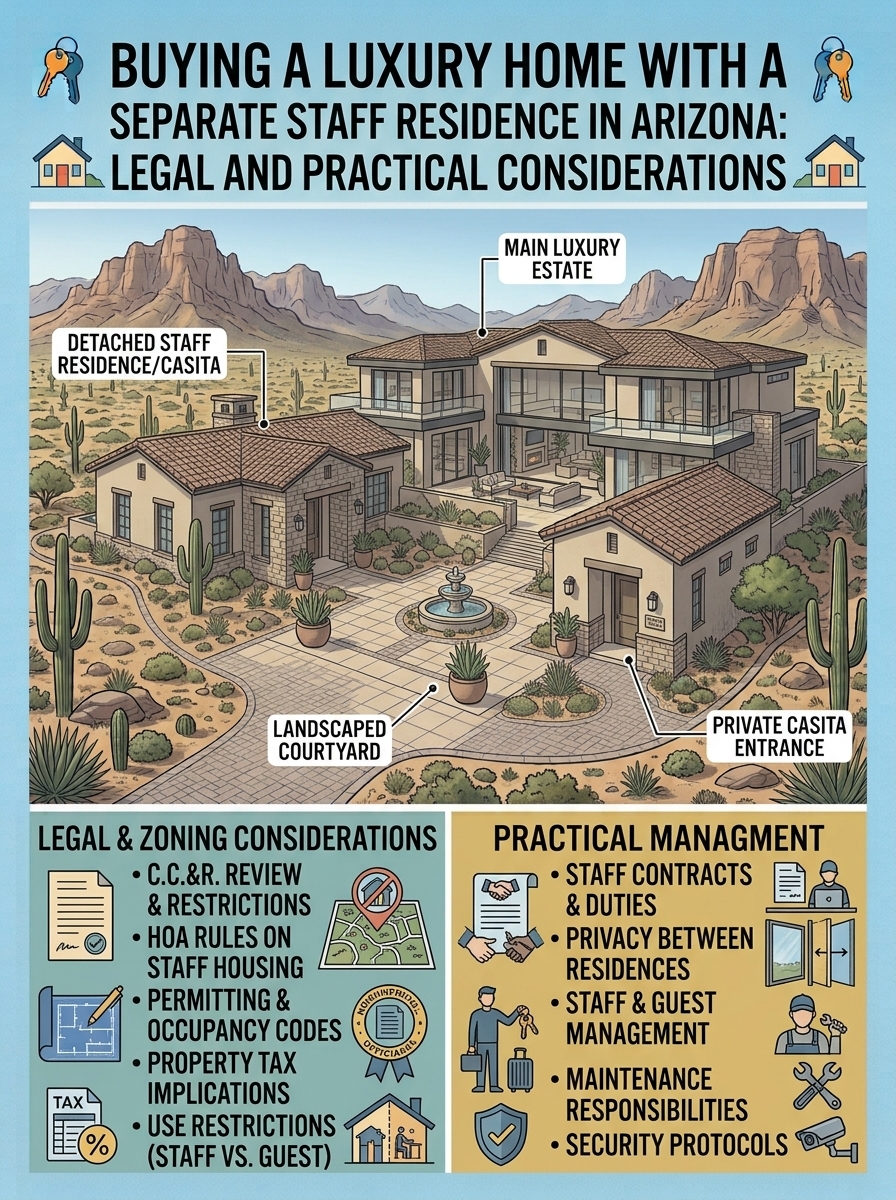
A separate staff residence can be an especially valuable feature in a luxury estate. For homeowners who employ household staff, property managers, caregivers, groundskeepers, or other live-in personnel, having a dedicated living space can provide convenience while preserving privacy within the main residence.
In Arizona, this arrangement may be found in expansive estates, custom-built homes, equestrian properties, and residences with extensive grounds. A separate structure may include a bedroom, bathroom, kitchenette, living area, private entrance, or even a fully equipped independent living space.
For buyers exploring luxury properties in Scottsdale, Paradise Valley, North Scottsdale, and the East Valley, this feature can offer meaningful flexibility. It may accommodate household employees, visiting relatives, long-term guests, or other living arrangements, depending on how the property is legally classified and what local regulations permit.
However, a structure marketed as a staff residence is not automatically approved for every possible use. Its permitted occupancy, rental potential, construction history, and relationship to the main home can depend on zoning classifications, building permits, deed restrictions, and applicable local requirements.
Before purchasing an Arizona luxury estate with a separate staff residence, buyers should understand both the practical advantages and the responsibilities that come with owning an additional living space.
1. Determine How the Separate Residence Is Legally Classified
One of the first things buyers should establish is how the additional structure is classified under the property's applicable zoning and building regulations.
A listing may describe the space as a staff residence, guest house, casita, caretaker's quarters, or detached living suite. These terms may sound interchangeable in everyday real estate conversations, but they do not necessarily have the same legal meaning.
Depending on the property's location, the structure may be classified as:
- Guest house: A secondary structure intended for guest accommodation, subject to local rules governing its use.
- Accessory dwelling unit (ADU): A self-contained additional dwelling on the same property as a primary residence, subject to applicable state and local requirements.
- Guest quarters: A designated living or sleeping area that may have restrictions on independent occupancy or kitchen facilities.
- Staff or caretaker quarters: A description of the intended use that may need to be evaluated under the property's actual zoning classification.
- Other permitted residential structure: A space approved under a specific property or zoning arrangement.
Buyers should not rely solely on the terminology used in the listing.
Request the property's approved plans, permit records, and zoning information to determine how the structure is officially recognized.
This distinction can affect whether the space may be occupied independently, rented separately, used by household employees, or modified in the future.
2. Understand Arizona's Accessory Dwelling Unit Rules
Arizona has state laws addressing accessory dwelling units, but buyers should understand that the rules are not a blanket approval for every separate residence or staff accommodation.
Arizona Revised Statutes § 9-461.18 establishes certain ADU requirements for qualifying municipalities with populations exceeding 75,000. A related provision, § 11-810.01, addresses county regulation.
The applicable rules include provisions concerning permitted ADUs on qualifying single-family residential properties, size limitations, and certain restrictions on local regulation. However, building codes, fire codes, public health and safety requirements, and private restrictions may still apply.
The classification of an existing staff residence is particularly important. A structure does not automatically qualify as an ADU simply because it has a bedroom, bathroom, and kitchen.
Buyers should verify:
- Whether the property is within a municipality or unincorporated county area
- Whether the structure qualifies as an ADU under applicable definitions
- Whether the local jurisdiction has approved the structure
- Whether the property is subject to private restrictions
- Whether the intended occupancy is consistent with the approved use
Arizona's ADU laws can provide flexibility, but the property's specific circumstances must be evaluated before buyers assume that a particular use is permitted.
3. Check Local Zoning Requirements in the Property's City or County
Arizona luxury estates may be located in different municipalities or unincorporated areas, and local regulations can vary.
A staff residence in Scottsdale may be subject to different requirements from an additional living space in Phoenix, Mesa, or an unincorporated portion of Maricopa County.
For example, Scottsdale distinguishes between guest houses and ADUs. Its published guidance explains that guest houses and ADUs have different rules involving rental use, utilities, size, and approval requirements.
This distinction matters because a separate residence intended for household staff may not have the same permitted uses as an independently rentable ADU.
Before purchasing, buyers should contact the appropriate planning or zoning department and confirm:
- The property's zoning designation
- The approved classification of the additional structure
- Whether the intended staff occupancy is allowed
- Whether separate rental use is permitted
- Whether additional approvals are necessary
- Whether any special conditions apply to the property
A local zoning review can help prevent buyers from assuming that the space can be used differently simply because it is physically separate from the main house.
4. Verify That the Structure Was Properly Permitted
A separate residence may look professionally designed and fully integrated into the estate, but its appearance does not establish that it was properly approved.
Buyers should request documentation showing that the structure was constructed in accordance with applicable requirements.
Relevant records may include:
- Building permits
- Approved architectural plans
- Electrical permits
- Plumbing permits
- Mechanical permits
- Inspection records
- Final approval or certificate documentation, where applicable
- Records of later additions or renovations
If the residence was originally built as storage space, a workshop, or another accessory structure and later converted into living quarters, buyers should investigate whether the conversion received the necessary approvals.
Unpermitted construction or changes in use can create complications when applying for insurance, making future improvements, or selling the property.
If documentation is incomplete, a qualified real estate professional, contractor, or local building department can help determine what additional verification is needed.
5. Review Any Deed Restrictions or Recorded Conditions
Some separate residences may be subject to restrictions that affect how they can be used.
These restrictions may appear in recorded deed documents, covenants, conditions and restrictions (CC&Rs), or other property-related agreements.
For example, a structure may be approved specifically as a guest house rather than as an independent rental unit.
Scottsdale's published rules distinguish between guest houses and ADUs and explain that certain guest houses constructed after January 1, 2025, must be subject to a recorded private deed restriction limiting their use to guest-house purposes.
This illustrates why buyers should review more than the property's listing description.
Ask for:
- Recorded deed restrictions
- Applicable CC&Rs
- Existing use agreements
- Any recorded restrictions involving the additional residence
- Documentation of conditions attached to prior approvals
A title professional or Arizona real estate attorney can help identify recorded restrictions and explain how they may affect the buyer's intended use.
6. Determine Whether the Residence Can Be Used Exclusively for Staff
For buyers specifically seeking live-in household accommodations, it is important to confirm whether the structure can legally serve that purpose.
A separate residence may have been approved for guest use, independent residential occupancy, or another designated purpose. Those distinctions can matter even when the space appears suitable for an employee.
Buyers should ask the local jurisdiction whether the proposed occupancy is consistent with the approved classification.
It is also worth considering whether the intended arrangement involves:
- A live-in housekeeper
- A private chef
- A groundskeeper
- A property caretaker
- A security or maintenance employee
- A caregiver
- Multiple household employees
The number of occupants, facilities provided, and intended use may affect which requirements apply.
If the buyer plans to employ someone who will live on the property, an Arizona employment attorney can help clarify any employment-related considerations associated with the housing arrangement.
7. Understand the Difference Between Employee Housing and a Rental Arrangement
A separate residence occupied by an employee may raise different practical and legal questions from one rented to an unrelated tenant.
Buyers should not assume that calling someone a staff member automatically determines the legal nature of the occupancy.
The arrangement may depend on whether the employee pays rent, whether occupancy is connected to employment, what agreements exist, and which laws apply to the specific circumstances.
Before establishing a live-in arrangement, buyers should consider:
- Is occupancy provided as part of the employment arrangement?
- Is rent charged?
- Is the residence available only while employment continues?
- Are utilities included?
- Are there written occupancy terms?
- What happens to the living arrangement if employment ends?
Arizona's Residential Landlord and Tenant Act governs many residential rental relationships. However, whether a particular employee-housing arrangement falls within the Act or another legal framework depends on the facts.
An Arizona employment or landlord-tenant attorney can help structure the arrangement appropriately.
A clear written agreement can also help prevent misunderstandings about privacy, maintenance responsibilities, household expectations, and occupancy.
8. Evaluate the Layout and Privacy Between the Main House and Staff Residence
One of the biggest practical advantages of a separate staff residence is the ability to provide accommodations without requiring employees to live within the primary household.
However, the design should support privacy for everyone.
During a property visit, evaluate:
- The distance between the main residence and the staff quarters
- Whether the residence has a private entrance
- Whether occupants can access their living space without passing through private family areas
- Whether outdoor spaces are shared
- Whether windows overlook private areas of the main home
- Whether there is adequate separation from entertaining spaces
- Whether noise from either structure may affect the other
Some estates position staff quarters near the garage or service entrance, while others place them in a separate wing or detached building.
The ideal layout depends on how the homeowner intends to use the space.
Buyers should consider both convenience and privacy rather than focusing only on the size of the additional residence.
9. Inspect the Quality and Condition of the Living Space
A separate residence should be evaluated with the same attention given to the primary home.
A beautifully maintained main house does not guarantee that the additional structure has received the same level of care.
Inspect the staff residence for:
- Roof condition
- Exterior walls and finishes
- Windows and doors
- Flooring and interior finishes
- Bathroom fixtures
- Kitchenette or kitchen equipment
- Plumbing performance
- Electrical outlets and lighting
- Heating and cooling systems
- Signs of leaks, moisture, or pest activity
If the structure includes a full kitchen, inspect its appliances, ventilation, cabinetry, and plumbing.
Buyers should also evaluate the overall quality of the living environment. A residence intended for year-round occupancy should provide suitable ventilation, temperature control, lighting, and functional facilities.
A separate inspection may be worthwhile, especially when the structure has its own mechanical or plumbing systems.
10. Review Utilities and Metering Arrangements
Utility arrangements can influence both the cost and convenience of maintaining a separate residence.
Some properties share utilities between the main house and the additional structure, while others have separate meters or sub-metering arrangements.
Buyers should identify how the property handles:
- Electricity
- Water
- Sewer
- Natural gas, where applicable
- Internet and telecommunications
- Trash collection
Ask whether utility connections were included in the original approved construction plans.
Separate metering may be relevant if the structure qualifies as an ADU, depending on the local requirements. Other classifications may have different rules.
It is also important to understand how utility expenses are currently allocated.
If the buyer intends to employ live-in staff, knowing whether utilities are shared or independently measured can make household budgeting and employment arrangements easier.
11. Evaluate Heating, Cooling, and Year-Round Comfort
Arizona's climate makes temperature control a significant consideration for any separate living space.
A staff residence may be detached from the main house and therefore rely on its own HVAC equipment.
Buyers should determine:
- Does the structure have an independent air-conditioning system?
- Is the equipment appropriately sized?
- When was the system last serviced?
- Does the residence maintain comfortable temperatures during summer?
- Are windows and exterior doors properly sealed?
- Is insulation adequate?
- Are there any areas with uneven cooling?
For detached structures, buyers should also consider how exposed the residence is to direct sunlight and whether the building has adequate shading.
If the system is older or has visible performance concerns, request a separate HVAC evaluation.
A comfortable secondary residence can be important for employee retention, household operations, and the property's overall functionality.
12. Consider Parking and Access to the Property
A separate staff residence should be convenient to reach without creating unnecessary disruption to the household.
Consider how occupants, visitors, and service providers will enter and move around the estate.
Evaluate:
- Dedicated parking availability
- Access from the main driveway
- Distance from the property's entrance
- Walkways between the residence and main house
- Lighting along access routes
- Gate access and security arrangements
- Accessibility during poor weather
- Space for service vehicles or deliveries
For large estates, it may be useful to distinguish between the primary guest entrance and the service access route.
A thoughtful layout can make everyday household operations more efficient while preserving the privacy of the main residence.
13. Review Fire Safety and Emergency Access
An additional living structure introduces safety considerations that buyers should not overlook.
The residence should be evaluated according to the applicable building and fire requirements for its classification, construction, and intended occupancy.
Depending on the property, buyers may want to review:
- Smoke alarms
- Carbon monoxide alarms, where applicable
- Fire extinguishers
- Electrical panel condition
- Safe exit routes
- Exterior lighting
- Emergency access
- Separation between structures
- Applicable fire protection systems
Buyers should also consider whether emergency responders can easily identify and reach the separate residence.
If the property has gated access, long private driveways, or multiple structures, ask whether the address and access arrangements are clear for emergency services.
A qualified inspector or fire-safety professional can help identify concerns that may not be apparent during an ordinary showing.
14. Understand Insurance and Liability Considerations
A separate residence can affect how a property should be described and insured.
Buyers should disclose the existence and intended use of the structure to their insurance provider rather than assuming that the main residence's existing policy automatically addresses every exposure.
Questions to discuss with the insurer may include:
- Is the additional structure included in the current policy?
- Is it insured as a separate dwelling or accessory structure?
- Does employee occupancy affect coverage?
- Are there special requirements for detached buildings?
- Are separate liability considerations involved?
- Would renting the residence change the coverage needed?
Buyers should also confirm whether the structure's actual condition and permitted use match the information provided to the insurer.
If the residence will house employees or tenants, discuss the arrangement with the appropriate insurance professional before occupancy begins.
15. Consider Maintenance Responsibilities and Operating Costs
A separate staff residence adds another structure to maintain.
Even when the residence is relatively small, it may have its own roof, HVAC equipment, plumbing, appliances, landscaping, and exterior finishes.
Potential ongoing expenses include:
- HVAC servicing
- Roof repairs
- Plumbing maintenance
- Electrical repairs
- Appliance replacement
- Pest control
- Exterior painting
- Landscaping
- Utility costs
- Cleaning and general upkeep
Buyers should ask whether the structure has a separate maintenance history and whether any repairs are outstanding.
If the property includes multiple buildings, it may be useful to prepare a maintenance schedule that covers both the main home and the additional residence.
Understanding the total cost of maintaining the estate can help buyers plan for ownership beyond the purchase price.
16. Consider the Property's Future Flexibility and Resale Appeal
A separate staff residence may appeal to a particular segment of luxury buyers, especially those who employ household staff or need additional private accommodation.
However, its long-term value depends on the quality of the structure, its legal classification, and the flexibility of its permitted use.
Future buyers may envision using the space for:
- Live-in household staff
- A caregiver or family support person
- Visiting relatives
- Extended-stay guests
- A private office or studio, where permitted
- An independent living arrangement, if legally approved
Buyers should not assume that all these uses are automatically permitted.
The property's zoning, recorded restrictions, building approvals, and applicable occupancy requirements may limit how the structure can be used.
A separate residence with clear documentation and a functional layout may be easier to explain and market to future buyers than one with uncertain approvals or unclear occupancy rights.
Questions Luxury Buyers Should Ask Before Purchasing
Before making an offer on an Arizona luxury estate with a separate staff residence, consider asking the seller the following:
Legal classification and approvals
- How is the additional structure officially classified?
- Is it recognized as a guest house, ADU, or another type of structure?
- Are building permits and approved plans available?
- Has the structure received final approval?
- Are there recorded deed restrictions or use limitations?
Occupancy and intended use
- Is the structure approved for independent occupancy?
- Can it be used as live-in staff accommodation?
- Is separate rental use permitted?
- Are there restrictions on the number of occupants?
- Are there existing occupancy agreements?
Construction and condition
- When was the structure built?
- Has it undergone renovations?
- Does it have its own HVAC system?
- Are plumbing and electrical systems in good condition?
- Has it experienced leaks or other maintenance problems?
Utilities and access
- Are utilities shared with the main house?
- Are separate meters installed?
- Is dedicated parking available?
- Does the residence have a private entrance?
- Is access separate from the main household areas?
Insurance and ownership
- Is the structure included in the current insurance policy?
- Are there special liability considerations?
- What are the estimated annual maintenance expenses?
- Are there outstanding repairs or upgrades?
These questions can help buyers understand whether the separate residence is a practical and legally appropriate addition to the estate.
The Murphy Group Arizona Perspective
A separate staff residence can make a luxury estate more functional, especially for homeowners who value household support, property management, and additional private accommodation.
However, buyers should look beyond the convenience of having another structure on the property. Its legal classification, approved use, construction quality, and relationship to the main residence can all influence the ownership experience.
As Mary Murphy of The Murphy Group Arizona explains:
“A luxury estate should support the way its owners live and manage their household. A separate staff residence can provide valuable flexibility, but buyers should understand how the space is approved, maintained, and intended to function before making it part of their long-term plans.”
For buyers exploring properties in Scottsdale, Paradise Valley, North Scottsdale, and the East Valley, evaluating the additional residence alongside the main home can provide a more complete picture of the estate.
The goal is to find a property where every structure contributes to the lifestyle, privacy, and functionality the buyer expects.
The Bottom Line: Verify the Use Before You Value the Space
A separate staff residence can be a meaningful advantage when purchasing an Arizona luxury estate. It can support live-in household employees, provide additional privacy, and offer flexibility for certain future living arrangements.
But buyers should not assume that every detached living space can be used interchangeably as staff quarters, a guest house, or an independent rental.
The structure's zoning classification, building approvals, recorded restrictions, occupancy arrangements, utilities, insurance, and maintenance requirements all deserve careful review.
Before closing, verify the property's approved use with the relevant local authorities and consult qualified Arizona legal and building professionals when necessary.
When the structure is properly documented and suited to the buyer's intended needs, it can become a valuable part of the overall property experience.
Explore Arizona Luxury Real Estate With The Murphy Group Arizona
If you're considering a luxury home in Scottsdale, Paradise Valley, North Scottsdale, or the East Valley, The Murphy Group Arizona can help you look beyond the listing photos and consider the property, neighborhood, and long-term ownership experience.
From separate staff residences and guest accommodations to zoning considerations, privacy, utilities, and property infrastructure, a thoughtful approach to due diligence can help you make a more informed decision.
Explore Arizona luxury real estate with The Murphy Group Arizona and discover your next exceptional property.
Website: www.mgsellsarizona.com

Mary Murphy
Team Leader | The Murphy Group - AZ | eXp Luxury | PLACE
or another way