

Categories
Arizona Luxury, Paradise Valley Luxury, Paradise Valley Real Estate, Scottsdale Luxury Real Estate, Scottsdale investment homes, North Scottsdale homes, North Scottsdale real estate, Luxury Outdoor Living, Home Buying Tips, Luxury Property Inspections, East Valley, East Valley Luxury, East Valley real estatePublished November 19, 2026
Arizona Luxury Homes With Rooftop Terraces: Privacy, Structural Limits, and Buyer Considerations

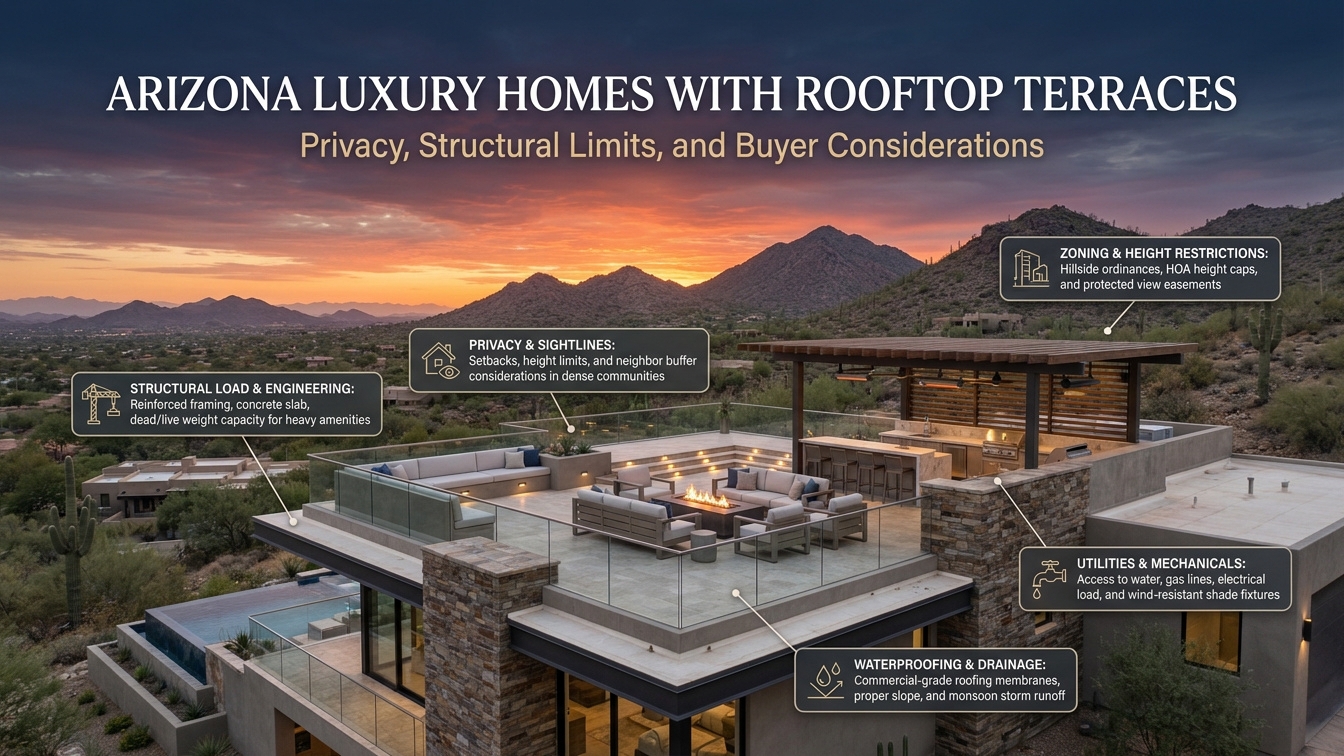
A rooftop terrace can transform an Arizona luxury home by creating an elevated outdoor retreat with expansive views, comfortable entertaining areas, and a distinctive connection to the surrounding landscape. In communities such as Scottsdale, Paradise Valley, North Scottsdale, and parts of the East Valley, rooftop living spaces can offer impressive perspectives of mountain ranges, desert scenery, city lights, and beautifully landscaped estates.
Beyond their visual appeal, rooftop terraces can provide additional outdoor living space without requiring a larger ground-level footprint. Some are designed as intimate private lounges, while others feature outdoor kitchens, shaded dining areas, fire features, built-in seating, or spaces for entertaining guests.
However, purchasing a home with a rooftop terrace requires more than appreciating its design and views. Buyers should understand how the terrace was engineered, whether the roof structure was designed for regular occupancy, how the waterproofing system protects the home, and whether the space meets applicable building and zoning requirements.
Privacy, sun exposure, wind conditions, drainage, access, and ongoing maintenance can also influence how enjoyable and practical the terrace will be.
For buyers considering an Arizona luxury property with an elevated outdoor living area, careful due diligence can help determine whether the rooftop terrace is a well-designed extension of the home or a feature that may require additional investment.
1. Evaluate the Structural Design and Weight Capacity
One of the most important considerations is whether the rooftop terrace was specifically designed to support regular human occupancy and outdoor activities.
A conventional roof and an occupiable rooftop terrace serve different purposes. A roof primarily protects the building, while a rooftop terrace must also accommodate people, furniture, planters, equipment, and potentially heavier features such as outdoor kitchens or built-in amenities.
The structure may need to support several types of loads, including:
- The weight of occupants and visitors.
- Outdoor furniture and built-in seating.
- Planters, landscaping materials, and mature vegetation.
- Outdoor kitchen equipment and appliances.
- Pergolas, shade structures, and privacy screens.
- Water features or other specialized installations.
- Wind forces acting on railings, screens, and overhead structures.
Buyers should not assume that a roof can safely accommodate additional furnishings or improvements simply because it is accessible.
A structural engineer can review the approved plans, available calculations, and existing conditions to determine whether the terrace was designed for its intended use. This is especially important if the seller has added heavy planters, outdoor kitchens, decorative masonry, or other improvements after the original construction.
Buyer consideration: Request the original structural drawings and any documentation supporting the terrace's approved occupancy and design loads. If the plans are unavailable or the space has been modified, consider an evaluation by a licensed structural engineer before closing.
2. Investigate Waterproofing and Roof Protection
A rooftop terrace must provide a comfortable outdoor surface while protecting the building underneath it from moisture intrusion.
This makes waterproofing one of the most important long-term maintenance considerations.
Unlike a conventional roof that may have limited foot traffic, a terrace experiences regular use, furniture movement, cleaning, and exposure to outdoor elements. Its surface materials and drainage system must work together to prevent water from reaching the underlying structure.
Buyers should investigate:
- The waterproofing membrane and installation history.
- The condition of the terrace's surface materials.
- Drainage outlets and water collection points.
- Flashing around walls, doors, and penetrations.
- Seals around railings and mounted fixtures.
- Expansion joints and transitions between materials.
- Signs of water staining or deterioration on ceilings below.
- Previous leak reports and repair documentation.
Pay particular attention to areas where the terrace meets exterior walls, sliding doors, parapets, and other building components. These transitions can be vulnerable if waterproofing details were not properly installed or maintained.
Arizona's monsoon season can bring periods of intense rainfall, making drainage and moisture protection especially important. A terrace that appears dry during a showing may still have drainage problems that become evident during heavy rain.
Buyer consideration: Request roofing and waterproofing records, including contractor information, product details, warranties, and previous repair invoices. A qualified roofing or waterproofing specialist can assess the system and identify concerns that may not be visible during a standard showing.
3. Assess Privacy From Neighboring Properties
An elevated outdoor space can provide impressive views, but it may also create privacy concerns that are less noticeable from ground level.
Depending on the home's position, a rooftop terrace may overlook neighboring yards, patios, balconies, or windows. Similarly, neighboring homes or elevated structures may have direct views into the terrace.
Privacy should be considered from multiple angles:
- Sightlines from neighboring second-story windows.
- Visibility from nearby balconies and rooftop spaces.
- Views from surrounding streets or public areas.
- Exposure to nearby hillside or elevated properties.
- Proximity to neighboring outdoor entertaining areas.
- Privacy between different sections of the terrace.
Architectural features can help improve privacy without completely sacrificing the views. These may include strategically positioned pergolas, decorative screens, parapet walls, privacy glazing, and carefully selected landscaping.
However, buyers should verify that proposed changes are permitted under applicable building codes, zoning requirements, and HOA restrictions. Adding a taller screen or enclosing part of the terrace may affect structural requirements, building height calculations, or other approvals.
Buyer consideration: Visit the property at different times of day and examine the terrace from the perspectives of neighboring homes and nearby public areas. Consider whether privacy improvements would be necessary and whether they are realistically achievable.
4. Understand Building Height, Zoning, and Permit Restrictions
A rooftop terrace may look like a simple outdoor improvement, but its construction and use can be affected by local building and zoning regulations.
Requirements vary by municipality, zoning district, property type, and the specific design of the structure. Buyers should not assume that a rooftop terrace approved in one Arizona community will automatically meet the requirements of another.
Relevant considerations may include:
- Maximum building height.
- Whether rooftop amenities count toward building height.
- Required setbacks and permitted projections.
- Guardrail and safety requirements.
- Permitted rooftop structures and enclosures.
- Restrictions on outdoor lighting and noise.
- Required building permits and inspections.
- HOA architectural approval.
For example, the City of Phoenix publishes its adopted building construction codes and local amendments, while Scottsdale maintains its own building code information and interpretations. These local requirements should be reviewed for the specific property rather than applying one city's standards to another.
Buyers should also distinguish between an approved rooftop terrace and an area that has simply been furnished or modified to resemble one.
A roof may be accessible through an existing stairway, but that does not establish that it was approved for regular occupancy.
Buyer consideration: Obtain approved construction plans, permit records, and final inspection documentation. If the terrace has been modified, ask the appropriate municipal department whether those changes were properly approved.
5. Examine Guardrails, Stairs, and Overall Safety
Because rooftop terraces are elevated outdoor spaces, their safety features deserve careful attention.
Guardrails, parapet walls, stairs, access doors, and lighting should be evaluated as part of the property's overall condition.
Buyers should inspect:
- The condition and stability of guardrails.
- The height and design of protective barriers.
- Openings and gaps that may present safety concerns.
- Stairway condition and handrails.
- Secure access doors and gates.
- Slip resistance of walking surfaces.
- Adequate lighting near stairs and edges.
- Drainage around walking paths.
- Potential trip hazards from raised fixtures or uneven materials.
Glass railings may offer uninterrupted views, but buyers should examine the glass panels, mounting hardware, seals, and overall installation condition. Metal railings should also be checked for corrosion, loose connections, or deterioration.
If the terrace includes built-in seating, raised planters, or decorative walls near the edge, buyers should confirm that these features do not compromise required protective barriers.
Buyer consideration: Have a qualified inspector evaluate visible safety conditions and consult the applicable building professional if guardrails, stairs, or other protective features appear altered or inadequate. Families with children, older adults, or frequent visitors should consider how the terrace will be used by everyone in the household.
6. Consider Arizona's Extreme Sun and Heat Exposure
Arizona's sunny climate makes rooftop terraces attractive for outdoor living, but the same exposure can limit how often these spaces are comfortable.
Unlike shaded patios or ground-level courtyards, rooftop terraces may receive direct sunlight for much of the day. Surfaces can become extremely hot, particularly during the summer months.
Buyers should consider:
- The direction the terrace faces.
- Hours of direct sunlight.
- Availability of natural shade.
- Heat retention of flooring materials.
- Surface temperatures around seating and walking areas.
- Protection from reflected sunlight.
- Access to cooling and electrical outlets.
- Opportunities for seasonal shade adjustments.
Materials such as stone, concrete, tile, and metal may absorb or retain substantial heat depending on their color, composition, and exposure.
A rooftop terrace that looks inviting in a morning showing may feel significantly different during a hot afternoon.
Buyer consideration: Visit the terrace at different times of day, particularly during periods when the household expects to use it. Evaluate whether existing shade features provide meaningful protection and whether additional improvements would be practical.
7. Evaluate Shade Structures and Wind Exposure
Shade structures can make a rooftop terrace more comfortable, but their design must account for the wind conditions associated with an elevated location.
Pergolas, retractable awnings, umbrellas, privacy screens, and outdoor curtains can improve usability. However, these additions may experience greater wind exposure than similar features installed at ground level.
Buyers should examine:
- Whether pergolas and shade structures are securely anchored.
- The condition of mounting brackets and hardware.
- Whether retractable awnings operate properly.
- Whether umbrellas have appropriate bases and storage arrangements.
- Whether privacy screens are stable and properly installed.
- Whether loose furniture can be secured during storms.
- Whether the terrace has a practical plan for storing removable accessories.
Arizona's monsoon season can bring strong winds, blowing dust, and sudden storms. Elevated spaces may be particularly exposed, depending on the property's location and surrounding structures.
A shade structure that is not properly designed or anchored can become a maintenance concern or create a safety hazard.
Buyer consideration: Ask whether rooftop structures were included in the original approved plans or installed later. Review permits, installation documentation, and any available maintenance records. Have questionable attachments evaluated by a qualified professional.
8. Inspect Drainage and Water Management
A rooftop terrace needs an effective drainage system to prevent standing water and protect the building envelope.
Even in Arizona's dry climate, heavy seasonal rainfall can place considerable demands on roof drains, scuppers, gutters, and surface slopes.
Buyers should look for:
- Properly positioned roof drains.
- Clear scuppers and drainage outlets.
- Adequate slope toward collection points.
- Areas where water may accumulate.
- Signs of staining around drainage components.
- Deteriorated sealants or flashing.
- Water intrusion near doors and exterior walls.
- Evidence of previous repairs or recurring leaks.
Furniture, decorative planters, and outdoor accessories can sometimes obstruct drainage pathways. Buyers should determine whether the terrace's layout allows water to move freely toward the intended drainage points.
Water management is particularly important when a terrace sits above a finished living area. A drainage problem may affect ceilings, insulation, electrical components, interior finishes, or structural materials below.
Buyer consideration: Ask a qualified roofing or building professional to evaluate the drainage system and look for evidence of previous water intrusion. Review repair records and ask whether any reported leaks have been fully resolved.
9. Review Outdoor Flooring and Surface Materials
The flooring selected for a rooftop terrace affects comfort, durability, maintenance, and the overall appearance of the space.
Luxury properties may feature natural stone, porcelain tile, concrete pavers, composite decking, or specialized exterior flooring systems.
Each material has different performance characteristics.
For example, natural stone can create an elegant appearance but may require periodic sealing or specialized maintenance. Porcelain pavers can offer a refined finish, although buyers should examine installation quality, drainage, and slip resistance. Composite decking may provide a warmer appearance underfoot, but its heat performance and expansion characteristics should be considered.
Inspect the surface for:
- Cracked or loose tiles.
- Uneven pavers.
- Deteriorated grout.
- Worn or damaged decking.
- Surface discoloration.
- Loose transition strips.
- Signs of water collecting beneath or around flooring.
- Deterioration near drains and edges.
Buyers should also determine whether the flooring system can be maintained without damaging the waterproofing membrane underneath.
Buyer consideration: Request product information and installation records when available. If flooring appears loose, cracked, or improperly sloped, have the surface and underlying waterproofing system evaluated before agreeing to repairs or replacement.
10. Examine Outdoor Kitchens, Fire Features, and Built-In Amenities
Some Arizona luxury rooftop terraces are designed as fully equipped outdoor entertaining spaces.
These may include built-in grills, refrigerators, sinks, bars, fireplaces, fire tables, televisions, speakers, and other amenities.
While these features can enhance the experience, they also introduce additional systems and maintenance responsibilities.
Buyers should investigate:
- Electrical connections and outdoor outlets.
- Gas lines and shutoff arrangements.
- Plumbing and drainage for sinks.
- Appliance condition and service history.
- Weather protection for electrical equipment.
- Ventilation and clearances around cooking equipment.
- Fire-feature installation and applicable safety requirements.
- Structural support beneath heavy built-in components.
Fire features deserve particular attention. Their location, fuel source, installation, ventilation, and clearances should be reviewed by qualified professionals.
Buyers should also consider whether the terrace has sufficient space for entertaining without obstructing walkways, stairs, or emergency access.
Buyer consideration: Request permits and installation documentation for built-in amenities. Test appliances where appropriate and confirm that gas, electrical, and plumbing systems are in suitable working condition.
11. Evaluate Lighting, Electrical Systems, and Smart-Home Features
A rooftop terrace often serves as an evening entertainment area, making lighting and electrical access important parts of its design.
Well-planned lighting can create a comfortable atmosphere while improving visibility around stairs, seating areas, and terrace edges.
Potential features include:
- Recessed architectural lighting.
- Step and pathway lighting.
- Wall-mounted fixtures.
- Landscape or planter lighting.
- Outdoor ceiling fans.
- Weather-rated electrical outlets.
- Audio and entertainment systems.
- Smart lighting controls.
- Automated shade systems.
Buyers should verify that exterior electrical components are suitable for their locations and have been installed in accordance with applicable requirements.
Look for damaged wiring, loose fixtures, exposed connections, water intrusion around outlets, and malfunctioning controls.
If the terrace includes smart-home integration, ask whether the equipment is compatible with the property's existing automation system and whether the seller will provide access information, operating instructions, and warranties.
Buyer consideration: Have a qualified electrician evaluate questionable electrical installations and test relevant systems. Confirm that the lighting and automation features can be maintained or replaced without extensive modifications.
12. Consider Noise, Lighting, and Neighbor Relationships
An elevated outdoor entertaining area can create a different relationship with neighboring properties than a conventional backyard patio.
Conversations, music, outdoor televisions, and lighting may carry beyond the property's boundaries, particularly when surrounding homes are positioned at similar elevations.
Buyers should consider:
- Proximity to neighboring bedrooms and outdoor living areas.
- Potential sound transmission across open spaces.
- Visibility of terrace lighting from nearby homes.
- Restrictions on amplified sound.
- HOA requirements for outdoor use.
- Local noise and nuisance regulations.
- Privacy concerns associated with frequent entertaining.
A terrace intended for large gatherings may require a different approach to lighting and sound than a private lounge designed for quiet relaxation.
Buyers should also consider whether outdoor speakers or entertainment systems can be controlled independently from the rest of the home.
Buyer consideration: Visit the property during the evening and observe the surrounding environment. Review HOA rules and applicable local requirements before planning frequent gatherings or installing additional lighting and entertainment equipment.
13. Understand the Maintenance and Replacement Costs
A rooftop terrace can be an impressive feature, but it requires ongoing care.
Its maintenance needs may be more involved than those of a conventional ground-level patio because the terrace is also part of the building's roof assembly.
Potential maintenance responsibilities include:
- Periodic inspection of waterproofing components.
- Cleaning roof drains and drainage outlets.
- Maintaining exterior flooring.
- Inspecting railings and mounting hardware.
- Servicing shade structures and retractable awnings.
- Cleaning outdoor kitchen equipment.
- Maintaining electrical and lighting systems.
- Checking sealants and exterior joints.
- Monitoring signs of water intrusion.
- Maintaining furniture and weather-exposed accessories.
The cost of repairs can vary depending on the terrace's size, construction, materials, accessibility, and complexity.
A minor surface repair may be relatively straightforward, while a failure in the underlying waterproofing system could require more extensive work involving the removal and replacement of finished materials.
Buyer consideration: Ask the seller for maintenance records, warranty information, and invoices for previous repairs. Consider the age and expected service life of major terrace components when preparing a long-term ownership budget.
14. Assess the Views and Their Long-Term Protection
One of the strongest attractions of a rooftop terrace is the opportunity to enjoy views that may not be available from the home's lower levels.
In Arizona, these views may include desert mountains, golf courses, city skylines, natural open spaces, or landscaped neighborhoods.
However, buyers should distinguish between the views currently available and the views that may remain available in the future.
Potential changes to the surrounding environment may include:
- New residential construction.
- Commercial or mixed-use development.
- Changes to neighboring properties.
- New landscaping or mature tree growth.
- Construction of taller structures.
- Changes to nearby public or private land uses.
A property overlooking vacant land may offer an impressive panorama today, but buyers should investigate whether that land is privately owned, designated for development, or subject to particular zoning restrictions.
Views should never be assumed to be permanently protected simply because the current surroundings appear open.
Buyer consideration: Review nearby zoning, land-use information, and development activity through the relevant municipality. For particularly important views, consider consulting a local planning professional to better understand the surrounding area's development potential.
15. Prepare a Rooftop Terrace Due Diligence Checklist
Before purchasing an Arizona luxury home with a rooftop terrace, buyers should organize their inspections and document reviews around the structure, safety features, legal approvals, and long-term maintenance requirements.
The following checklist can help guide the process:
- Confirm that the rooftop terrace was approved for regular occupancy.
- Review original architectural and structural plans.
- Verify the structural design and intended load capacity.
- Check for unpermitted additions or modifications.
- Inspect guardrails, parapets, stairs, and access points.
- Evaluate waterproofing and roofing materials.
- Inspect drainage outlets, scuppers, and surface slopes.
- Look for evidence of leaks or previous water intrusion.
- Examine flooring, pavers, and exterior finishes.
- Review pergolas, awnings, screens, and shade structures.
- Evaluate sun exposure, surface heat, and wind conditions.
- Inspect outdoor kitchen and fire-feature installations.
- Review electrical, lighting, and smart-home systems.
- Consider privacy, noise, and neighboring sightlines.
- Review HOA requirements and applicable local regulations.
- Obtain maintenance records, warranties, and repair invoices.
- Investigate surrounding land use and potential view changes.
A qualified home inspector can help identify visible concerns, while specialized evaluations from a structural engineer, roofing professional, waterproofing contractor, electrician, or other licensed professional may be appropriate depending on the terrace's design and condition.
The Murphy Group Arizona Perspective
A rooftop terrace can be one of the most memorable features of an Arizona luxury home. It creates an opportunity to enjoy the surrounding landscape, entertain guests, and experience outdoor living from an entirely different perspective.
However, its value should not be measured by the views alone. Structural integrity, waterproofing, privacy, shade, drainage, and ongoing maintenance all influence whether the space will remain enjoyable and functional over time.
As Mary Murphy might emphasize, buyers should look beyond the visual appeal of a property and consider how every feature contributes to the overall ownership experience. A beautiful rooftop terrace should complement the architecture, offer practical comfort, and provide a safe environment for everyday use.
For buyers exploring luxury homes in Scottsdale, Paradise Valley, North Scottsdale, and the East Valley, understanding the property's construction history and the surrounding neighborhood is especially important. A careful review of permits, structural documentation, roof condition, and potential privacy concerns can help prevent unexpected expenses after closing.
The goal is to find a property where the rooftop terrace is not simply an impressive architectural feature, but a thoughtfully designed extension of the home's living space.
Frequently Asked Questions
1. Are rooftop terraces common in Arizona luxury homes?
Rooftop terraces can be found in select Arizona luxury properties, particularly contemporary homes and residences designed to maximize mountain, desert, or city views. Their availability depends on architectural style, lot conditions, local regulations, and the property's design.
2. Does a rooftop terrace require a building permit in Arizona?
Permit requirements depend on the municipality, property type, construction scope, and applicable building codes. New rooftop terraces and significant structural modifications generally require professional review and may require permits and inspections. Buyers should verify the approvals associated with the specific property.
3. Can every residential roof support a rooftop terrace?
No. A conventional roof is not automatically designed to support regular occupancy, furniture, planters, or outdoor amenities. A qualified structural engineer should evaluate the structure and its approved design loads before buyers rely on the space for regular use.
4. How can buyers determine whether a rooftop terrace is structurally safe?
Buyers can request original structural drawings, engineering calculations, construction permits, and inspection records. A licensed structural engineer can review the available documentation and assess visible conditions, particularly if the terrace has undergone modifications.
5. What are the biggest maintenance concerns with rooftop terraces?
Waterproofing, drainage, roofing materials, exterior flooring, railings, and shade structures are among the most important maintenance considerations. Water intrusion can be particularly costly when a terrace is located above finished interior living space.
6. Are rooftop terraces comfortable during Arizona summers?
They can be, but comfort depends on sun exposure, shade, airflow, surface materials, and the availability of cooling features. Buyers should evaluate how much direct sunlight the terrace receives and whether its design provides adequate protection during hot weather.
7. How can homeowners improve rooftop terrace privacy?
Privacy can be improved through properly designed pergolas, architectural screens, parapet walls, privacy glazing, and landscaping where appropriate. Any proposed changes should be reviewed for structural suitability, municipal approval requirements, and HOA restrictions.
8. Can buyers add an outdoor kitchen or fire feature to an existing rooftop terrace?
Possibly, but these improvements may require structural evaluation, permits, and professional installation. Buyers should verify load capacity, electrical and gas connections, ventilation, drainage, and applicable fire-safety requirements before planning additional amenities.
9. Do rooftop terraces affect a luxury home's resale value?
They can enhance a property's appeal by providing distinctive outdoor living space and attractive views. However, their contribution to market value depends on buyer demand, construction quality, permitted use, privacy, maintenance condition, and the overall appeal of the property.
10. What professionals should inspect a rooftop terrace before closing?
Depending on the property's design and condition, buyers may need a qualified home inspector, structural engineer, roofing specialist, waterproofing contractor, electrician, and other appropriate professionals. Each can help evaluate a different aspect of the terrace's safety and performance.
The Bottom Line
Arizona luxury homes with rooftop terraces offer a distinctive way to enjoy outdoor living, panoramic views, and additional entertaining space. Whether overlooking the mountains of Scottsdale, the desert surroundings of North Scottsdale, or the city lights of the East Valley, these elevated spaces can make a property especially memorable.
However, buyers should carefully evaluate the structure, waterproofing, drainage, safety features, privacy, and maintenance requirements before purchasing.
A rooftop terrace should be more than an attractive addition to a listing. It should be properly designed, appropriately approved, structurally sound, and comfortable enough to support the homeowner's intended lifestyle.
By combining a thorough property inspection with careful review of permits, plans, and maintenance records, buyers can make a more informed decision and better understand the long-term value of this unique luxury feature.
Explore Arizona Luxury Real Estate With The Murphy Group Arizona
If you're considering a luxury home in Scottsdale, Paradise Valley, North Scottsdale, or the East Valley, The Murphy Group Arizona can help you look beyond the listing photos and consider the property, neighborhood, and long-term ownership experience.
From rooftop terraces and elevated outdoor entertaining spaces to structural considerations, waterproofing, privacy, and long-term maintenance, a thoughtful approach to due diligence can help you make a more informed decision.
Explore Arizona luxury real estate with The Murphy Group Arizona and discover your next exceptional property.
Website: www.mgsellsarizona.com

Mary Murphy
Team Leader | The Murphy Group - AZ | eXp Luxury | PLACE
or another way