

Categories
Arizona Real Estate, Arizona Luxury, Scottsdale Real Estate, Scottsdale Luxury Real Estate, Paradise Valley Luxury, Paradise Valley Real Estate, North Scottsdale homes, Arizona Lifestyle, East Valley Luxury, East Valley real estate, Arizona home buying guides, Arizona homebuyersPublished November 11, 2026
Arizona Luxury Estates With Underground Garages: What Buyers Need to Know Before Purchasing

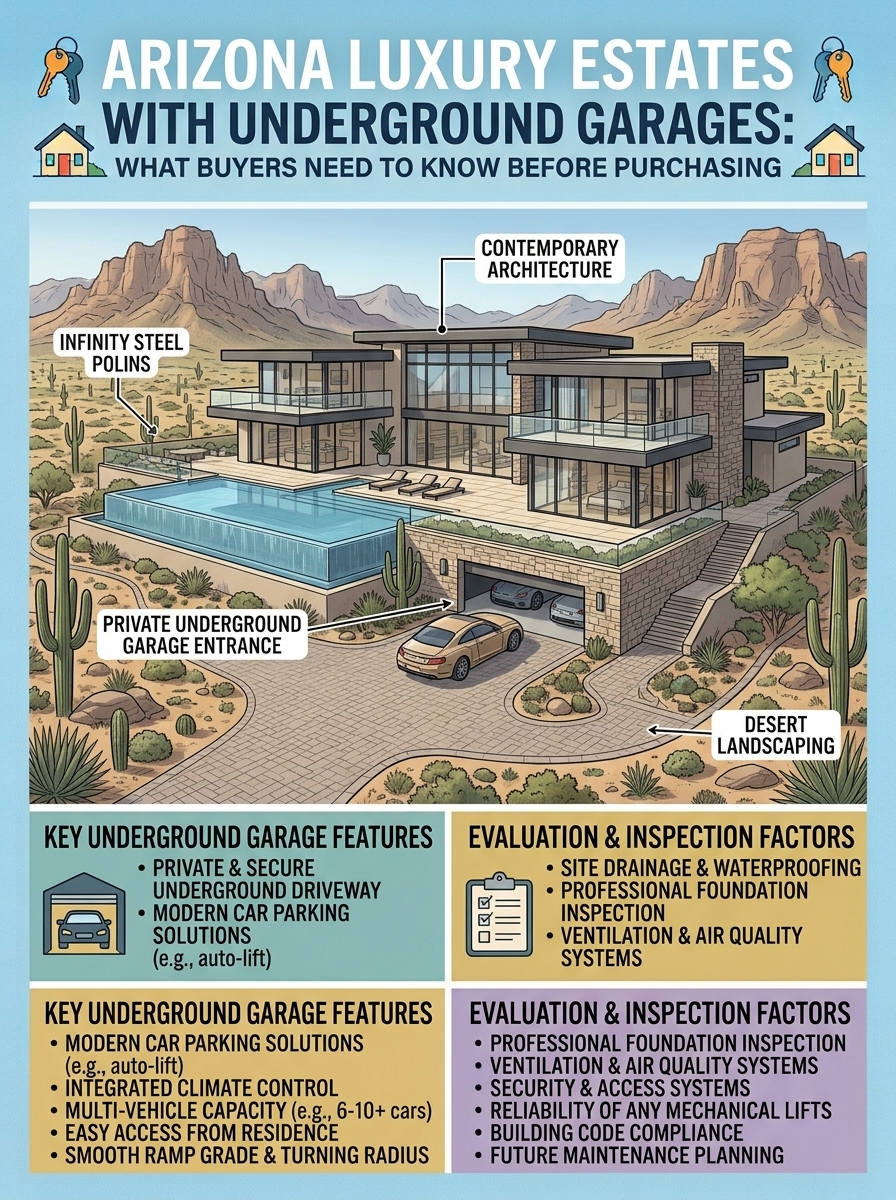
An underground garage can be one of the most distinctive features of an Arizona luxury estate. Designed to protect valuable vehicles while maintaining a clean exterior appearance, these spaces can offer privacy, additional security, and a more discreet approach to vehicle storage.
In Scottsdale, Paradise Valley, North Scottsdale, and the East Valley, underground garages may be incorporated into custom estates, hillside residences, contemporary architectural homes, and properties designed around expansive outdoor living spaces. For collectors and homeowners with multiple vehicles, the feature can provide more than a place to park. It can become an extension of the property's overall design and lifestyle.
However, an underground garage is also a specialized part of a home's construction. Unlike a conventional garage, it may involve below-grade structural walls, waterproofing systems, drainage infrastructure, mechanical ventilation, specialized access ramps, and additional electrical components.
These systems need to work together to protect the space and the vehicles stored inside.
For buyers considering an Arizona luxury estate with an underground garage, understanding how the space was designed, constructed, maintained, and equipped is an important part of due diligence.
1. Understand How the Underground Garage Was Designed
Underground garages can vary considerably in layout and construction. Some are located beneath the main residence, while others are built into a hillside or positioned below an outdoor courtyard.
The garage's location can influence its structural design, drainage requirements, accessibility, and maintenance needs.
Before purchasing, consider:
- Is the garage directly beneath the residence?
- Is it built into a hillside or below an elevated driveway?
- How many vehicles can it accommodate?
- Does it connect directly to the home?
- Are there separate storage, workshop, or utility areas?
- Is the garage designed for everyday parking or vehicle collection storage?
Buyers should also request available architectural plans and construction documentation.
Understanding the original design can help clarify how the garage relates to the rest of the property and whether later modifications may have affected its intended use.
2. Evaluate Waterproofing and Moisture Protection
Water intrusion is one of the most important concerns when evaluating any below-grade structure.
Even in Arizona, where rainfall is generally limited compared with many other parts of the country, underground garages still need effective protection against water entering through surrounding soil, walls, floor joints, and other vulnerable areas.
Water may enter through several pathways, including:
- Poorly sealed construction joints
- Cracks in below-grade walls
- Deteriorated waterproofing membranes
- Improperly sealed penetrations
- Inadequate drainage around the structure
- Water collecting near garage entrances
Buyers should look for visible signs of moisture, such as staining, peeling finishes, efflorescence, musty odors, or previous patchwork repairs.
Ask the seller whether the garage has experienced leaks or water intrusion and whether any waterproofing repairs have been completed.
A qualified professional should evaluate the condition of accessible waterproofing components and investigate any signs of moisture before closing.
3. Inspect the Drainage System
An underground garage needs a dependable drainage strategy because its position below surrounding ground levels can make it vulnerable to water accumulation.
The design may include trench drains, floor drains, sump pumps, or other drainage components, depending on the property's layout and construction.
During due diligence, buyers should determine:
- Where does water go when it enters the garage?
- Are floor drains positioned near vulnerable areas?
- Does the garage have a sump pump?
- Is there a backup system if the pump loses power?
- Are drainage channels clear and accessible?
- Has the property experienced flooding or standing water?
- Is there a documented history of drainage maintenance?
If a sump pump is installed, ask when it was last serviced and whether it has an alarm or backup power arrangement.
The drainage system should be evaluated by an appropriate professional to confirm that it is suitable for the garage's design and operating conditions.
A visually clean garage does not necessarily mean its drainage infrastructure is functioning properly.
4. Understand the Impact of Arizona's Monsoon Season
Arizona's monsoon season makes water management especially relevant when purchasing an estate with below-grade spaces.
Heavy rainfall can occur over short periods, and runoff may collect around driveways, retaining walls, hillside properties, and other areas surrounding a home.
For underground garages, the most important question is how the property manages water before it reaches the garage entrance or surrounding structure.
Buyers should examine:
- The slope of the driveway leading to the garage
- Drainage channels near the entrance
- Nearby retaining walls and landscape features
- The direction of surface runoff
- The condition of surrounding pavement
- Any visible water damage or previous flooding evidence
Properties built into hillsides deserve particular attention because their grading and drainage systems may involve more complex site conditions.
Ask whether the seller has experienced water entering the garage during heavy storms.
If possible, review maintenance records and previous repair invoices rather than relying only on verbal assurances.
5. Review Structural Walls, Slabs, and Retaining Systems
An underground garage depends on structural elements designed to support the surrounding soil and, in some cases, portions of the residence above it.
These may include reinforced concrete walls, floor slabs, retaining walls, and other structural components.
Because these elements are not always fully visible, buyers should pay attention to signs that may indicate movement, deterioration, or water-related damage.
Potential warning signs include:
- Significant or widening cracks
- Uneven or deteriorating concrete surfaces
- Water staining along wall joints
- Evidence of previous structural patching
- Doors or openings that appear misaligned
- Visible corrosion on exposed metal components
Not every crack indicates a serious structural issue. Some may be associated with ordinary concrete behavior or surface finishes. However, unexplained or concerning conditions should be evaluated by a qualified structural engineer.
Buyers should also ask whether the garage is located beneath any major living areas, terraces, pools, or other structures that may influence its structural requirements.
6. Evaluate Ventilation and Air Quality
An underground garage needs an appropriate ventilation system, particularly when it is enclosed and used for vehicle storage.
Vehicle exhaust, heat, odors, and other airborne contaminants can accumulate in spaces without adequate air movement.
Depending on the garage's design and applicable requirements, ventilation may be natural, mechanical, or a combination of both.
Buyers should ask:
- Does the garage have a dedicated ventilation system?
- Is the system designed for the garage's size and intended use?
- Are exhaust fans installed?
- Are air intake and exhaust locations appropriate?
- Are ventilation controls functioning?
- Is there a maintenance history for the equipment?
A qualified mechanical or ventilation professional can evaluate whether the system is operating as intended.
This is particularly important if the garage is connected directly to the residence or includes enclosed storage and workshop areas.
7. Check Temperature and Humidity Conditions
Arizona's hot climate makes temperature management an important consideration for luxury vehicle storage.
An underground garage may offer a more stable environment than an exposed parking area, depending on its construction and surrounding conditions. However, buyers should not assume that every underground garage is automatically climate-controlled.
Consider whether the space has:
- Dedicated air conditioning or cooling
- Mechanical ventilation
- Humidity monitoring
- Appropriate insulation
- Temperature controls
- Equipment designed for the garage's intended use
For buyers with collectible, vintage, or high-performance vehicles, the garage's environmental conditions may be especially important.
Ask whether the seller has monitored temperature or humidity levels and whether any specialized systems have been installed.
If vehicle preservation is a priority, consult an appropriate specialist about the environmental conditions recommended for the specific collection.
8. Examine the Garage Entrance and Access Ramp
The entrance is one of the most important functional elements of an underground garage.
A poorly designed or difficult-to-navigate ramp can make everyday vehicle access inconvenient, particularly for larger luxury SUVs, sports cars, or vehicles with low ground clearance.
During a property visit, evaluate:
- The slope and length of the access ramp
- Turning space at the entrance
- Clearance height
- Door width
- Surface condition and traction
- Visibility when entering and exiting
- Drainage near the bottom of the ramp
- Space for larger vehicles to maneuver
If possible, have the vehicles you intend to store assessed against the garage's actual dimensions.
A low-profile sports car, for example, may require more careful consideration of ramp transitions and clearance than a standard vehicle.
Buyers should also determine whether the entrance has a motorized door and whether its operating mechanism is functioning properly.
9. Assess Security and Access Control
An underground garage may provide an additional layer of privacy and vehicle protection, but its security depends on the systems and design features installed.
For luxury estates with valuable vehicle collections, security deserves particular attention.
Potential features include:
- Controlled garage access
- Motorized security doors
- Surveillance cameras
- Motion detection
- Alarm integration
- Access restrictions between the garage and residence
- Secure storage areas
Buyers should verify that these systems are functional and understand whether they are integrated with the home's broader security platform.
It is also worth examining how the garage connects to the main residence.
A direct interior entrance can be convenient, but buyers may want to understand whether it includes appropriate access controls and security provisions.
10. Consider Lighting and Electrical Capacity
Lighting and electrical infrastructure can significantly affect the usability of an underground garage.
A well-designed space should provide sufficient illumination for parking, walking, vehicle maintenance, and accessing storage areas.
During the inspection, consider:
- General ceiling lighting
- Lighting near parking spaces
- Stairway and doorway illumination
- Emergency lighting, where applicable
- Electrical outlet locations
- Dedicated circuits for equipment
- Electrical panel capacity
For buyers who collect electric vehicles, charging capability may be another important consideration.
Do not assume that an underground garage is already equipped for every type of electric vehicle charging installation.
Ask whether charging equipment is present, whether it is compatible with your intended vehicles, and whether the electrical system can support additional charging needs.
A licensed electrician should evaluate any proposed upgrades before buyers rely on them as part of their ownership plans.
11. Review Fire Safety and Emergency Access
An enclosed underground garage introduces safety considerations that buyers should understand before purchasing.
Depending on its size, design, and applicable requirements, the garage may have specific fire protection, detection, ventilation, and emergency access provisions.
Ask the seller for available documentation and have qualified professionals evaluate the systems that apply to the property.
Items worth reviewing may include:
- Smoke or heat detection systems
- Fire suppression equipment, where installed or required
- Emergency lighting
- Clearly accessible exits
- Ventilation controls
- Fire-rated doors or separations, where applicable
- Emergency access arrangements
Buyers should also understand how occupants can safely exit the garage if the main entrance becomes unavailable.
The appropriate systems and requirements can vary by property and jurisdiction. A qualified professional should confirm whether the installation is appropriate for the garage's specific design and use.
12. Investigate Storage, Workshop, and Additional Uses
Some luxury underground garages are designed to accommodate more than vehicle parking.
Depending on the property, they may include vehicle display areas, workbenches, storage rooms, or dedicated spaces for automotive equipment.
These additional features can be attractive, but buyers should determine whether the space is suitable for the activities they intend to pursue.
Consider:
- Is there enough room to open vehicle doors comfortably?
- Are storage areas separated from parking spaces?
- Is there adequate lighting for detailed work?
- Are electrical outlets conveniently located?
- Is ventilation suitable for the intended use?
- Are there restrictions on how the space may be used?
If the garage includes a workshop or vehicle maintenance area, ask whether the electrical, ventilation, and safety arrangements are appropriate for those activities.
A space designed primarily for parking should not automatically be assumed suitable for more intensive automotive work.
13. Review Maintenance Responsibilities and Long-Term Costs
An underground garage may require more specialized maintenance than a conventional garage.
Its ownership costs can extend beyond ordinary cleaning and door maintenance because several systems may need periodic professional attention.
Potential expenses include:
- Waterproofing repairs
- Drainage and sump pump servicing
- Mechanical ventilation maintenance
- Garage door repairs
- Lighting and electrical work
- Concrete and surface repairs
- Structural evaluations
- Security system maintenance
- Climate-control servicing
Buyers should ask the seller for maintenance records and details of any recurring problems.
If the garage includes specialized equipment, consider obtaining service estimates before closing.
It is also useful to determine whether major components are nearing the end of their expected service life.
Understanding these expenses in advance can help buyers plan for ownership rather than discovering significant maintenance needs after moving in.
14. Confirm Permits and Available Construction Documentation
An underground garage is a substantial construction feature, so buyers should review available records related to its original installation and any later modifications.
Depending on the property and jurisdiction, relevant documentation may include:
- Architectural and structural plans
- Building permits
- Inspection records
- Waterproofing specifications
- Drainage plans
- Electrical documentation
- Mechanical ventilation plans
- Records of additions or renovations
If the garage was added after the original home was built, it is especially important to understand how the work was completed and documented.
Buyers should also verify whether modifications were made to structural walls, drainage systems, electrical components, or the garage entrance.
When documentation is incomplete, consult the appropriate professionals and local authorities to determine what additional verification may be needed.
15. Consider How the Underground Garage Fits Your Lifestyle
The practical value of an underground garage depends on how well it supports the buyer's daily routines and long-term plans.
For a homeowner with a vehicle collection, it may offer a private and organized space for displaying and protecting automobiles.
For another buyer, the main benefit may be secure parking, convenient access to the home, or a more discreet exterior design.
Before purchasing, consider:
- How many vehicles will you regularly store?
- Will you need space for future additions to your collection?
- Do you own vehicles with unusual dimensions or low clearance?
- Will you use the garage for storage or automotive activities?
- Is the access route convenient for everyday use?
- Does the space connect naturally with the rest of the property?
A garage that looks impressive during a showing may not necessarily be practical for every vehicle or household.
Thinking through how you intend to use the space can help determine whether the feature genuinely adds value to your ownership experience.
Questions Buyers Should Ask Before Purchasing
Before making an offer on an Arizona luxury estate with an underground garage, consider asking the seller these questions:
Construction and history
- When was the underground garage built?
- Was it part of the original home construction?
- Are architectural and structural plans available?
- Have there been any major renovations or modifications?
Waterproofing and drainage
- Has the garage ever experienced water intrusion?
- What waterproofing system was installed?
- Are there floor drains or sump pumps?
- Have drainage components required repairs?
Mechanical systems
- Does the garage have dedicated ventilation?
- Is it climate-controlled?
- Are the mechanical systems regularly serviced?
- Are there maintenance records?
Access and security
- What are the garage's clearance height and ramp dimensions?
- Can larger or low-clearance vehicles enter comfortably?
- Are access doors and security systems functioning?
- Is there a direct entrance into the residence?
Safety and documentation
- What fire and emergency systems are installed?
- Are permits and inspection records available?
- Have any structural concerns been identified?
- Are there outstanding repairs or recommended upgrades?
These questions can help buyers identify areas that deserve further investigation before completing the purchase.
The Murphy Group Arizona Perspective
An underground garage can be an impressive feature in a luxury estate, especially for homeowners who value privacy, vehicle protection, and distinctive architectural design. However, the space should be evaluated as a specialized part of the home's construction rather than simply an upgraded parking area.
As Mary Murphy of The Murphy Group Arizona explains:
“Luxury features should add to the experience of owning a home, not create unexpected responsibilities. With an underground garage, buyers should look beyond the design and understand the systems that keep the space dry, secure, functional, and well-maintained.”
For buyers exploring luxury estates in Scottsdale, Paradise Valley, North Scottsdale, and the East Valley, a careful review of the garage's construction, drainage, ventilation, accessibility, and maintenance history can provide a clearer picture of the property's long-term ownership considerations.
The most attractive underground garage is not necessarily the largest or most elaborate. It is one that is thoughtfully designed, properly maintained, and suited to the homeowner's needs.
The Bottom Line: Evaluate the Systems Behind the Space
An underground garage can bring privacy, convenience, and a distinctive level of functionality to an Arizona luxury estate. It can also provide a dedicated environment for valuable vehicles while preserving the property's exterior design.
But before purchasing, buyers should look beyond the finished surfaces and examine the systems that make the space work.
Waterproofing, drainage, structural integrity, ventilation, temperature management, security, electrical capacity, and emergency provisions all deserve attention.
A professional evaluation of these components, supported by available construction and maintenance records, can help buyers understand the condition of the garage and anticipate future ownership responsibilities.
When these details are carefully considered, buyers can make a more informed decision about whether an estate's underground garage is truly an asset to their lifestyle.
Explore Arizona Luxury Real Estate With The Murphy Group Arizona
If you're considering a luxury home in Scottsdale, Paradise Valley, North Scottsdale, or the East Valley, The Murphy Group Arizona can help you look beyond the listing photos and consider the property, neighborhood, and long-term ownership experience.
From underground garages and vehicle storage to drainage systems, structural features, privacy, and property infrastructure, a thoughtful approach to due diligence can help you make a more informed decision.
Explore Arizona luxury real estate with The Murphy Group Arizona and discover your next exceptional property.
Website: www.mgsellsarizona.com

Mary Murphy
Team Leader | The Murphy Group - AZ | eXp Luxury | PLACE
or another way