

Categories
Arizona Luxury, Arizona Real Estate, East Valley, East Valley Luxury, luxury home buying guide, Luxury Home Building & Buyer Guides, Paradise Valley Luxury, Paradise Valley Real Estate, Scottsdale Luxury Real Estate, Scottsdale Housing Market, North Scottsdale real estatePublished October 7, 2026
Why the History of a Neighborhood Can Matter When Buying a Luxury Home

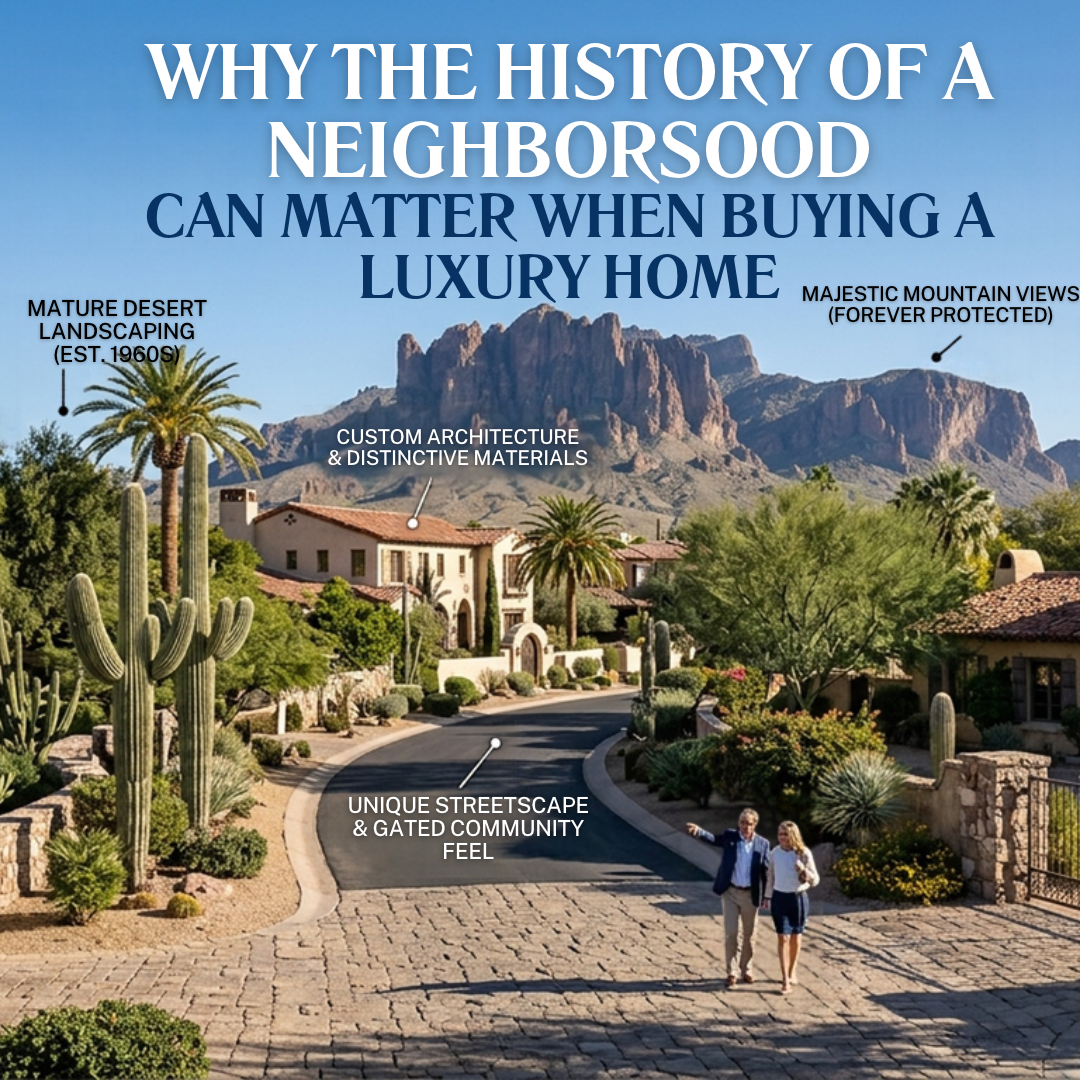
When luxury buyers search for a home, the conversation usually starts with the property.
How large is it?
Who designed it?
What are the finishes?
Does it have a pool?
How private is the backyard?
What does the view look like?
But there is another story worth understanding before making a major purchase:
The story of the neighborhood itself.
A luxury home doesn't exist in isolation.
The streets, surrounding properties, landscaping, architecture, development patterns, nearby amenities, and people who have shaped the area all contribute to the experience of living there.
And neighborhoods evolve.
What may have started as a small collection of custom homes can become one of an area's most established luxury enclaves.
An older community may develop a distinctive architectural character.
A once-remote area may become highly connected.
Formerly undeveloped land may eventually become surrounded by new construction.
Understanding that history can help buyers see something a listing cannot always communicate:
Why does this neighborhood feel the way it does today—and where could its identity go from here?
🏘️ 1. Neighborhood History Can Explain What You're Seeing Today
Every established neighborhood has a story.
Perhaps the community was developed around a particular architectural vision.
Maybe it was built for larger custom estates.
Maybe the original homes were designed around desert landscapes and mountain views.
Maybe the neighborhood gradually changed as homeowners renovated and expanded their properties.
Understanding that background can make today's streetscape easier to interpret.
The architecture, lot sizes, landscaping, setbacks, and overall atmosphere may make much more sense once you know how the community developed.
🏗️ 2. Development Patterns Can Reveal a Neighborhood's Character
Some luxury communities were developed all at once.
Others evolved gradually over decades.
That difference can be significant.
A neighborhood built in a concentrated period may have more consistent:
- Lot sizes
- Home styles
- Setbacks
- Streetscapes
- Landscaping
- Infrastructure
A neighborhood that developed over many years may contain a much broader mix of:
- Original homes
- Renovated properties
- Custom rebuilds
- New construction
- Expanded estates
Neither approach is automatically better.
But understanding the development pattern helps buyers know what kind of neighborhood experience they're purchasing.
🏡 3. Older Luxury Neighborhoods Can Have a Different Kind of Appeal
New construction often gets attention for obvious reasons.
Everything is fresh.
Technology is current.
Design trends are contemporary.
But established luxury neighborhoods can offer something different.
Large trees.
Established streetscapes.
Longstanding homes.
Distinctive architecture.
A sense of permanence.
For some buyers, that maturity is part of the appeal.
The neighborhood may feel less like a newly created development and more like a place with an identity that has developed over time.
🌳 4. Mature Landscaping Can Be Part of the Neighborhood's Story
Arizona luxury neighborhoods can change dramatically as landscaping matures.
A community that once looked relatively open may eventually become shaded and private.
Trees grow.
Hedges become established.
Landscaping fills in.
Outdoor spaces become more secluded.
That means a neighborhood's appearance today may represent decades of growth.
For buyers, mature landscaping can contribute significantly to the experience of driving down the street or approaching an estate.
🏔️ 5. The Original Relationship With the Landscape Matters
Many Arizona neighborhoods were designed with the surrounding environment in mind.
Mountains.
Desert.
Open land.
Natural washes.
Views.
Topography.
Understanding how the neighborhood originally related to its surroundings can help buyers appreciate why certain streets, lots, and homes are positioned the way they are.
It can also encourage buyers to think carefully about which surrounding features are permanent and which may change.
👀 6. A Neighborhood's History Can Help Explain Its Views
Imagine a home with a spectacular mountain or desert view.
One of the questions worth asking isn't simply:
“What can I see?”
It is:
“Why can I see it?”
Is the view created by elevation?
An undeveloped parcel?
A large setback?
The orientation of the neighborhood?
The surrounding terrain?
Understanding the area's development history can help buyers better understand the context behind a property's views.
🛣️ 7. Roads and Access Can Tell Part of the Story
Neighborhoods often evolve alongside transportation infrastructure.
Roads may be widened.
New connections may be created.
Previously quiet routes may become more heavily traveled.
New developments can change traffic patterns.
A neighborhood that once felt relatively isolated may eventually become much more connected.
That doesn't necessarily make it less desirable.
For some buyers, improved access is a benefit.
For others, quiet streets and limited traffic may be part of the appeal.
The important thing is knowing how the neighborhood has evolved.
🏙️ 8. What Was Once Nearby May Not Be Nearby Forever
Neighborhood history isn't only about what happened inside the community.
It's also about the surrounding area.
Retail centers.
Restaurants.
Schools.
Golf facilities.
Office developments.
Recreation.
Major roads.
Other residential communities.
The relationship between a luxury neighborhood and its surroundings can change considerably over time.
A location that once required a longer drive for everyday conveniences may eventually become much more connected.
That can influence both lifestyle and buyer demand.
🧭 9. Look at How the Area Has Changed Around the Neighborhood
A useful exercise is to compare the neighborhood's past with its present surroundings.
Ask:
What was here 10, 20, or 30 years ago?
What has been developed since then?
Which roads have changed?
Which amenities were added?
Which surrounding parcels remain undeveloped?
How has the character of the area evolved?
This isn't about predicting the future with certainty.
It's about recognizing patterns.
🏠 10. Original Homes Can Tell You Something About the Community
In established luxury neighborhoods, original homes can provide clues about the area's design philosophy.
Look at:
- Lot sizes
- Home orientation
- Architectural styles
- Setbacks
- Garage placement
- Outdoor living
- Landscaping
- Privacy features
Even when individual properties have been remodeled, the original neighborhood framework may still influence how the community feels.
🔨 11. Renovation History Can Reveal How Owners View the Neighborhood
Pay attention to how homes have changed.
Are owners preserving original architecture?
Are they substantially expanding?
Are older homes being replaced?
Are buyers building entirely custom estates?
Are properties being modernized while maintaining the neighborhood's character?
These patterns can provide insight into how homeowners perceive the community.
A neighborhood where owners consistently invest in properties may indicate strong long-term attachment.
🏗️ 12. New Construction Can Change an Established Neighborhood
New development isn't necessarily negative.
In many cases, it can add investment, updated infrastructure, and renewed interest.
But buyers should understand what type of change is occurring.
New construction may introduce:
- Larger homes
- Different architectural styles
- Modern landscaping
- Different lot configurations
- New traffic patterns
- Changed streetscapes
For buyers who value consistency, these changes may matter.
For buyers who prefer evolution and modernization, they may be attractive.
🔄 13. Neighborhood Turnover Can Change the Social Experience
A neighborhood's history can also include its pattern of ownership turnover.
Some communities have long-term owners.
Others experience frequent transitions.
A high level of long-term ownership can contribute to a strong sense of continuity.
Higher turnover can create a different atmosphere as new owners bring different preferences and lifestyles.
Neither is automatically better.
The important question is whether the neighborhood's social character aligns with what you want from the property.
📚 14. Historic Identity Can Create a Stronger Sense of Place
Some neighborhoods become recognizable because they develop a distinctive identity.
Perhaps it's the architecture.
Perhaps it's the landscaping.
Perhaps it's the lot sizes.
Perhaps it's the surrounding scenery.
Perhaps it's the area's connection to a particular period of development.
For luxury buyers, that identity can be part of the appeal.
You aren't simply purchasing a house.
You're purchasing membership in a particular environment.
🔎 15. Look Beyond the Current Listing
A listing tells you about one property.
Neighborhood research tells you about the environment surrounding it.
When evaluating a luxury home, consider looking at:
- Nearby properties
- Development history
- Street patterns
- Lot configurations
- Surrounding land
- Architectural consistency
- Renovation trends
- Nearby development
- Community amenities
The objective isn't to become a neighborhood historian.
It's to understand the context of your investment.
📈 16. Neighborhood Evolution Can Influence Long-Term Appeal
Real estate value is influenced by many factors, and no neighborhood history can guarantee future appreciation.
But established identity can matter.
A neighborhood that has maintained desirable characteristics over many years may have qualities that buyers continue to seek.
Those qualities could include:
- Location
- Privacy
- Lot sizes
- Architecture
- Mature landscaping
- Access
- Views
- Community character
History doesn't guarantee the future.
But it can provide useful context for understanding why a neighborhood has attracted buyers over time.
🌵 17. Arizona's Growth Makes Context Especially Important
Arizona communities continue to evolve.
Areas that once felt distant from major activity can become increasingly connected.
New communities can emerge nearby.
Infrastructure can change.
Commercial development can expand.
Population growth can reshape surrounding areas.
For luxury buyers, understanding how an established neighborhood fits into that broader evolution can help put the property in perspective.
The question isn't simply:
“Is this a desirable neighborhood today?”
It's also:
“What has made it desirable, and what characteristics are likely to remain important?”
🏡 18. Compare the Neighborhood With Your Lifestyle
History becomes most useful when connected to your priorities.
If you value privacy, look at how the neighborhood's lots and landscaping create separation.
If you value walkability or convenience, understand how the surrounding area has developed.
If you want architectural consistency, examine how much rebuilding or renovation is occurring.
If you want large lots, study how the neighborhood was originally planned.
If you value established character, look for signs of long-term continuity.
The right neighborhood isn't necessarily the most prestigious one.
It's the one whose characteristics fit your lifestyle.
🕰️ 19. Imagine the Neighborhood Ten Years From Now
After understanding its history, take the next step.
Imagine the neighborhood's future.
Which characteristics are likely to remain?
Which surrounding areas are changing?
Are older properties likely to be renovated or replaced?
Could nearby development affect traffic or views?
Will the community become more established?
Could new amenities improve convenience?
You won't have every answer.
But asking these questions can lead to better due diligence.
💬 20. Ask Why the Neighborhood Has Lasted
One of the most revealing questions a luxury buyer can ask is:
“Why do people continue to want to live here?”
The answer may not be obvious from a listing.
It could be the location.
The privacy.
The architecture.
The views.
The lot sizes.
The established landscaping.
The access.
The sense of community.
Or simply the fact that the neighborhood has a character that newer developments haven't replicated.
Understanding that reason can help buyers determine whether the neighborhood's appeal aligns with their own priorities.
💬 A Murphy Group Perspective
“When you're considering a luxury home, it's important to understand more than the property itself. The history of the neighborhood can tell you a great deal about its character, how it has evolved, and why homeowners have continued to value living there.”
— Mary Murphy, The Murphy Group
A luxury purchase is rarely just about square footage and finishes.
It's about finding the right setting for the life you want to live.
📊 The Bottom Line
A beautiful luxury home can capture your attention immediately.
But the neighborhood surrounding it can determine much of your everyday experience.
Its history can help explain:
Why the streets look the way they do.
Why the lots are configured the way they are.
Why the landscaping feels established.
Why certain views exist.
Why homeowners continue to invest.
And why buyers are attracted to the area in the first place.
History isn't a guarantee of future value.
But it can provide context that a listing sheet can't.
Before choosing your next Arizona luxury home, look beyond the walls of the estate.
Learn what came before it. Understand how the neighborhood became what it is today. Then decide whether its story is one you want to become part of.
📲 Explore Arizona Luxury Real Estate With the Neighborhood in Mind
If you're searching for a luxury home in Scottsdale, Paradise Valley, North Scottsdale, or the East Valley, The Murphy Group can help you evaluate more than the property itself.
From neighborhood character and development patterns to privacy, views, lot configuration, architecture, surrounding amenities, and long-term lifestyle considerations, understanding the broader setting can help you make a more informed luxury home decision.
Because the right luxury home isn't just located in a neighborhood. It's part of one.

Mary Murphy
Team Leader | The Murphy Group - AZ | eXp Luxury | PLACE
or another way