

Categories
Arizona architecture, Arizona Community, Arizona Real Estate, luxury home design, Scottsdale Luxury Real Estate, Scottsdale Real EstatePublished September 15, 2026
Why the Best Luxury Homes Are Designed Around Daily Routines

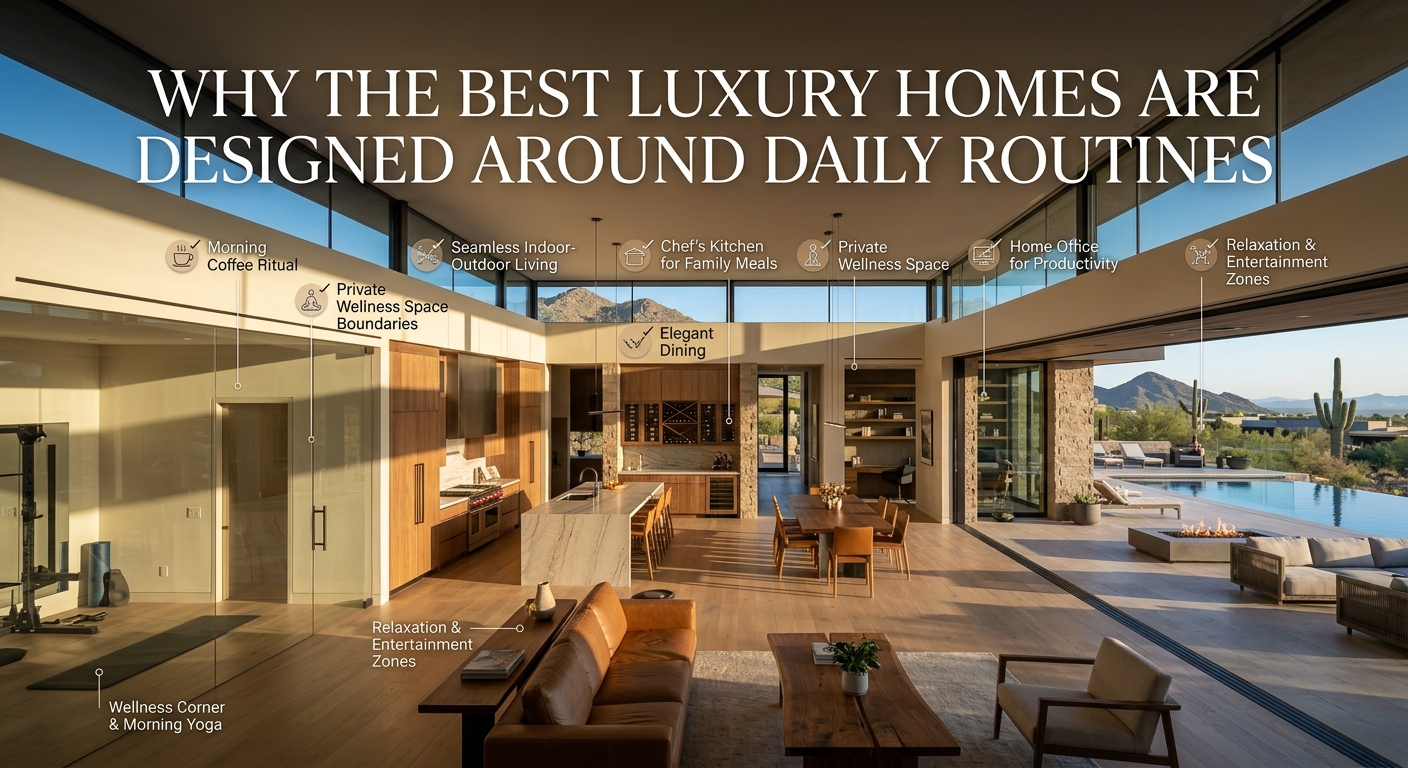
Luxury real estate is often described through dramatic features.
A spectacular view.
A resort-style pool.
A chef's kitchen.
A dramatic staircase.
A sprawling primary suite.
Floor-to-ceiling glass.
But there is another quality that can make a luxury home truly exceptional—and it is much harder to photograph.
How well does the home support the way you actually live?
The best luxury properties aren't simply collections of beautiful rooms. They are carefully designed environments that anticipate how residents move through their days.
Where do you drink your morning coffee?
Where do you exercise?
Where do you work?
Where do children gather after school?
Where do you relax at the end of the day?
How easily can you move from the kitchen to the outdoor living area?
Where do deliveries arrive?
Where does clutter disappear?
These seemingly ordinary questions can reveal extraordinary differences between a home that looks luxurious and one that feels effortless to live in.
As Mary Murphy of The Murphy Group explains:
"The most successful luxury homes aren't just beautiful when you walk through them. They make everyday life feel easier once you live there."
🏡 Luxury Is Becoming More Personal
For many luxury buyers, the definition of an ideal home has become increasingly personal.
Two buyers with the same budget may want completely different properties.
One may prioritize entertaining.
Another may want privacy and quiet.
One may need multiple workspaces.
Another may want a wellness-focused retreat.
A family may need flexible gathering areas.
A frequent traveler may value security, storage, and low-maintenance design.
This is why square footage alone doesn't tell the whole story.
The question isn't simply how much space a home has. It's how intelligently that space is used.
☀️ 1. The Morning Routine Should Influence the Floor Plan
Think about the first hour of the day.
A homeowner might:
- Wake up
- Exercise
- Shower
- Make coffee
- Check messages
- Eat breakfast
- Walk outside
- Begin working
A thoughtfully designed home can make those transitions remarkably simple.
Perhaps the primary suite connects conveniently to a private outdoor space.
Maybe the coffee station is positioned near the breakfast area.
Perhaps the wellness room is close to the primary suite.
The best layouts reduce unnecessary movement.
That's an invisible form of luxury.
☕ 2. Morning Coffee Can Become a Design Consideration
A small daily ritual can influence the way a home feels.
Some homeowners want a quiet coffee space overlooking the mountains.
Others prefer a bright kitchen island where the household naturally gathers.
A luxury home can accommodate either preference.
The important consideration is whether the architecture creates a natural place for the ritual to happen.
Instead of forcing residents to adapt to the house, the house supports the routine.
🧘 3. Wellness Spaces Should Fit Naturally Into the Day
Wellness is increasingly integrated into luxury living.
A home may include:
- Fitness rooms
- Yoga spaces
- Saunas
- Steam rooms
- Meditation areas
- Outdoor exercise spaces
- Spa-inspired bathrooms
But location matters.
A beautiful gym tucked into an inconvenient corner may not be used as often as one that naturally fits into the owner's morning routine.
Accessibility can be more important than extravagance.
💻 4. Work-From-Home Spaces Need More Than a Desk
For many luxury buyers, working from home is no longer occasional.
The ideal home office may need to support:
- Video meetings
- Concentration
- Private calls
- Document storage
- Multiple monitors
- Technology
- Client meetings
But there's another question:
How easily can the homeowner transition out of work mode?
A well-designed office can provide separation from the primary living areas without feeling disconnected from the household.
🚪 5. Circulation Matters More Than Buyers Realize
One of the easiest ways to understand a home is to walk through it as though you're living there.
Don't simply admire the rooms.
Follow the routine.
Walk from:
Bedroom → closet → bathroom → kitchen → office.
Then imagine:
Kitchen → pantry → dining → outdoor entertaining area.
Then:
Garage → storage → laundry → primary living spaces.
Does everything flow naturally?
Or do you repeatedly have to backtrack?
The best floor plans often feel intuitive because the circulation has been carefully considered.
🧺 6. Everyday Chores Need Their Own Architecture
Luxury doesn't eliminate household tasks.
Laundry still needs to be done.
Supplies need to be stored.
Packages arrive.
Trash needs to leave the home.
Outdoor equipment needs maintenance.
A well-designed property provides dedicated spaces for these activities.
That could mean:
- Large laundry rooms
- Mudrooms
- Secondary storage
- Service entrances
- Utility rooms
- Package areas
- Dedicated household organization
These spaces may not be glamorous.
But they can dramatically improve daily life.
🍽️ 7. The Kitchen Should Match How You Actually Eat
A kitchen designed primarily for entertaining can look very different from one designed around family life.
Consider:
Do you cook every day?
Do you order frequently?
Do you entertain large groups?
Do several people cook simultaneously?
Do you prefer casual meals at an island?
Do you need a separate prep kitchen?
The answers can determine whether the kitchen truly fits the household.
The most impressive kitchen isn't necessarily the biggest one.
It's the one that works.
🥂 8. Entertaining Should Feel Separate From Preparing
For homeowners who entertain regularly, the ideal experience often involves a distinction between preparation and presentation.
A prep kitchen, butler's pantry, secondary refrigerator, or discreet service route can allow the primary entertaining space to remain calm and polished.
Guests see the finished experience.
The work happens behind the scenes.
That separation can make entertaining feel considerably less stressful.
🌵 9. Arizona Homes Need to Embrace Outdoor Routines
Arizona luxury living often extends beyond the walls of the house.
Outdoor spaces may support:
- Morning coffee
- Afternoon relaxation
- Swimming
- Outdoor dining
- Evening entertaining
- Exercise
- Quiet reflection
That means the transition between interior and exterior becomes important.
Large openings, covered patios, strategically placed doors, outdoor kitchens, shaded areas, and comfortable circulation can turn outdoor living into part of the home's everyday rhythm.
🌅 10. Views Should Be Experienced, Not Just Displayed
A spectacular desert or mountain view shouldn't necessarily be reserved for the formal living room.
A thoughtfully oriented home might allow residents to experience it from:
- The primary bedroom
- Bathroom
- Kitchen
- Home office
- Breakfast area
- Outdoor spaces
This is an important distinction.
A great view is a feature. A view integrated into daily life is an experience.
🛋️ 11. Formal Rooms Still Need a Purpose
Some luxury homes contain rooms that look impressive but rarely get used.
Today's buyers may ask:
What will we actually do here?
A formal living room might become:
- A library
- A music room
- A quiet conversation space
- A gallery
- A secondary lounge
Flexibility can make a large home feel more personal.
👨👩👧👦 12. Family Routines Should Have Their Own Spaces
For families, the home's daily rhythm can be complex.
There may be:
- School mornings
- Homework
- Activities
- Meals
- Friends visiting
- Sports equipment
- Family gatherings
A well-designed home can create natural zones for these activities without allowing them to overwhelm the rest of the property.
A homework area near the kitchen, for example, can allow parents and children to remain connected while completing different activities.
🛏️ 13. Guest Areas Should Protect Both Privacy and Connection
Luxury homes often host family and friends.
The challenge is creating guest accommodations that feel connected without compromising the owner's privacy.
Separate guest suites, private entrances, strategically positioned bedrooms, and dedicated outdoor spaces can help create that balance.
A guest should feel welcome.
The homeowner should still feel at home.
🔇 14. Quiet Should Be Designed Into the Home
Daily routines also include moments when residents don't want to interact.
A person may need:
- Quiet sleep
- Focused work
- Reading time
- Meditation
- Private conversations
Bedrooms located away from high-traffic areas can make a meaningful difference.
Likewise, separating noisy spaces—such as media rooms or recreational areas—from quiet zones can improve the overall experience.
📱 15. Technology Should Support Routines Rather Than Complicate Them
Smart-home technology is most useful when it simplifies everyday life.
Consider systems that help manage:
- Lighting
- Climate
- Security
- Shades
- Entertainment
- Access
- Pool systems
The goal isn't to have the most technology.
It's to have technology that works naturally with the homeowner's routine.
A system that requires constant troubleshooting isn't particularly luxurious.
🚗 16. Arrival and Departure Should Be Easy
Think about the daily transition between home and outside life.
Where do you enter?
Where do keys go?
Where are packages delivered?
Where are shoes and bags stored?
How far is the garage from the kitchen?
Where do guests arrive?
These details can dramatically affect how a home feels every day.
The best homes often make arrival and departure almost automatic.
🌙 17. Evening Routines Deserve Just as Much Attention
Luxury design shouldn't stop at the morning routine.
Consider the final hours of the day.
Perhaps the ideal sequence is:
Dinner → outdoor seating → fire feature → primary suite → spa bathroom → quiet bedroom.
A home designed around this rhythm can create a natural sense of progression from activity to relaxation.
🏊 18. Outdoor Amenities Should Be Convenient Enough to Use
A resort-style backyard is impressive.
But how often will it actually be used?
If accessing the pool requires walking through the entire house, carrying towels across several rooms, or navigating awkward transitions, the feature may become less convenient.
Outdoor amenities work best when they are integrated into everyday circulation.
That could include:
- Nearby bathrooms
- Outdoor showers
- Towel storage
- Easy kitchen access
- Covered seating
- Direct pool access
Luxury is often about removing friction.
📐 19. Square Footage Isn't the Same as Livability
A 6,000-square-foot home can feel awkward.
A smaller home can feel remarkably spacious.
Why?
Because livability depends on:
- Proportion
- Circulation
- Sightlines
- Storage
- Natural light
- Room relationships
- Flexibility
- Daily routines
More space isn't automatically better.
Better-connected space often is.
🔍 20. Buyers Should Tour a Home Like They Already Own It
During a luxury home showing, don't simply walk from room to room.
Imagine living there.
Ask yourself:
Where would I have coffee?
Where would I work?
Where would I exercise?
Where would my guests gather?
Where would I put deliveries?
Where would I store seasonal items?
How would I move through the house at night?
Where would I go when I want complete privacy?
These questions can reveal details that photographs and listing descriptions rarely capture.
💎 The Difference Between Impressive and Exceptional
An impressive luxury home can make you say:
"Wow."
An exceptional luxury home makes you think:
"I could live here."
That's a very different reaction.
The first is about visual impact.
The second is about connection.
And for many sophisticated buyers, the second may ultimately matter more.
💼 How The Murphy Group Helps Buyers Look Beyond the Showpiece
The Murphy Group understands that luxury real estate is about more than impressive finishes and high-end amenities.
When evaluating a property, buyers can benefit from considering:
- How the floor plan supports their lifestyle
- How rooms connect
- Where daily tasks happen
- How privacy is maintained
- How indoor and outdoor spaces interact
- Whether the property can adapt over time
- Which features genuinely improve everyday living
Because the right luxury home isn't simply the one with the longest feature list.
It's the one that fits the life you want to live.
As Mary Murphy puts it:
"A home becomes truly luxurious when the design starts anticipating your needs instead of asking you to work around the design."
📊 The Bottom Line
The best luxury homes aren't necessarily designed around grand rooms.
They're designed around real life.
Morning routines.
Work.
Family time.
Wellness.
Entertaining.
Privacy.
Relaxation.
Outdoor living.
Even the small transitions between those moments matter.
When architecture supports those routines naturally, luxury becomes something you experience every day—not something you simply see during a showing.
The ultimate luxury may be a home that feels like it was designed specifically for you.
📲 Discover a Luxury Home That Fits Your Lifestyle
If you're searching for a luxury home in Scottsdale, Paradise Valley, North Scottsdale, or the East Valley, The Murphy Group can help you look beyond the obvious features and evaluate how a property truly fits the way you live.
The right home should not simply impress you when you walk through the door.
It should make sense for your life once you close it.
Visit The Murphy Group's Arizona luxury real estate website to explore available properties and discover a home designed around the lifestyle you want.

Mary Murphy
Team Leader | The Murphy Group - AZ | eXp Luxury | PLACE
or another way