

Categories
Arizona architecture, Arizona Luxury, Arizona Real Estate, East Valley Luxury, East Valley real estate, luxury home buying guide, Luxury Home Trends Arizona, Luxury planning real estate, North Scottsdale homes, North Scottsdale real estate, Paradise Valley Luxury, Paradise Valley Real Estate, Scottsdale Luxury Real Estate, Scottsdale Real EstatePublished September 28, 2026
The Resale Challenge of Highly Personalized Luxury Homes

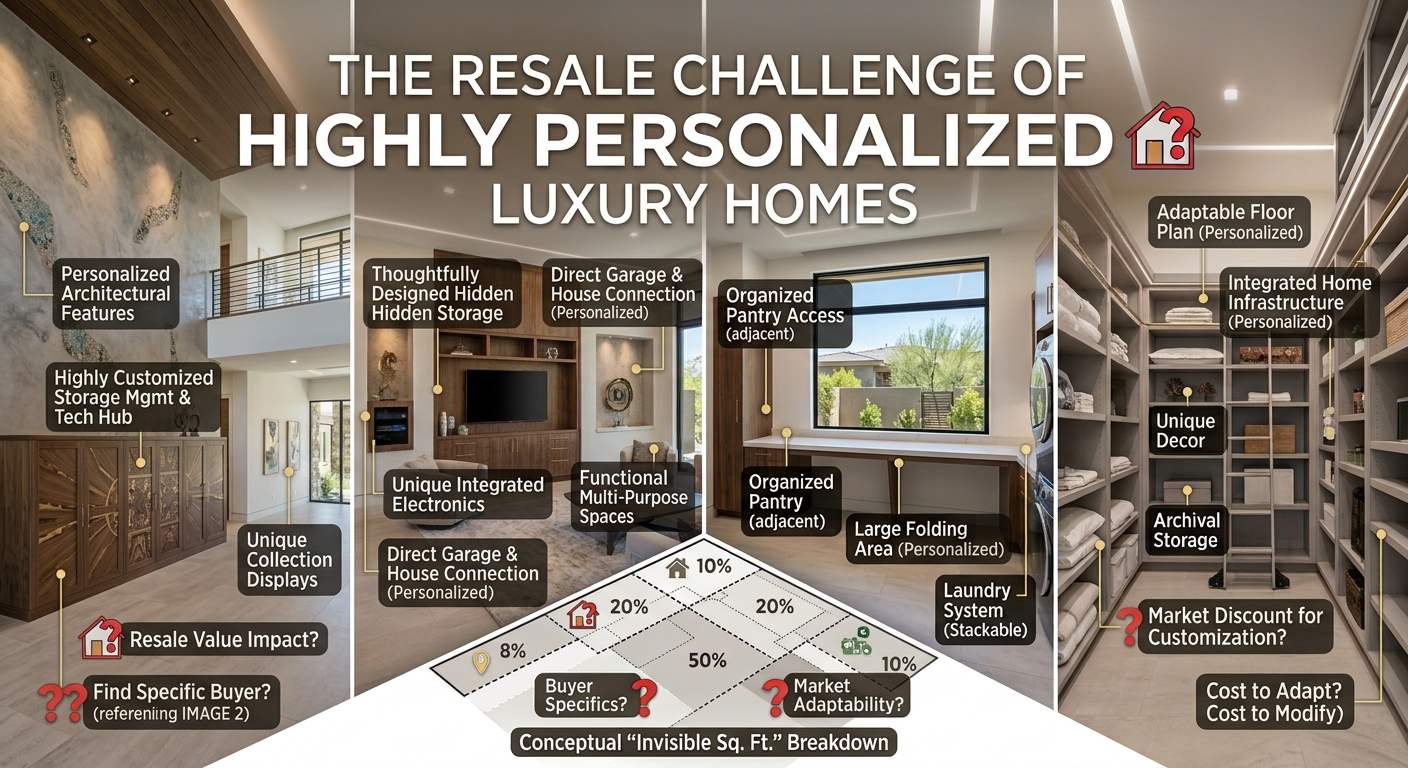
One of the greatest privileges of owning a luxury home is the ability to make it your own.
A homeowner can design a private wine room.
Build a custom recording studio.
Create a dedicated car gallery.
Install a dramatic home theater.
Transform a bedroom into a private spa.
Design a highly specialized office.
Or build an outdoor entertaining environment unlike anything else in the neighborhood.
For the current owner, these features can make the property feel extraordinary.
But eventually, circumstances may change.
The owner may relocate.
The family may grow or become smaller.
A career may change.
A property may become an investment rather than a primary residence.
And suddenly, a question emerges:
What happens when a luxury home designed around one person's lifestyle needs to appeal to someone else's?
This is where highly personalized luxury homes can face a unique resale challenge.
The very features that made the home special to one owner may not carry the same meaning for the next buyer.
That doesn't mean personalization is a mistake.
It means luxury homeowners should understand the difference between personal expression and long-term adaptability.
🎨 1. Personalization Is One of the Great Benefits of Luxury Ownership
Luxury homes often provide something conventional properties cannot:
The opportunity to customize.
A homeowner may have the resources to create spaces around very specific interests and routines.
That could include:
- Custom libraries
- Wine cellars
- Art studios
- Private gyms
- Recording spaces
- Golf simulators
- Car collections
- Home theaters
- Wellness suites
- Professional-grade kitchens
For the person using the space every day, the value can be substantial.
The challenge only becomes apparent when the property enters the resale market.
🏠 2. A Highly Specialized Room Has a Narrower Audience
Consider two rooms.
One is a flexible bonus room with excellent natural light.
The other is a highly customized recording studio with specialized acoustic construction.
The studio may be far more valuable to a musician.
But the flexible room may appeal to a much broader range of buyers.
This is an important distinction in luxury real estate.
Cost does not always equal universal market appeal.
A homeowner can spend significantly on a specialized feature without creating an equivalent increase in resale value.
🍷 3. The Same Is True for Entertainment Spaces
A luxury homeowner may love entertaining and create an elaborate space around that lifestyle.
Perhaps the home includes:
- A dedicated wine room
- A large bar
- Multiple entertainment lounges
- A professional kitchen
- A theater
- An outdoor party area
For one buyer, this could be the perfect property.
For another, some of those spaces may rarely be used.
The question becomes whether the spaces can be repurposed without substantial reconstruction.
🚗 4. Car Collections Can Create a Similar Resale Question
A luxury homeowner with an extensive vehicle collection may design a garage around the cars.
That could include:
- Climate-controlled storage
- Display lighting
- Specialized flooring
- Workshop areas
- Vehicle lifts
- Glass walls
- Dedicated detailing spaces
For an enthusiast, these features can be extraordinary.
For another buyer, the same space may simply look like a very large garage that needs to be converted.
The value of the investment therefore depends heavily on who eventually buys the property.
🧘 5. Wellness Spaces Can Be More Adaptable—If Designed Carefully
Personalized wellness spaces can sometimes have broader appeal.
A spa, gym, yoga room, sauna, or meditation space may serve different purposes for different homeowners.
But even here, flexibility matters.
A large wellness room with neutral finishes and multiple possible uses may be easier to adapt than a highly specialized installation designed around one particular routine.
The difference is often in the underlying architecture.
🛠️ 6. The Cost of Removing Customization Can Become Part of the Resale Equation
One of the biggest concerns with highly personalized homes is not always the cost of the original improvement.
It can be the cost of undoing it.
Imagine a homeowner spends heavily converting several rooms into a specialized facility.
A future buyer may love the property but want those rooms returned to conventional living spaces.
That could involve:
- Removing specialized equipment
- Rebuilding walls
- Replacing flooring
- Restoring plumbing
- Reworking electrical systems
- Repainting
- Reconfiguring lighting
- Changing cabinetry
The more permanent the customization, the greater the potential adaptation cost.
🧱 7. Structural Changes Carry More Weight Than Cosmetic Choices
Not all personalization creates the same resale challenge.
Some changes are relatively easy to reverse.
Paint colors.
Light fixtures.
Furniture.
Window treatments.
Decorative finishes.
Others are much more difficult.
Removing walls.
Moving plumbing.
Changing ceiling heights.
Reconfiguring major mechanical systems.
Building highly specialized additions.
A useful distinction is:
How easily can another owner make this space their own?
The easier the answer, the more adaptable the property may be.
🌿 8. Outdoor Personalization Can Also Affect Resale
Luxury homeowners sometimes customize outdoor environments extensively.
A backyard might include:
- Large structures
- Elaborate water features
- Specialized gardens
- Outdoor kitchens
- Sports courts
- Entertainment installations
- Custom landscaping
These can create an exceptional lifestyle.
But outdoor features also require maintenance.
A future buyer may love the design—or see it as a significant ongoing responsibility.
This is particularly relevant in Arizona, where landscaping, irrigation, pools, and outdoor systems can require regular attention.
🏜️ 9. Arizona Luxury Homes Have a Unique Relationship With Outdoor Living
In Scottsdale, Paradise Valley, North Scottsdale, and surrounding luxury markets, outdoor space can be a major component of the property's identity.
That makes personalization especially important.
A backyard designed around a specific hobby may be extraordinary.
But a thoughtfully designed outdoor environment that supports multiple uses may appeal to a broader audience.
For example, flexible outdoor areas can support:
- Entertaining
- Dining
- Relaxation
- Wellness
- Family activities
- Quiet retreats
The goal isn't to eliminate personality.
It is to avoid making every part of the property dependent on one lifestyle.
🛋️ 10. Flexible Rooms Can Protect Against Over-Personalization
One of the most effective strategies is creating spaces with more than one possible future.
A room can function as:
Office → guest room → library
or:
Gym → studio → wellness space
or:
Entertainment room → media room → family lounge
The more easily a room can transition between uses, the more potential buyers can imagine themselves living there.
That matters because buyers aren't only purchasing the current configuration.
They're purchasing the possibility of what the property could become.
🖼️ 11. Personal Style Isn't Necessarily the Problem
It's easy to assume that a luxury home should be neutral to maximize resale.
But that can oversimplify the issue.
Luxury buyers often appreciate distinctive architecture, craftsmanship, materials, and design.
A home does not have to look generic to appeal to the market.
The bigger concern is whether personalization overwhelms the property's underlying strengths.
A distinctive home can still have:
- Excellent architecture
- Strong proportions
- Quality construction
- Desirable location
- Functional circulation
- Flexible spaces
- Exceptional outdoor areas
Those fundamentals can remain valuable even when the decorative style is highly individual.
🔄 12. The Best Personalization Can Be Layered Over a Flexible Foundation
Think of a luxury home in layers.
The first layer is the structure:
- Architecture
- Floor plan
- Lot
- Orientation
- Major systems
The second layer is functionality:
- Kitchens
- Bathrooms
- Storage
- Circulation
- Technology
- Outdoor living
The third layer is personalization:
- Finishes
- Furniture
- Art
- Lighting
- Decorative details
The closer a customization is to the underlying structure, the harder it may be to change.
That doesn't mean homeowners should avoid major customization.
It means they should understand the long-term implications.
💰 13. A Large Investment Doesn't Automatically Create Equal Resale Value
This is one of the most important concepts for luxury homeowners.
Spending $300,000 on a highly specialized feature doesn't necessarily mean the home will be worth $300,000 more when it sells.
The market may value the improvement differently.
A buyer might see the feature as:
A major benefit
or
An expensive renovation they will need to remove.
The difference depends heavily on the buyer pool and the property itself.
🔍 14. Buyers Should Separate the Home From the Current Owner's Lifestyle
When touring a highly personalized luxury home, buyers should try to evaluate two things separately.
First:
What does the home provide today?
Second:
What could the home become?
A specialized theater may not interest you.
But could it become a bedroom?
Could a studio become an office?
Could a wine room become storage?
Could a highly customized lounge become a library?
This way of thinking can reveal whether personalization is actually a limitation—or simply the current expression of a flexible space.
📐 15. Floor Plan Flexibility Can Be More Valuable Than Decorative Neutrality
A neutral paint color can be changed in a weekend.
A poorly adaptable floor plan cannot.
That's why buyers evaluating a personalized luxury property should pay attention to:
- Room proportions
- Window placement
- Ceiling heights
- Natural light
- Door locations
- Plumbing locations
- Structural walls
- Circulation
- Storage
- Access to outdoor spaces
These elements determine how easily the home can evolve.
✨ 16. The Most Valuable Customization May Be the Kind You Don't Notice
There is an interesting paradox in luxury design.
Some of the best improvements may be highly personalized to the homeowner while remaining broadly useful.
Better storage.
Improved lighting.
Superior sound insulation.
High-quality windows.
Efficient climate systems.
Thoughtful technology infrastructure.
Better indoor-outdoor connections.
Exceptional craftsmanship.
These features can improve the owner's experience without making the home difficult for someone else to use.
That can be a powerful form of personalization.
🏡 17. Knowing When to Stop Personalizing Can Be Difficult
If you're living in a home for many years, it can make perfect sense to design it around yourself.
After all, you are the one enjoying it.
But homeowners who believe they may sell within a shorter timeframe may want to think differently.
Before undertaking a major project, ask:
Would I still make this change if I knew I might sell in five years?
That question doesn't provide a universal answer.
It simply encourages homeowners to think beyond the immediate moment.
💬 A Murphy Group Perspective
“Luxury homeowners should absolutely enjoy the freedom to personalize their properties. The key is understanding which improvements enhance the experience for almost anyone and which ones are designed for one very specific lifestyle.”
— Mary Murphy, The Murphy Group
A highly personalized home isn't automatically difficult to sell.
The real question is whether the property's individuality is supported by strong fundamentals and whether future buyers can envision making the home their own.
📊 The Bottom Line
A luxury home should feel personal.
That's part of what makes owning one special.
But there is a difference between personalization that enhances a property's character and customization that makes the property difficult to reinterpret.
The most resilient luxury homes often combine both:
Distinctive enough to be memorable.
Flexible enough to be reimagined.
For homeowners, that can mean enjoying highly personal spaces while remaining mindful of permanence, adaptability, and future ownership.
For buyers, it means looking past the current owner's lifestyle and asking a more important question:
“What could this home become for me?”
Because when the right luxury property has strong bones, exceptional architecture, and flexible spaces, even highly personalized details don't necessarily have to define its future.
📲 Discover a Luxury Home With Long-Term Potential
If you're searching for a luxury home in Scottsdale, Paradise Valley, North Scottsdale, or the East Valley, The Murphy Group can help you evaluate both the immediate experience of a property and its longer-term potential.
From floor-plan flexibility and architectural quality to outdoor living, privacy, storage, and opportunities for personalization, the right home should give you room to make it yours without limiting what it could become tomorrow.
Luxury should reflect your lifestyle today—while leaving room for the next chapter.

Mary Murphy
Team Leader | The Murphy Group - AZ | eXp Luxury | PLACE
or another way