

Categories
Arizona Luxury, Arizona Real Estate, East Valley Luxury, East Valley real estate, luxury home buying guide, North Scottsdale homes, Paradise Valley Luxury, Paradise Valley Real Estate, Scottsdale Luxury Real Estate, Scottsdale Real EstatePublished September 23, 2026
The Luxury Estate’s “Invisible Square Footage”: Spaces Buyers Often Overlook

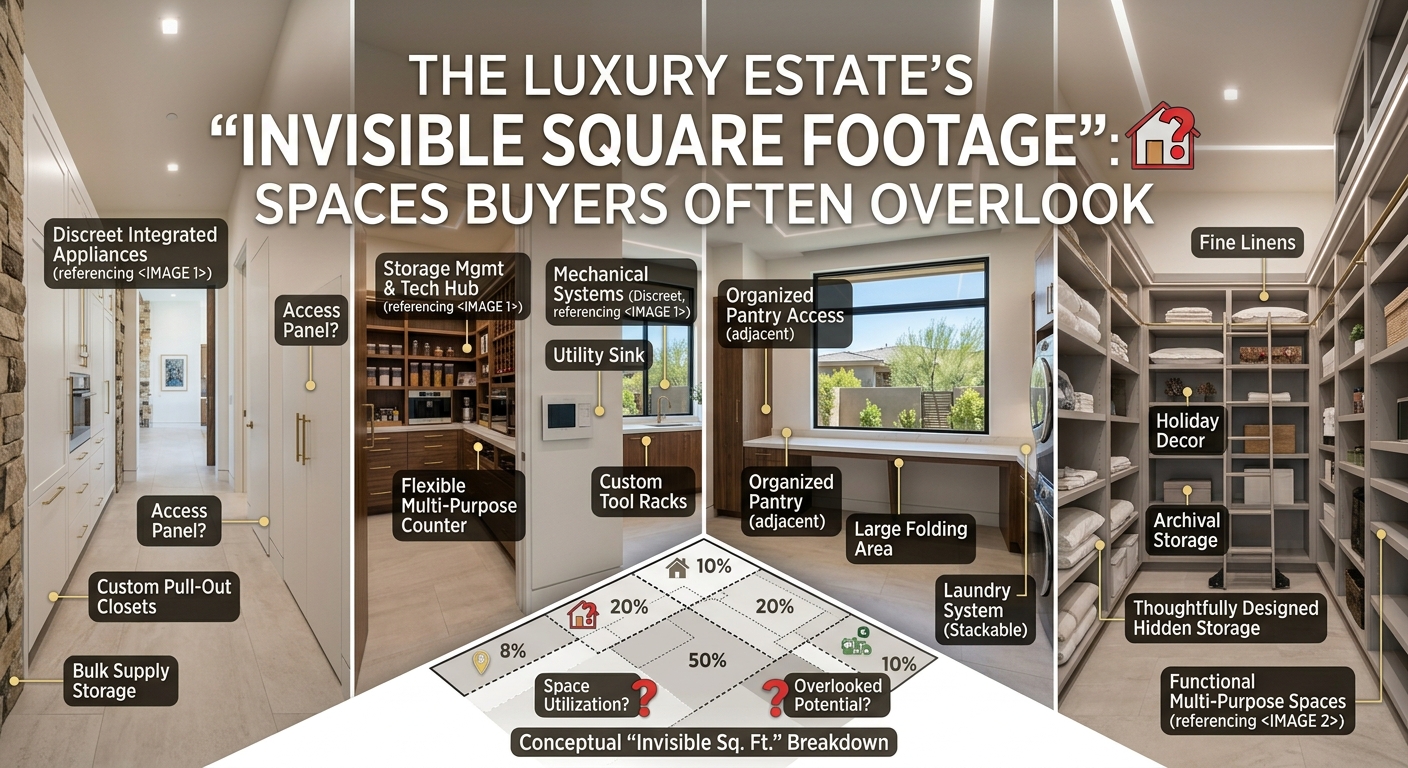
When buyers compare luxury homes, square footage is usually one of the first numbers they see.
3,500 square feet.
5,000 square feet.
7,000 square feet.
10,000 square feet or more.
The number is easy to understand.
But it doesn't necessarily tell you how much usable living experience a property actually provides.
Some of the most valuable parts of a luxury estate may not appear in listing photographs or receive much attention during a showing.
A walk-in storage room.
A service corridor.
A generously sized laundry room.
A separate pantry.
A well-organized mechanical room.
A mudroom.
A large garage.
A hidden equipment area.
Even thoughtfully designed hallways and transitional spaces.
These areas may not be the first things buyers fall in love with.
Yet they can determine whether a large home feels effortless—or surprisingly difficult—to live in.
This is what can be called a luxury home's “invisible square footage.”
It is the space that supports the experience of the home without necessarily being the star of it.
And in an estate where every part of the property has a job to perform, those overlooked spaces can matter enormously.
📦 1. Storage Is Square Footage You Appreciate Every Day
A luxury home may have enormous bedrooms and spectacular entertaining spaces.
But where does everything go?
Homeowners accumulate luggage, seasonal decorations, sports equipment, household supplies, linens, outdoor accessories, and countless other items.
Well-planned storage allows those possessions to disappear from the primary living environment.
Look beyond bedroom closets.
Consider:
- Walk-in storage rooms
- Linen closets
- Pantry storage
- Garage storage
- Seasonal storage
- Utility closets
- Built-in cabinetry
- Pool and outdoor equipment storage
A home with excellent storage can feel considerably larger than one with the same overall square footage but fewer places to put things.
🚪 2. Hallways Can Be More Important Than They Look
Hallways sometimes get dismissed as wasted space.
In a luxury estate, that isn't always the case.
A well-designed hallway can:
- Separate private and public areas
- Create privacy between bedrooms
- Improve circulation
- Connect indoor and outdoor spaces
- Establish architectural rhythm
- Reduce interruptions between rooms
The question isn't simply how many square feet a hallway consumes.
It is what that space accomplishes.
A thoughtfully designed circulation path can make an expansive home feel intuitive and comfortable.
🧺 3. A Large Laundry Room Can Transform Everyday Living
Laundry may not be a glamorous feature, but it is one of the most consistent household activities.
A generously designed laundry area can provide space for:
- Multiple appliances
- Folding
- Hanging
- Sorting
- Storage
- Utility sinks
- Household supplies
- Linens
In larger homes, having sufficient laundry infrastructure can prevent everyday tasks from spilling into other areas.
It is a perfect example of invisible square footage doing its job.
🥫 4. Pantries Can Function Like Secondary Kitchens
A beautiful kitchen may be the centerpiece of a luxury estate.
But the pantry can reveal how practical the kitchen really is.
A large pantry or scullery may provide room for:
- Bulk food storage
- Small appliances
- Additional refrigeration
- Food preparation
- Dish storage
- Cleaning
- Entertaining supplies
This allows the primary kitchen to remain visually calm while supporting the work required behind it.
For homeowners who entertain frequently, that distinction can be especially valuable.
🚗 5. The Garage Is More Than Parking
A luxury garage can represent a substantial amount of functional space.
Depending on the property, it may accommodate:
- Multiple vehicles
- Golf carts
- Bikes
- Sports equipment
- Tools
- Storage
- Charging equipment
- Workshop areas
Pay attention to how the garage connects with the rest of the property.
Can groceries move easily into the kitchen?
Is there interior access?
Is there room to open vehicle doors comfortably?
Is storage integrated into the design?
The answers can tell you much more than the number of parking spaces alone.
🔧 6. Mechanical Space Is Expensive to Ignore
Mechanical rooms rarely make the cover of a luxury listing.
They should still be examined.
A large estate may rely on substantial infrastructure for climate control, electrical systems, water, pool equipment, irrigation, technology, and other property functions.
Adequate mechanical space can make those systems easier to access and maintain.
The important question is not simply:
“What equipment is here?”
It is also:
“Can someone realistically service it?”
Thoughtful access can become an important part of long-term ownership.
🧹 7. Service Areas Keep Everyday Operations Out of Sight
Large luxury homes often require regular support.
Housekeeping.
Landscaping.
Pool maintenance.
Repairs.
Deliveries.
Catering.
A property with dedicated service areas can accommodate these activities without forcing everything through the main living spaces.
This might include:
- Secondary entrances
- Service corridors
- Utility rooms
- Equipment areas
- Staff or housekeeping spaces
- Receiving areas
These spaces may not contribute much to the home's visual drama.
They can contribute substantially to its functionality.
🧥 8. Mudrooms Can Become Luxury Features
A mudroom may sound more associated with practical family homes than luxury estates.
But in a large property, a transitional space can be incredibly useful.
It can provide a place for:
- Shoes
- Bags
- Coats
- Outdoor gear
- Pet supplies
- Packages
- Household items
Instead of bringing everything directly into the primary living areas, homeowners have a controlled transition zone.
That is a small architectural decision with a potentially large everyday impact.
🏊 9. Outdoor Equipment Needs a Home Too
Arizona luxury properties often incorporate substantial outdoor features.
Pools.
Spas.
Outdoor kitchens.
Water features.
Landscaping.
Lighting.
Entertainment areas.
But all of those amenities require infrastructure.
Equipment rooms and discreet service areas allow the property to maintain its resort-like appearance without exposing every operational component.
When evaluating an estate, ask where the equipment lives and how easily it can be accessed.
🔌 10. Technology Has Its Own Invisible Footprint
Smart-home systems can create an enormous amount of convenience while remaining almost completely invisible.
Behind the scenes may be infrastructure supporting:
- Networking
- Security
- Audio
- Video
- Automated lighting
- Climate controls
- Motorized shades
- Access systems
A sophisticated home needs somewhere to house and service that infrastructure.
Technology rooms, organized equipment areas, and accessible wiring pathways can make future maintenance and upgrades easier.
🌵 11. Arizona's Climate Makes Support Spaces Especially Important
An Arizona luxury estate may place enormous emphasis on outdoor living.
But the desert environment also creates operational demands.
Cooling systems, landscaping infrastructure, irrigation, pool equipment, shade systems, and other features all require thoughtful planning.
The more complex the property becomes, the more important its supporting spaces can be.
A beautiful estate isn't simply a collection of finished rooms.
It is an interconnected system.
🛋️ 12. Transitional Spaces Can Make a Home Feel More Expansive
Not every valuable area needs a specific label.
Consider:
- Entry vestibules
- Galleries
- Sitting areas
- Interior courtyards
- Covered transitions
- Connecting corridors
- Small retreats
These spaces can create separation and rhythm between major rooms.
They may not be where homeowners spend hours every day.
But they can influence how the entire property feels as you move through it.
🧳 13. Seasonal Storage Can Be Particularly Valuable in an Estate
Large homes often come with large quantities of possessions.
Holiday decorations.
Guest linens.
Outdoor cushions.
Travel luggage.
Seasonal clothing.
Recreational equipment.
If all of these items compete for space inside closets and garages, the house can quickly feel less organized.
Dedicated seasonal storage gives homeowners somewhere to place things they need—but don't need to see every day.
👀 14. Buyers Should Look Beyond the Photographs
Listing photography naturally focuses on spaces that sell the emotional experience of a home.
That's understandable.
But buyers should also investigate the areas that don't photograph as dramatically.
Open the closet.
Look inside the pantry.
Walk through the laundry room.
Examine the garage.
Ask where the pool equipment is located.
Find the mechanical rooms.
Look at service access.
These spaces can reveal how thoughtfully the property was designed.
📐 15. Square Footage Should Be Evaluated by Function, Not Just Quantity
Two homes can have identical square footage and feel completely different.
One may dedicate substantial space to:
- Storage
- Circulation
- Service
- Maintenance
- Flexibility
Another may allocate more of its footprint to oversized formal rooms.
Neither approach is automatically right or wrong.
The important question is:
Which design better matches the way you intend to live?
That is why square footage should always be considered alongside layout and functionality.
🔍 16. “Invisible” Doesn't Mean “Unimportant”
The phrase invisible square footage doesn't mean these spaces have no value.
Quite the opposite.
Their value often comes from what they allow the visible spaces to become.
A pantry helps the kitchen stay organized.
A storage room keeps living areas uncluttered.
A service corridor protects privacy.
A mechanical room makes maintenance possible.
A mudroom contains everyday mess.
A well-designed garage supports the household.
The space may disappear from view.
Its function doesn't.
✨ 17. The Best Luxury Homes Hide Their Complexity
Perhaps this is the defining characteristic of invisible square footage.
You shouldn't necessarily notice it.
When a luxury estate is thoughtfully designed, the complicated parts of ownership can fade into the background.
Deliveries have somewhere to go.
Cleaning supplies have somewhere to live.
Equipment can be serviced.
Guests can move comfortably.
Outdoor systems remain discreet.
The kitchen stays organized.
Storage doesn't overwhelm the living areas.
Everything feels easier.
That ease is one of the quietest forms of luxury.
💬 A Murphy Group Perspective
“When buyers evaluate a luxury home, it's easy to focus on the rooms that photograph beautifully. But some of the spaces that make a property truly exceptional are the ones quietly supporting everything else—storage, service areas, circulation, mechanical access, and everyday functionality.”
— Mary Murphy, The Murphy Group
The next time you tour a luxury estate, don't just ask how many square feet it has.
Ask:
“What are all those square feet doing for me?”
That question can lead to a much more meaningful evaluation of the property.
📊 The Bottom Line
Luxury isn't simply about having more space.
It's about having the right space in the right places.
The square footage behind a pantry door, inside a storage room, around a mechanical system, or along a thoughtfully designed service corridor may never become the centerpiece of a listing photograph.
But those spaces can make the difference between a home that merely looks impressive and one that genuinely works.
The next time you're comparing luxury estates, look beyond the headline square footage.
Some of the property's most valuable space may be the space you almost never notice.
📲 Discover a Luxury Home Designed Beyond the Numbers
If you're searching for a luxury home in Scottsdale, Paradise Valley, North Scottsdale, or the East Valley, The Murphy Group can help you evaluate more than the home's visible finishes and advertised square footage.
We can help you look at the details behind the experience—from storage and circulation to service access, outdoor infrastructure, entertaining flow, privacy, and long-term functionality.
Because when it comes to luxury real estate, every square foot has a story.
Some of the most important ones simply happen behind the scenes.

Mary Murphy
Team Leader | The Murphy Group - AZ | eXp Luxury | PLACE
or another way