

Categories
Scottsdale Luxury Real Estate, Scottsdale Real Estate, luxury home buying guide, Paradise Valley Real Estate, Paradise Valley Luxury, North Scottsdale homes, North Scottsdale real estate, Arizona Real Estate, Arizona Luxury, East Valley, East Valley Luxury, East Valley real estate, Home Energy Efficiency, HVAC Maintenance, Luxury HomeownersPublished October 20, 2026
The Hidden Complexity of Owning an Arizona Estate With Multiple HVAC Systems

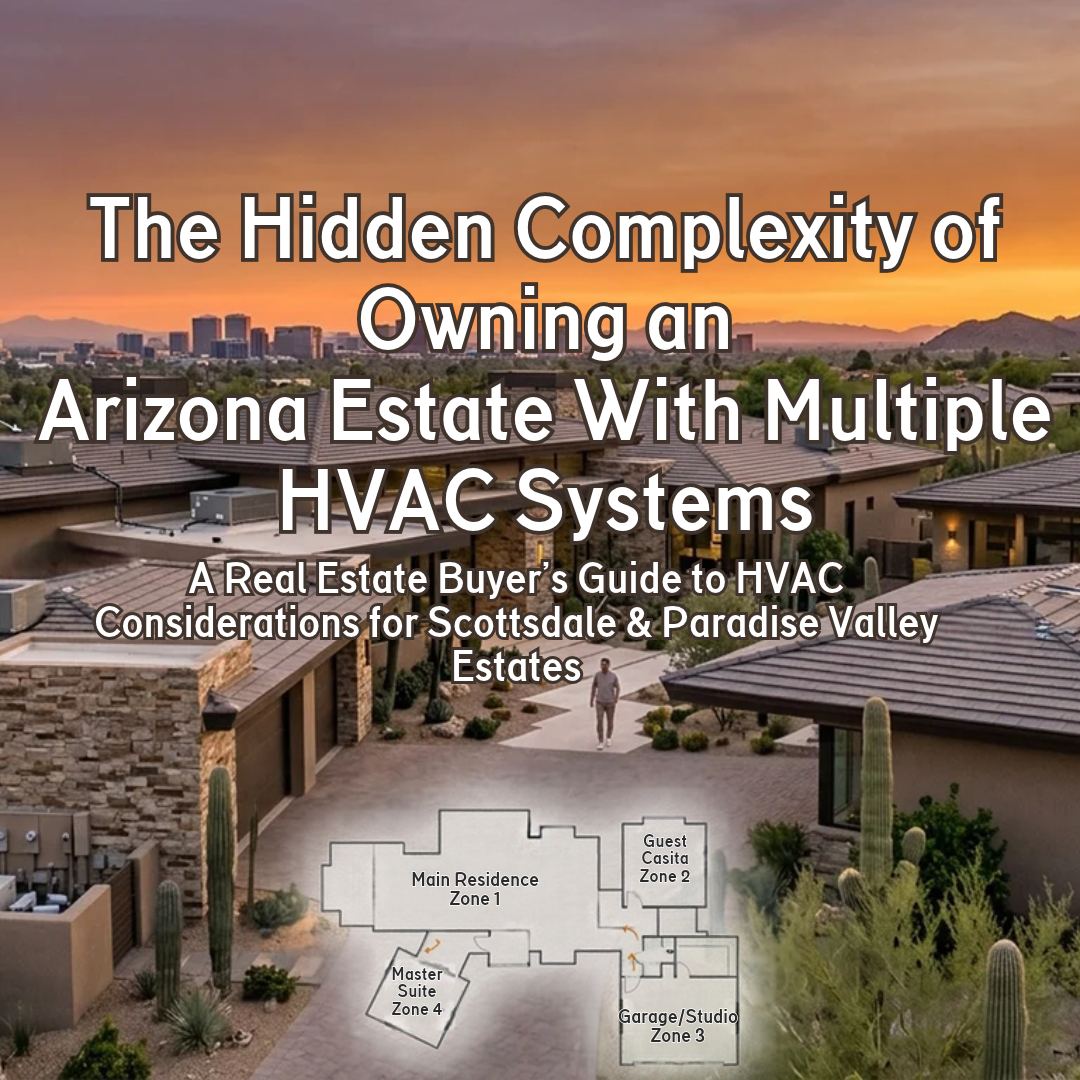
An Arizona luxury estate can offer impressive square footage, expansive living areas, guest accommodations, home offices, entertainment spaces, and carefully designed indoor environments.
Behind that comfort, however, may be a complex network of heating, ventilation, and air conditioning systems working to keep different parts of the property comfortable throughout the year.
A large estate may have separate HVAC units for the main residence, upstairs bedrooms, guest casita, home theater, wine room, or other specialized spaces. Some properties may also feature zoned temperature controls, smart thermostats, dedicated ventilation equipment, or additional systems designed to manage unique indoor conditions.
These features can improve comfort and allow different areas of the home to operate independently. However, they can also introduce additional maintenance requirements, energy expenses, repair considerations, and potential replacement costs.
For luxury buyers, the question is not simply whether the home has air conditioning. It is whether the systems are appropriately designed, properly maintained, and capable of supporting the property's layout and intended use.
Are the systems operating efficiently? Do they provide consistent cooling throughout the estate? Are the units approaching the end of their useful lives? Can the current owner provide maintenance records? Will the property require specialized service or substantial investment after closing?
Multiple HVAC systems can improve comfort and flexibility, but they also create additional responsibilities that buyers should understand before purchasing an Arizona luxury estate.
Here's what buyers should investigate when evaluating a luxury property with multiple HVAC systems in Scottsdale, Paradise Valley, North Scottsdale, or the East Valley.
1. Understand Why the Estate Has Multiple HVAC Systems
A large luxury home may require more than one HVAC system because of its size, architectural design, number of floors, room arrangement, or separate living spaces.
Rather than relying on one central unit, a property may use several systems to provide cooling and heating to different areas.
These systems may serve:
- The main living areas and bedrooms
- Upper floors or separate wings of the residence
- Guest houses and casitas
- Home offices and private studies
- Home theaters and entertainment rooms
- Garages or workshops with dedicated climate control
- Enclosed sunrooms or specialty living spaces
- Areas with unusual cooling or ventilation requirements
Multiple systems are not automatically a sign of poor design. In some homes, they can provide more precise temperature control and allow unoccupied areas to operate independently.
However, the number of systems alone does not establish whether the property's HVAC design is appropriate.
The equipment must be evaluated in relation to the home's square footage, insulation, window placement, air leakage, ductwork, ceiling heights, and exposure to direct sunlight.
Ask the seller for an overview of the HVAC configuration, including which areas each system serves and whether the systems operate independently or share any controls.
Understanding this arrangement can help you evaluate the home's comfort, efficiency, and future maintenance needs.
2. Investigate the Age and Condition of Every HVAC Unit
One of the most important considerations when buying an estate with multiple HVAC systems is the age and condition of each unit.
A property might have several relatively new systems, or it may have equipment installed at different times as the home was expanded or renovated.
For example, the main residence might have received a recent HVAC upgrade while an older guest casita still relies on equipment installed many years earlier.
This difference matters because the systems may not need replacement at the same time.
During due diligence, request information about each unit, including:
- Manufacturer and model
- Installation date, if available
- Type of system and cooling capacity
- Previous repairs and service history
- Warranty information
- Reported performance issues
- Previous equipment replacements
- Current operating condition
Do not assume that all units have the same age or remaining useful life.
Even systems from the same installation period can experience different levels of wear depending on operating hours, maintenance, environmental exposure, and installation quality.
An HVAC professional can inspect each system and help identify equipment that may need repairs or closer monitoring.
A luxury estate's HVAC condition should be evaluated unit by unit, not treated as a single yes-or-no question.
3. Evaluate How Well the Systems Handle Arizona's Extreme Heat
Arizona's summer temperatures place significant demands on residential cooling equipment.
A system that performs adequately during mild weather may struggle when outdoor temperatures rise, particularly if it serves a large area with substantial afternoon sun exposure.
Luxury estates can present additional challenges because they may feature expansive windows, high ceilings, large open-plan rooms, multiple stories, and extensive glass doors connecting indoor and outdoor living areas.
These architectural features can affect the amount of heat entering the home.
During a showing, pay attention to whether the indoor environment feels consistently comfortable across different rooms.
Consider asking:
- Do some rooms become noticeably warmer than others?
- Does the upstairs remain comfortable during the afternoon?
- Are west-facing rooms difficult to cool?
- Does the system run for unusually long periods during hot weather?
- Have the owners reported cooling problems during peak summer temperatures?
- Are certain areas consistently more comfortable than others?
A warm room does not necessarily mean the HVAC equipment is failing. The cause could involve insulation, air leakage, ductwork, window exposure, thermostat placement, or system design.
If concerns arise, have a qualified HVAC contractor assess the system's performance under appropriate operating conditions.
Where possible, request information about how the equipment performed during the hottest months rather than relying exclusively on a showing conducted during cooler weather.
4. Understand the Difference Between Multiple Systems and Zoned HVAC
Multiple HVAC systems and zoned HVAC are related concepts, but they are not the same.
A property with multiple systems generally has separate equipment serving different areas. A zoned system, meanwhile, divides the areas served by a system into separate temperature-control zones, often using dampers and individual thermostats or sensors.
A large estate may have multiple independent systems, one system with several zones, or a combination of both.
Each arrangement has different implications for comfort, maintenance, and energy use.
For buyers, the important questions include:
- Which areas are controlled by each thermostat?
- Can bedrooms and living areas maintain different temperatures?
- Are separate floors controlled independently?
- Are zone dampers and sensors functioning properly?
- Can unused areas be conditioned without cooling the entire home?
- Does the control system require a particular technician or software platform?
A well-designed zoning arrangement may improve comfort by allowing temperature settings to reflect how different rooms are used.
However, zoning cannot compensate for every problem. Incorrect equipment sizing, poor duct design, insufficient airflow, or faulty controls may still affect performance.
Ask the seller for a system diagram or a simple explanation of how the controls work.
Knowing how to operate the equipment before moving in can make the transition easier and help prevent unnecessary energy use.
5. Review Energy Consumption Across the Entire Estate
Operating several HVAC systems can contribute substantially to a luxury home's energy expenses, especially during Arizona's hottest months.
However, multiple systems do not automatically mean that a property is inefficient. The overall energy demand depends on several factors, including equipment efficiency, home size, insulation, air leakage, thermostat settings, occupancy, and the amount of time each system operates.
A well-designed estate with efficient equipment may perform better than a smaller home with poorly maintained or improperly sized systems.
Before purchasing, ask whether the seller can provide available electricity bills covering both summer and milder months.
Review the information alongside the home's occupancy and usage patterns.
For example, energy consumption may be higher when the property is fully occupied, when guests are staying in a casita, or when entertainment spaces are used frequently.
Useful questions include:
- What are the typical summer electricity expenses?
- Are the main residence and guest house separately metered?
- Does the property have a solar energy system?
- Are there energy-monitoring features?
- Have any HVAC efficiency upgrades been completed?
- Do certain systems account for unusually high consumption?
Remember that utility bills reflect the household's behavior as well as the building's performance.
If the property has multiple systems and limited operating history, consider requesting an energy assessment to better understand potential efficiency improvements.
6. Inspect Ductwork, Airflow, and Insulation
Even high-quality HVAC equipment may struggle if the ductwork or building envelope is not performing properly.
Ductwork distributes conditioned air throughout the home. If ducts are leaking, poorly insulated, restricted, or incorrectly balanced, some rooms may receive too little cooling while others receive too much.
These issues can be particularly important in large Arizona estates, where ductwork may extend through attics, utility spaces, or other areas exposed to high temperatures.
During the inspection process, ask about:
- Visible duct damage or disconnected sections
- Signs of air leakage
- Insulation condition around accessible ductwork
- Restricted return-air pathways
- Unusual airflow differences between rooms
- Dust accumulation around supply registers
- Past duct repairs or modifications
- Insulation and air-sealing improvements
Also consider the home's windows, doors, attic insulation, and weatherstripping.
A system that runs continuously may be responding to excessive heat gain or air leakage rather than an equipment problem alone.
A qualified HVAC contractor can evaluate airflow and duct performance, while a broader home energy assessment may help identify improvements to the building envelope.
Correctly identifying the cause of a comfort problem can help prevent spending money on new equipment that does not fully resolve the issue.
7. Investigate the HVAC Needs of Guest Casitas and Separate Living Spaces
Many Arizona luxury estates include guest casitas, detached guest houses, pool houses, or separate living quarters.
These spaces may have independent HVAC systems, which can be convenient when family members or visitors occupy them at different times.
However, separate living areas also introduce additional equipment that must be inspected and maintained.
A detached casita may experience different operating conditions from the main house because of its roof design, insulation, window exposure, occupancy, and distance from the primary residence.
When evaluating these spaces, ask:
- Does the casita have its own heating and cooling equipment?
- When was the equipment installed?
- Is the system sized appropriately for the space?
- Are separate thermostats and controls functioning correctly?
- Does the unit receive regular maintenance?
- Are replacement parts readily available?
- Are there any known cooling or ventilation issues?
If the casita is intended for frequent guests, extended family, or another permitted use, its comfort and reliability may be especially important.
Do not assume that a well-maintained main residence guarantees the same condition in the guest quarters.
Inspect each living area separately and include its equipment in the overall ownership budget.
8. Check Specialized Climate-Controlled Rooms
Some luxury homes include spaces that have specific temperature or humidity requirements.
Examples may include wine rooms, home theaters, equipment rooms, indoor gyms, or other specialty areas.
These spaces may rely on dedicated equipment or controls that differ from the home's standard residential HVAC systems.
A wine room, for example, may require a system specifically designed to maintain appropriate temperature and humidity conditions. A general-purpose air conditioner may not provide the same level of environmental control.
A home theater may have substantial equipment-related heat loads, while a room with specialized electronics may require carefully planned ventilation.
During due diligence, identify any dedicated climate-control systems and ask for their installation and service documentation.
Determine whether the equipment is designed for the specific purpose, whether it is operating as intended, and whether it requires specialist servicing.
If a room contains valuable equipment, collections, or materials that depend on controlled environmental conditions, consider having the relevant system evaluated by a professional with experience in that application.
These specialized systems can be easy to overlook during a general home inspection, yet their failure may affect both comfort and the contents of the room.
9. Review Smart Thermostats and Integrated Home Automation
Luxury estates may use smart thermostats or integrated automation systems to control temperature settings across multiple areas.
Depending on the installation, these systems may allow owners to adjust temperatures remotely, establish schedules, monitor energy use, or coordinate certain functions with other home systems.
While these features can improve convenience, buyers should understand how they operate before taking ownership.
Ask whether the controls are compatible with the installed HVAC equipment and whether any functions depend on subscriptions, third-party platforms, or specialized configuration.
Also investigate:
- Whether every thermostat responds correctly
- Whether temperature sensors provide consistent readings
- Whether schedules are configured properly
- Whether remote access can be transferred to the new owner
- Whether the system relies on a specific home automation platform
- Whether backup controls are available if the smart system fails
If the property has a complex automation setup, request operating instructions and any relevant technical documentation.
You may also want the seller or installer to demonstrate the controls before closing.
A sophisticated control system can be valuable, but only when the next owner can operate and maintain it confidently.
10. Investigate Refrigerant, Condensate Drainage, and Water-Related Issues
Air conditioning systems do more than cool indoor air. They also remove moisture, which must be managed appropriately.
In Arizona, cooling equipment can produce condensate during operation, and drainage problems may cause water to collect where it should not.
Multiple systems mean there may be several condensate lines, drain pans, safety switches, and related components to inspect.
Look for visible signs such as:
- Water stains near air handlers
- Moisture around equipment cabinets
- Rust or corrosion on drain pans
- Evidence of previous water leaks
- Blocked or damaged condensate lines
- Improperly routed drainage outlets
- Signs of repeated overflow near ceilings or walls
Ask whether the property has experienced HVAC-related leaks and whether any resulting damage has been repaired.
Also request service records relating to refrigerant leaks, cooling performance problems, or major component replacements.
Refrigerant work should be handled by appropriately qualified professionals. Buyers should not attempt to diagnose or repair refrigerant systems themselves.
A contractor can inspect accessible components, verify system operation, and identify maintenance or repair concerns that may not be apparent during a standard walkthrough.
11. Review Maintenance Records and Service Agreements
Maintaining multiple HVAC systems requires a more organized approach than maintaining a single unit.
Depending on the equipment and manufacturer recommendations, servicing may include filter replacement, coil cleaning, condensate drainage checks, electrical inspections, and performance testing.
The exact schedule varies by system type, operating conditions, and manufacturer guidance.
Before purchasing, ask the seller for available maintenance records covering every system.
Useful documentation may include:
- Routine service reports
- Filter and coil maintenance history
- Repair invoices
- Equipment replacement records
- Warranty documents
- Service agreements
- Previous performance assessments
- Notes about recurring problems
A well-documented maintenance history can help you understand how the systems have been cared for and whether any unresolved issues remain.
If a service agreement is in place, determine whether it can be transferred to the next owner and what it actually covers.
Do not assume that a maintenance plan includes replacement parts, emergency service, or major repairs without reviewing its terms.
After purchasing the property, consider creating a centralized HVAC maintenance schedule that tracks every unit, its filter requirements, service dates, warranties, and upcoming maintenance tasks.
A simple recordkeeping system can make a complex estate easier to manage.
12. Understand Replacement Costs and Equipment Compatibility
Replacing one HVAC system can be a substantial expense. Replacing several systems over a short period can create a much larger financial commitment.
Costs vary according to equipment type, capacity, efficiency, installation complexity, ductwork modifications, electrical requirements, accessibility, and local labor rates.
A luxury estate may also have specialized controls or equipment that require compatible replacement components.
Before purchasing, determine whether any systems appear to be approaching the end of their expected service life or have a history of recurring failures.
Ask an HVAC professional to identify which units may require attention in the near term and which appear to be in satisfactory condition.
Also consider whether future replacements might involve:
- New thermostats or control systems
- Ductwork repairs or redesign
- Electrical upgrades
- Changes to refrigerant lines
- Modifications to equipment platforms
- Crane access or other specialized installation requirements
- Coordination with smart-home automation
- Additional work to maintain consistent performance across the estate
Not every replacement requires these additional measures, but the possibility should be investigated when the installation is complex.
Obtain professional estimates when significant repairs or replacements appear likely, and include those potential expenses in your purchase decision.
13. Verify Permits, Installation Records, and Previous Modifications
An estate's HVAC configuration may have changed as the property was renovated, expanded, or upgraded.
An owner might have added a guest house, converted a garage, finished additional living space, or replaced only part of the original cooling system.
These modifications can affect the overall design and operation of the HVAC network.
Request available documentation for significant installations and changes, including:
- Contractor invoices
- Equipment specifications
- Installation dates
- Warranty information
- Mechanical permits where required
- Plans showing which systems serve each area
- Records of ductwork modifications
- Documentation for additions and converted spaces
Requirements vary by jurisdiction and the nature of the work, so buyers should verify applicable requirements with the relevant local authority or a qualified professional.
If a recently finished room or separate living area does not appear to have an obvious heating or cooling solution, ask how that space is conditioned and whether the arrangement was properly evaluated.
A clear record of the property's HVAC history can help identify inconsistencies, explain the current configuration, and support future maintenance or replacement decisions.
14. Consider the Impact on Long-Term Ownership and Resale
Multiple HVAC systems can make an estate more adaptable to different lifestyles, but they can also affect how future buyers evaluate the property.
Some buyers may appreciate independent temperature control for guest quarters, private offices, and separate wings of the home.
Others may be concerned about aging equipment, high operating expenses, or the complexity of maintaining several systems.
The property's overall appeal will depend on how well the HVAC arrangement serves the home and how clearly its condition can be documented.
Before purchasing, consider whether the systems provide practical benefits that justify their maintenance requirements.
Ask yourself:
- Does the configuration support the way you intend to use the estate?
- Are the systems reasonably efficient for the property's size and design?
- Is the equipment condition consistent across the home?
- Are service records available?
- Can local professionals maintain the installed equipment?
- Are future repair and replacement costs manageable?
- Would any planned renovation require HVAC modifications?
Well-maintained systems with clear documentation can make ownership easier to plan for.
Conversely, unresolved comfort problems or poorly documented installations may require additional investigation before you commit to the purchase.
The goal is not to avoid estates with multiple systems. It is to understand what the configuration offers and what responsibilities come with it.
A Murphy Group Arizona Perspective
“A luxury estate should be evaluated as a complete property, including the systems that make everyday comfort possible. Multiple HVAC units can provide flexibility across a large home, but understanding their condition, maintenance history, and future costs is an important part of making an informed buying decision.”
— Mary Murphy, The Murphy Group Arizona
For buyers exploring luxury real estate in Arizona, the HVAC system deserves attention beyond a simple confirmation that the air conditioning turns on. Understanding how the equipment serves the property can help buyers prepare for the realities of ownership.
The Bottom Line
Owning an Arizona luxury estate with multiple HVAC systems can offer greater flexibility, independent temperature control, and improved comfort across different living areas.
However, the arrangement also introduces additional equipment, maintenance schedules, potential repair expenses, and replacement decisions.
Before making an offer, review the age and condition of every unit, assess cooling performance, investigate ductwork and drainage, examine specialized climate-control equipment, and request available service records.
Pay particular attention to guest casitas, separate wings, and rooms with unique temperature or humidity requirements. If concerns arise, consult a qualified HVAC professional who can evaluate the property's equipment and identify potential costs.
Most importantly, consider the entire HVAC configuration in relation to the estate's size, design, energy consumption, and your long-term plans.
The best luxury estate is not simply the one that feels comfortable during a showing. It is the one whose systems, condition, and ongoing ownership requirements align with your expectations.
Explore Arizona Luxury Real Estate With The Murphy Group Arizona
If you're considering a luxury home in Scottsdale, Paradise Valley, North Scottsdale, or the East Valley, The Murphy Group Arizona can help you look beyond the listing photos and consider the property, neighborhood, and long-term ownership experience.
From multiple HVAC systems and energy efficiency to property infrastructure, privacy, landscaping, and lifestyle considerations, a thoughtful approach to due diligence can help you make a more informed decision.
Explore Arizona luxury real estate with The Murphy Group Arizona and discover your next exceptional property.
Website: www.mgsellsarizona.com
```html

Mary Murphy
Team Leader | The Murphy Group - AZ | eXp Luxury | PLACE
or another way