

Categories
premium lot AZ, Arizona Luxury, Arizona Lifestyle, Arizona home buying guides, Arizona Real Estate, Arizona real estate investment, Desert-living, Estate Planning, family luxury home, luxury home buying guide, Luxury Home Trends Arizona, North Scottsdale homes, Paradise Valley Luxury, Paradise Valley Real Estate, Scottsdale Luxury Real Estate, Scottsdale Real Estate, solar homes ArizonaPublished September 1, 2026
How Desert Terrain Can Change the True Cost of Owning a Luxury Home

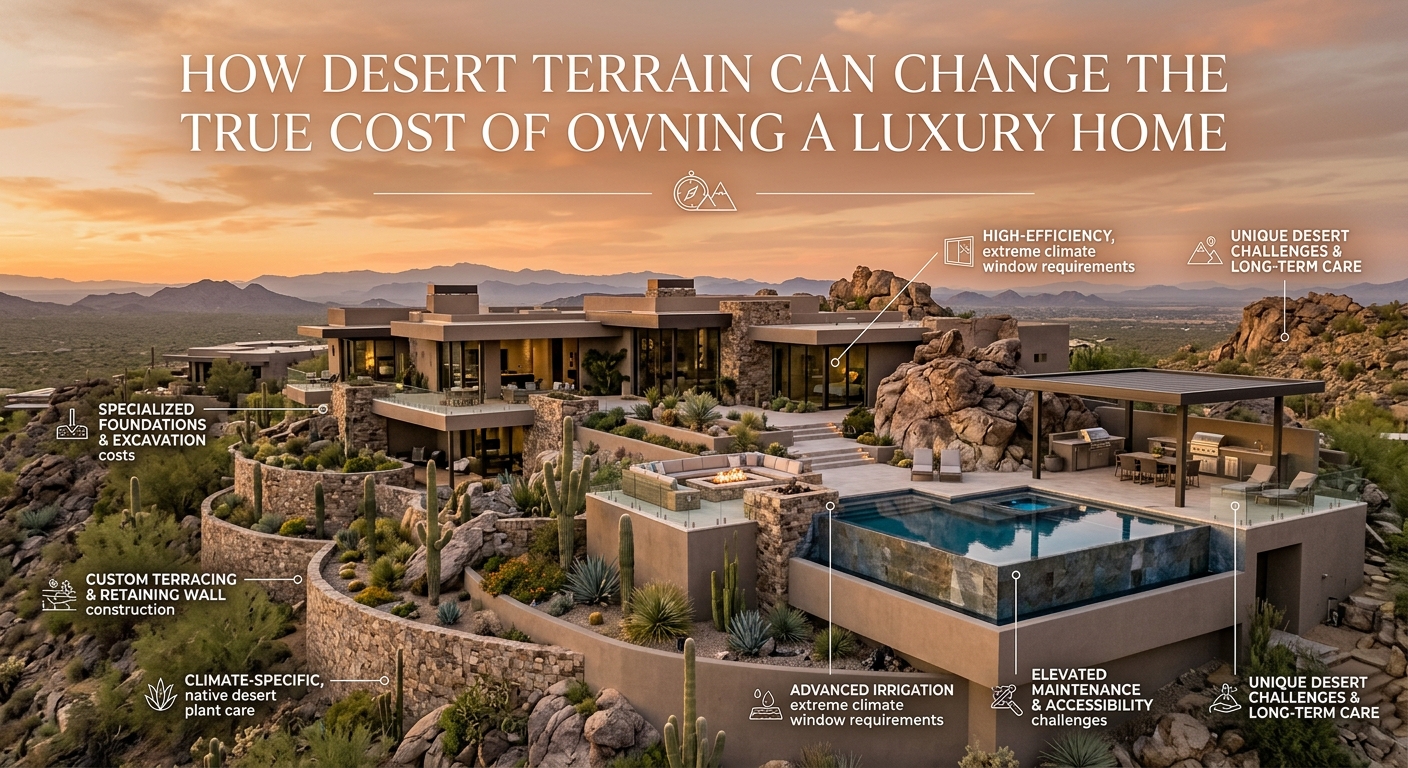
A dramatic desert lot can be one of the most compelling features of an Arizona luxury property.
Mountain views.
Rocky outcroppings.
Elevated lots.
Natural washes.
Sloping terrain.
Mature desert landscaping.
These characteristics can make a property feel truly one of a kind.
But the same terrain that creates a spectacular setting can also influence what it costs to build, maintain, remodel, landscape, and eventually sell the property.
A luxury home on a flat, straightforward lot can have a very different ownership profile from an estate built into a hillside or surrounded by challenging desert terrain.
Terrain can affect:
- Drainage
- Landscaping
- Irrigation
- Retaining walls
- Driveways
- Outdoor living spaces
- Maintenance
- Construction
- Accessibility
- Future improvements
Arizona's desert environment can also produce intense runoff and erosion during heavy storms, making drainage particularly important on sloped or rocky properties. The University of Arizona notes that improper water management can contribute to erosion, standing water, and landscape damage, especially where steep slopes are involved.
As Mary Murphy of The Murphy Group explains:
"The best luxury lots often come with characteristics that make them special. Buyers just need to understand that those same characteristics can influence the property's long-term cost of ownership."
🏜️ 1. The View May Come With a Price
One of the biggest attractions of Arizona hillside and elevated properties is the view.
A higher lot can offer:
- Mountain vistas
- City lights
- Sunrise views
- Sunset views
- Desert panoramas
- Greater privacy
But creating and maintaining a home on sloping terrain can require more specialized work than a relatively level property.
Site preparation, drainage, retaining structures, access, and landscaping can all become more complicated.
The view may be priceless—but the terrain isn't free.
📐 2. Slopes Can Increase Site Complexity
A sloped lot can create opportunities for dramatic architecture.
But it can also introduce additional considerations involving:
- Grading
- Drainage
- Retaining walls
- Foundations
- Driveway access
- Landscaping
- Erosion control
Arizona landscape guidance specifically notes that slopes require specialized approaches to irrigation and plant selection, while proper landscaping can help reduce erosion and slope movement.
For buyers, this means the slope itself should be evaluated as part of the property's long-term ownership equation.
💧 3. Drainage Can Become a Major Ownership Consideration
Arizona is a desert, but that doesn't mean water management is simple.
Heavy seasonal storms can move substantial amounts of water quickly across the landscape.
On sloped properties, water may:
- Flow toward structures
- Wash away soil
- Move gravel
- Damage hardscape
- Erode landscaping
- Put pressure on retaining structures
The University of Arizona warns that poorly designed or maintained water-harvesting and drainage systems can contribute to standing water and erosion, particularly where water moves quickly down steep slopes.
That makes drainage something buyers should investigate—not simply something to think about after purchasing.
🧱 4. Retaining Walls Can Add Complexity
Retaining walls can transform a difficult slope into usable outdoor space.
They can create:
- Terraced gardens
- Level patios
- Pool areas
- Walkways
- Outdoor entertaining spaces
But they also need to be properly designed and maintained.
Water management behind retaining walls is especially important because drainage problems can increase pressure on the structure.
If a property has extensive retaining walls, buyers should understand:
- Their age
- Construction
- Drainage
- Maintenance history
- Visible condition
- Any available engineering or permit records
🪨 5. Rocky Soil Can Affect Landscaping
Desert terrain can be beautiful precisely because it isn't perfectly uniform.
Rocky soil and hard subsurface conditions can make excavation and planting more difficult.
This can affect projects involving:
- Trees
- Large shrubs
- Irrigation
- Pools
- Patios
- Outdoor kitchens
- Landscape lighting
- New structures
Some Arizona soils also contain caliche, a hardened calcium-carbonate layer that can complicate digging and drainage.
For a buyer planning significant landscaping or construction, understanding site conditions early can help avoid unpleasant surprises.
🌵 6. Landscaping Costs Can Vary With Terrain
A desert landscape isn't automatically a low-cost landscape.
A luxury estate may include:
- Mature specimen trees
- Large cacti
- Custom stonework
- Terraced planting areas
- Irrigation networks
- Outdoor lighting
- Water features
- Extensive hardscape
Terrain can make these features more complicated to install and maintain.
Steep areas may require specialized irrigation and erosion-control strategies.
The result can be spectacular—but the maintenance plan needs to match the property's complexity.
💦 7. Irrigation Is More Important Than It Looks
Water doesn't always move naturally where you want it to.
On sloped terrain, irrigation must be designed carefully to avoid:
- Runoff
- Uneven watering
- Erosion
- Plant stress
- Water waste
The Arizona Department of Water Resources emphasizes efficient, regionally appropriate landscaping and irrigation as important ways to reduce outdoor water use.
For a large luxury property, efficient irrigation can become an important part of both maintenance and long-term operating costs.
🚗 8. Driveways Can Become More Expensive
The driveway is easy to overlook during a luxury home tour.
But terrain can affect:
- Length
- Slope
- Surface materials
- Drainage
- Retaining structures
- Lighting
- Snow or weather considerations in higher elevations
- Emergency access requirements
A dramatic private drive can be part of the property's luxury experience.
It can also require more maintenance than a simple level driveway.
🏡 9. Outdoor Living Spaces May Require More Engineering
Arizona luxury living often revolves around the outdoors.
But if the backyard slopes significantly, creating a level entertaining area may require substantial site work.
A buyer's dream outdoor space might include:
- Pool
- Spa
- Outdoor kitchen
- Fire feature
- Covered patio
- Putting green
- Dining area
On difficult terrain, however, these features may require:
- Grading
- Retaining walls
- Drainage
- Utility extensions
- Structural design
The result can be spectacular—but buyers should understand the underlying infrastructure.
🏊 10. Pools Can Be More Complicated on Sloped Lots
A hillside pool can create an incredible visual experience.
But the terrain can affect:
- Excavation
- Structural design
- Retaining requirements
- Drainage
- Access
- Pool-deck construction
If you're buying a property because you plan to add or significantly modify a pool, investigate the site's physical limitations before assuming the project will be straightforward.
🌧️ 11. Monsoon Conditions Make Terrain More Important
Arizona's monsoon season generally runs from June 15 through September 30.
During intense storms, terrain determines where water travels.
That makes it important to observe:
- Where runoff moves
- Where water collects
- Whether slopes show erosion
- How drainage channels perform
- Whether hardscape remains stable
A property can look completely different after a significant storm than it does during a dry-weather showing.
🔍 12. Look for Signs of Erosion
During a property tour, pay attention to clues such as:
- Exposed roots
- Washed-out gravel
- Soil movement
- Cracks
- Deposited sediment
- Damaged landscaping
- Water stains
- Soft or uneven areas
These signs don't automatically mean a property has a serious problem.
But they can indicate that further professional evaluation may be worthwhile.
🌿 13. Mature Landscaping Can Be an Asset—and a Responsibility
A mature desert landscape can dramatically increase a property's sense of privacy and beauty.
But large trees and established plantings also require:
- Irrigation
- Pruning
- Pest management
- Storm cleanup
- Specialized care
Arizona guidance emphasizes the importance of maintaining healthy root zones and appropriate irrigation practices for landscape trees and plants.
The question isn't simply:
"How beautiful is the landscaping?"
It's:
"What does it take to keep this landscaping healthy?"
🛣️ 14. Remote or Difficult Access Can Affect Maintenance
Some luxury estates are intentionally secluded.
That privacy can be incredibly valuable.
But difficult access can influence:
- Contractor availability
- Landscaping logistics
- Equipment delivery
- Construction
- Emergency services
- Driveway maintenance
The more challenging the access, the more important it becomes to understand how routine services are handled.
🏗️ 15. Future Remodeling Can Become More Complicated
A buyer may love the idea of adding:
- A guest casita
- Pool
- Garage
- Outdoor kitchen
- Expanded patio
- Additional living space
But terrain can affect the feasibility and cost of those projects.
Before assuming an improvement is possible, investigate:
- Building envelope
- Setbacks
- Easements
- Slope
- Drainage
- Utilities
- HOA restrictions
- Applicable permits
A large lot doesn't necessarily mean unlimited development potential.
💰 16. The Purchase Price Isn't the Entire Cost
This is one of the most important concepts for luxury buyers.
The true cost of ownership can include:
Purchase price
Maintenance
Landscape care
Utilities
Repairs
Infrastructure
Future improvements
A property with a lower purchase price may not necessarily be less expensive to own if it has significantly more complicated terrain and infrastructure.
📊 17. Compare Properties by Total Ownership Experience
When comparing two luxury homes, don't stop at:
"Which one costs less?"
Ask:
Which property requires more landscape maintenance?
Which has more complicated drainage?
Which has more retaining structures?
Which has the more difficult driveway?
Which has older infrastructure?
Which has greater outdoor maintenance?
Which property will be easier to modify later?
These questions can reveal meaningful differences between otherwise comparable properties.
🌅 18. Terrain Can Also Create Value
The story isn't entirely about additional costs.
Unique terrain can create characteristics that buyers are willing to pay for.
These can include:
- Exceptional views
- Privacy
- Natural rock formations
- Elevated positioning
- Dramatic architecture
- Unique outdoor spaces
- Greater separation from neighboring properties
The goal isn't to avoid challenging terrain.
It's to understand what you're paying for and what it requires.
🏜️ 19. Natural Terrain Can Become Part of the Luxury Experience
Some of Arizona's most memorable properties don't try to erase the landscape.
Instead, they work with it.
Architecture can be positioned around:
- Rock formations
- Mountains
- Desert washes
- Natural slopes
- Mature vegetation
The terrain becomes part of the property's identity.
That's a form of luxury that is difficult to replicate.
🧠 20. The Best Buyers Evaluate the Land as Carefully as the House
When touring an Arizona luxury property, look beyond the architecture.
Study the:
Lot.
Slope.
Drainage.
Landscape.
Access.
Outdoor infrastructure.
Natural features.
The home may be the most visible part of the purchase.
But the land underneath and around it can influence the ownership experience for decades.
🔎 Questions to Ask Before Buying a Luxury Home on Challenging Terrain
Before committing to a property, consider asking:
How does water move across the lot during heavy rain?
Are there visible signs of erosion?
Are retaining walls present?
How old are those walls?
Is drainage properly maintained?
What type of soil or rock conditions are present?
How complex is the irrigation system?
Are there mature trees requiring specialized care?
Is the driveway difficult to maintain?
Are there limitations on future construction?
What improvements have previously been made to the site?
Would a qualified specialist recommend additional evaluation?
These questions can help reveal costs that aren't obvious from the listing.
🧾 What Buyers Should Review During Due Diligence
Depending on the property, buyers may want to investigate:
- Survey information
- Grading and drainage information
- Inspection reports
- Retaining-wall records
- Landscaping records
- Irrigation information
- Permits
- Easements
- HOA documents
- Previous renovation records
The appropriate professionals can help determine which documents and inspections are relevant to a particular property.
💼 How The Murphy Group Helps Buyers Look Beyond the View
The Murphy Group helps Arizona luxury buyers evaluate properties based on more than their immediate visual appeal.
That can mean considering:
- Lot position
- Terrain
- Views
- Privacy
- Landscaping
- Outdoor living
- Maintenance requirements
- Future improvement potential
When terrain introduces specialized questions, buyers can work with the appropriate inspectors, engineers, landscape professionals, contractors, and other specialists to understand the property's condition and potential costs.
As Mary Murphy explains:
"A great luxury property should reward you with its beauty without surprising you with the realities of owning the land beneath it."
📊 The Bottom Line
Desert terrain can be one of the greatest assets of an Arizona luxury home.
It can create:
👉 Privacy
👉 Views
👉 Character
👉 Natural beauty
👉 Architectural opportunities
👉 Exceptional outdoor experiences
But it can also influence:
👉 Drainage
👉 Landscaping
👉 Irrigation
👉 Retaining walls
👉 Construction
👉 Maintenance
👉 Future remodeling
👉 Ownership costs
The key isn't to avoid dramatic terrain.
It's to understand it.
Because when you're buying an Arizona luxury property, you're not only buying the house.
You're buying the land, the setting, the infrastructure, and everything required to care for them.
📲 Find an Arizona Luxury Home That Fits the Full Picture
If you're considering a luxury property in Scottsdale, Paradise Valley, North Scottsdale, or another premier Arizona community, The Murphy Group can help you look beyond the home's finishes and evaluate the lot, setting, lifestyle, and long-term ownership considerations.
👉 Start here: www.mgsellsarizona.com

Mary Murphy
Team Leader | The Murphy Group - AZ | eXp Luxury | PLACE
or another way