

Categories
Arizona Luxury, Arizona Real Estate, Scottsdale Real Estate, Paradise Valley Real Estate, Paradise Valley Luxury, North Scottsdale homes, North Scottsdale real estate, East Valley Luxury, East Valley real estate, East Valley, luxury home buying guide, Scottsdale Luxury Real EstatePublished October 20, 2026
Buying a Luxury Home With a Private Tennis or Pickleball Court: Costs, Rules, and Resale

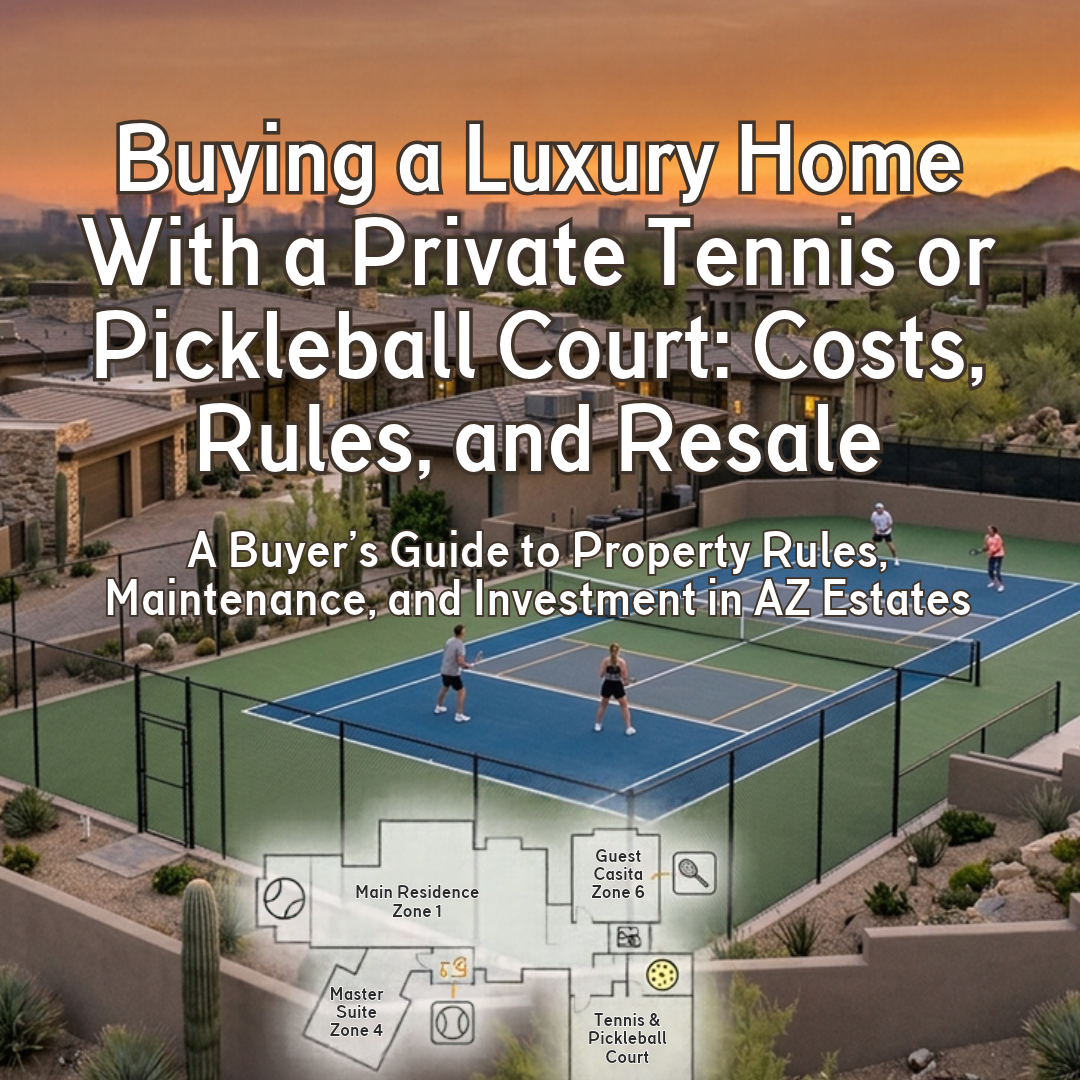
An Arizona luxury estate can offer much more than impressive architecture, resort-style swimming pools, expansive outdoor kitchens, and beautifully landscaped grounds. For homeowners who enjoy an active lifestyle, a private tennis or pickleball court can be an especially attractive feature.
Imagine stepping outside for an early morning tennis match, practicing pickleball with friends before the afternoon heat arrives, or entertaining guests with a private recreational space just steps from the main residence.
In Scottsdale, Paradise Valley, North Scottsdale, and the East Valley, outdoor amenities can contribute to the overall lifestyle experience of a luxury property. A private sports court may also complement an estate's other recreational features, creating a setting that feels more like a personal resort than a traditional residence.
However, a court's presence introduces considerations that go beyond appearance and convenience.
The surface may require specialized maintenance. Arizona's intense sunlight can affect playing conditions and certain materials. Lighting can influence evening use and neighboring properties. Zoning requirements, property setbacks, homeowners association (HOA) restrictions, and insurance considerations may also affect how the court can be used or modified.
Resale introduces another question: Will future buyers view the court as a valuable lifestyle amenity, or would they prefer the space for another purpose?
A private tennis or pickleball court should be evaluated as both a recreational feature and a long-term property improvement.
Here's what luxury buyers should investigate before purchasing an Arizona estate with a private sports court.
1. Understand How a Private Court Fits Into the Property's Overall Value
A private tennis or pickleball court can make a luxury estate stand out, particularly for buyers who prioritize recreation, fitness, and entertaining at home.
Unlike shared community facilities, a private court offers direct access without requiring reservations or travel to another location. It can also provide a dedicated space for family activities, private lessons, and friendly competitions.
Depending on the property, the court may include:
- A full-size tennis court
- A dedicated pickleball court
- A court designed for multiple sports
- Professional-grade playing surfaces
- Fencing and perimeter netting
- Integrated lighting for evening play
- Spectator seating or shaded viewing areas
- Landscaping and privacy screening
- Storage for sports equipment
- Nearby restrooms or outdoor entertaining areas
These features can enhance the property's appeal to buyers who will actively use them.
However, the presence of a court does not automatically increase a home's market value by the full amount spent constructing it.
The value of a specialized amenity depends on its condition, quality, permitted use, location, maintenance requirements, and appeal to prospective buyers.
For some households, a private court may be a major selling point. Others may see it as unnecessary space that requires ongoing upkeep.
When evaluating the estate, consider whether the court complements the home's architecture, fits the available outdoor space, and supports the lifestyle you intend to enjoy.
The goal is to determine whether the amenity provides meaningful value to you rather than assuming it will generate a guaranteed financial return.
2. Inspect the Playing Surface and Its Overall Condition
The playing surface is one of the most important components of a private sports court.
Different courts may feature acrylic hard courts, concrete bases, asphalt, synthetic turf, modular sports tiles, or other specialized materials. Each has different maintenance requirements and may respond differently to Arizona's heat, sunlight, and seasonal weather.
During the property inspection, look for visible signs of deterioration, including:
- Cracks across the playing surface
- Uneven areas or changes in elevation
- Peeling or faded surface coatings
- Standing water after irrigation or rainfall
- Loose or damaged modular tiles
- Worn lines and faded court markings
- Areas where the surface appears to be separating
- Deteriorating edges or transitions
- Visible settlement near the perimeter
Not every crack or cosmetic defect indicates a serious structural problem. However, recurring cracks or unevenness may suggest movement in the underlying base or other conditions that deserve further investigation.
Ask the seller when the court was installed, which materials were used, and whether the surface has been resurfaced or repaired.
Request available contractor invoices, warranties, and maintenance records.
If significant defects are present, consider having a qualified sports-court contractor assess the surface and determine whether localized repairs are sufficient or more extensive rehabilitation may be necessary.
A court that looks impressive from the patio may still require substantial work beneath the playing surface.
3. Evaluate the Impact of Arizona's Heat and Sun Exposure
Arizona's climate makes sun exposure an important consideration for any outdoor recreational amenity.
A private court may receive direct sunlight for much of the day, and playing conditions can become uncomfortable during hotter periods. Surface temperatures can also differ substantially from the surrounding air temperature.
The actual conditions depend on the surface material, color, exposure, shade, and time of day.
When evaluating the court, consider:
- Which direction the playing area faces
- Whether nearby structures create useful shade
- How much afternoon sunlight reaches the surface
- Whether shaded seating is available
- Whether players can access drinking water nearby
- Whether the surrounding landscape offers privacy without obstructing play
- Whether the court can be used comfortably during your preferred playing hours
A court that is enjoyable during an early morning showing may feel very different during a hot afternoon.
If possible, revisit the property at different times to understand how sunlight affects the court and nearby outdoor spaces.
Also consider whether you would need to add shade structures, trees, or covered seating to improve usability.
Any planned additions should be evaluated for drainage, structural requirements, visibility, and applicable zoning or HOA restrictions.
For Arizona buyers, the most appealing court is not necessarily the one with the largest footprint. It is the one that fits the local climate and the way the household intends to use it.
4. Understand the Maintenance Costs of a Private Sports Court
A private court can offer convenience and enjoyment, but it also creates ongoing maintenance responsibilities.
The amount of work required depends on the court's materials, age, construction quality, surrounding landscaping, and frequency of use.
Typical maintenance needs may include:
- Cleaning the playing surface
- Removing leaves, dust, and debris
- Inspecting cracks and surface deterioration
- Maintaining court lines and coatings
- Checking fencing, gates, and net posts
- Inspecting lighting and electrical components
- Managing drainage around the perimeter
- Maintaining surrounding landscaping
- Repairing damaged equipment
- Resurfacing or renovating the court when needed
A court surrounded by desert landscaping may require less routine lawn care than a traditional grass recreational area, but that does not make it maintenance-free.
Dust, windblown debris, irrigation overspray, and seasonal storms can still affect the playing surface.
Ask the seller how frequently the court is maintained and whether a landscaping or specialty contractor handles the work.
Request available invoices for resurfacing, repairs, lighting maintenance, and other improvements.
Before closing, consider obtaining estimates for any visible defects and developing a realistic annual maintenance budget.
This is particularly important for larger estates with multiple recreational amenities, where pool maintenance, landscaping, outdoor kitchens, and sports facilities may all contribute to the property's operating expenses.
5. Investigate Zoning, Permits, and Property Setbacks
A private sports court may appear to be a simple outdoor improvement, but its construction and permitted use can be subject to local requirements.
Depending on the property and jurisdiction, relevant considerations may include zoning classifications, setbacks, grading, drainage, fencing, lighting, electrical work, and other development standards.
Requirements can differ between the City of Scottsdale, the Town of Paradise Valley, other East Valley municipalities, and unincorporated areas of Maricopa County.
For example, Maricopa County's zoning ordinance contains provisions addressing private tennis courts in certain residential and rural zoning districts, including a specific setback provision. That does not mean the same rule applies to every property in the Phoenix metropolitan area. The applicable requirements must be verified for the property's actual location and circumstances. See the Maricopa County Zoning Ordinance.
Before purchasing, ask for available documentation covering:
- Original court construction
- Applicable building or development permits
- Required zoning approvals
- Grading and drainage plans
- Electrical permits for court lighting, where required
- Approved fencing and related structures
- Any subsequent renovations or expansions
If the court was installed by a previous owner, do not assume that its age establishes compliance with current or applicable historical requirements.
Contact the appropriate local planning or building department when documentation is incomplete or questions arise.
A qualified local professional can help determine whether additional verification is necessary and whether the existing court can be maintained or modified as planned.
6. Review HOA Rules and Architectural Restrictions
Some Arizona luxury properties are located in communities with homeowners associations, architectural review committees, or additional neighborhood restrictions.
Even when a court is located entirely within the property's boundaries, its construction or modification may be subject to applicable governing documents.
Restrictions can address matters such as:
- Whether private sports courts are permitted
- Court location and setbacks
- Fence height and appearance
- Lighting design and operating hours
- Noise and recreational activities
- Landscaping and privacy screening
- Construction approval requirements
- Restrictions on expanding existing amenities
An existing court does not automatically establish that every proposed modification will be approved.
For example, a buyer may want to add pickleball markings to a tennis court, install brighter lighting, or construct a shaded spectator area. Those changes could require additional review depending on local rules and the community's governing documents.
Before making an offer, request the relevant HOA covenants, conditions, and restrictions (CC&Rs), architectural guidelines, and rules.
Ask whether the existing court has documented approval and whether any unresolved compliance issues have been reported.
If the property is subject to multiple associations, verify the requirements of each applicable association.
Understanding these restrictions before closing can help you avoid purchasing a property with an amenity that cannot be used or modified in the way you expected.
7. Evaluate Court Lighting and Evening Use
Court lighting can extend playing hours and make a private recreational space more versatile.
For homeowners with busy schedules, the ability to play after work or entertain guests in the evening may be one of the court's greatest advantages.
However, lighting introduces additional considerations involving equipment condition, energy use, glare, and neighboring properties.
During due diligence, examine:
- The condition of light fixtures and mounting structures
- Whether all lights operate correctly
- Whether the illumination appears reasonably uniform
- Whether light spills onto adjoining properties
- Whether fixtures create glare from nearby windows
- Whether timers or controls are functioning
- Whether the installation has appropriate documentation
Also ask about operating hours and any existing complaints involving brightness or nighttime use.
If you intend to upgrade the lighting, investigate applicable municipal standards and HOA requirements before committing to the project.
Modern lighting may offer opportunities to improve efficiency or control light direction, but an upgrade should be evaluated in the context of the existing installation.
A court that can be used comfortably in the evening may be especially attractive in Arizona, where outdoor activities often shift toward cooler hours. Its practical value depends, however, on the quality of the installation and the conditions under which it can be operated.
8. Consider Noise, Privacy, and Neighboring Properties
A private tennis or pickleball court can create an enjoyable gathering space, but regular play may introduce noise that affects nearby properties.
Pickleball, in particular, produces distinctive paddle-and-ball sounds that some neighbors may find noticeable, especially when courts are close to homes or reflective walls.
The actual impact depends on the distance between properties, court orientation, fencing, surrounding structures, frequency of use, and time of day.
When evaluating the estate, consider:
- How close the court is to neighboring bedrooms and outdoor seating areas
- Whether nearby homes overlook the playing space
- Whether walls or other surfaces reflect sound
- Whether the court is used frequently for group gatherings
- Whether nighttime play is anticipated
- Whether existing landscaping provides useful visual screening
Ask the seller whether any complaints, disputes, or restrictions have affected the court's use.
You may also want to visit the property during a time when the court is being used, if practical and permitted.
If you plan to add sound-reduction measures, investigate which options are feasible and whether they require approval.
Landscaping, barriers, or court orientation changes may help in some situations, but their effectiveness depends on the specific conditions.
For luxury buyers who value privacy and peaceful outdoor living, the relationship between the court and the surrounding neighborhood deserves as much attention as the condition of the playing surface.
9. Investigate Drainage, Grading, and Water Runoff
Drainage is an important consideration for any large outdoor improvement.
A sports court creates an extensive hard surface that changes how rainfall and irrigation water move across the property.
If the court's grading or drainage system is inadequate, water may collect along the edges, flow toward the home, affect nearby landscaping, or contribute to erosion.
During your inspection, look for:
- Standing water or visible water stains
- Sediment collecting around the court
- Soil erosion near the perimeter
- Uneven areas that appear to retain water
- Damaged drainage channels
- Water flowing toward walls or structures
- Signs of repeated repairs around the court's edges
- Irrigation spray reaching the playing surface
Ask whether the court has experienced flooding, drainage problems, or repairs following storms.
Also determine whether the court's drainage connects to another system or relies on specific grading patterns that must be maintained.
If the property has substantial retaining walls or sits on sloping terrain, consider whether the court's installation affects the broader site drainage.
A qualified drainage professional or appropriate contractor can investigate concerning conditions and help determine whether repairs are necessary.
Addressing drainage issues early is important because unresolved water-management problems can affect both the court and other property improvements.
10. Examine Fencing, Netting, and Other Safety Features
The court's supporting structures deserve their own inspection.
Fencing helps keep balls within the playing area and can provide privacy. Netting, gates, posts, and surrounding walkways contribute to the court's usability and safety.
Over time, these features may deteriorate from sun exposure, corrosion, repeated use, or movement in the underlying ground.
Look for:
- Bent or corroded fence sections
- Loose posts or unstable supports
- Damaged gates and latches
- Torn or deteriorated netting
- Sharp edges or exposed hardware
- Uneven transitions around entry points
- Damaged walkways near the court
- Poorly positioned obstacles near the playing area
If the court includes retaining walls, elevated viewing areas, or nearby swimming pools, evaluate how people move between these spaces.
Ask for documentation of previous fence repairs or structural work, especially if the court has tall perimeter fencing or substantial support structures.
If safety concerns are present, obtain an assessment from a qualified contractor before assuming the issue can be resolved with minor repairs.
For households with children, older adults, or frequent guests, safe access and clear circulation around the court are particularly important.
11. Review Electrical Systems and Equipment
A private court may rely on more electrical infrastructure than buyers initially realize.
Lighting, automated controls, electronic scoreboards, ball machines, and nearby recreational equipment can introduce additional maintenance requirements.
The complexity depends on the installation and the features included.
During due diligence, identify the equipment that will remain with the property and determine how it is powered and controlled.
Ask about:
- Dedicated electrical circuits
- Outdoor outlets and their protection
- Lighting controls and timers
- Equipment warranties
- Previous electrical repairs
- The condition of exposed wiring or fixtures
- Any automated or remotely controlled features
Where electrical work is involved, use an appropriately qualified professional to investigate concerns.
If the court has been expanded or additional equipment installed, ask whether the changes were evaluated for electrical capacity and any applicable permit requirements.
A professionally maintained installation can support reliable use, while undocumented modifications may warrant additional investigation before closing.
12. Understand Insurance and Liability Considerations
A private sports court is an additional recreational feature on the property, and buyers should consider how it fits within their insurance arrangements.
Coverage varies by insurer, policy language, property characteristics, and the way the court is used.
A standard homeowners policy may address certain liability exposures, but buyers should not assume that every activity, structure, or incident is covered in the same way.
Before closing, discuss the property and intended court use with your insurance professional.
Questions may include:
- Is the court considered part of the insured premises?
- Are the court's lights, fencing, and other structures covered?
- Are there exclusions or special conditions?
- Would regular coaching or paid lessons change the coverage requirements?
- Would organized events or frequent guest use affect liability considerations?
- Is additional personal liability or umbrella coverage appropriate?
If you intend to hire instructors, host recurring events, or allow people outside your household to use the court, explain those plans to your insurer.
Also review any existing claims or known safety issues disclosed by the seller.
Insurance considerations should be evaluated according to your circumstances rather than assuming that a particular policy automatically covers every recreational use.
Understanding the coverage before moving in can help you plan appropriately and reduce uncertainty about the risks associated with the amenity.
13. Determine Whether the Court Can Be Converted or Repurposed
Not every future owner will want to keep a tennis or pickleball court indefinitely.
Some buyers may prefer a larger landscaped yard, a putting green, additional outdoor entertaining space, or a different recreational feature.
If you are considering a property with a specialized court, investigate whether the space can realistically accommodate alternative uses.
Consider:
- The size and shape of the existing court
- The condition of the underlying base
- Whether the surface can be removed or modified
- Whether drainage would need to be redesigned
- Whether fencing and lighting can be reused
- Whether landscaping can be added without creating new problems
- Whether the planned changes require HOA or municipal approval
- The likely cost of removal and restoration
Repurposing a court may be relatively straightforward in some situations, but other projects can involve substantial demolition, grading, drainage work, and landscaping.
Do not assume that removing the painted surface alone will turn the area into a functional garden or lawn.
Ask a qualified contractor to assess the existing construction and provide an estimate for your intended alternative.
Understanding the property's flexibility can be especially helpful if you enjoy the estate but do not expect to use the court frequently.
14. Evaluate the Court's Appeal to Future Buyers
A private sports court can differentiate a luxury property, but its influence on resale depends on the buyer pool and the overall quality of the estate.
For buyers who regularly play tennis or pickleball, a private court may be a highly desirable feature. It can offer convenience, privacy, and the opportunity to exercise without leaving home.
For other buyers, the same space may represent additional maintenance, limited landscaping flexibility, or an amenity they would rarely use.
The court's condition and presentation can also influence how prospective buyers perceive it.
A well-maintained surface, functional lighting, attractive landscaping, and clear documentation may make the feature easier to appreciate.
Conversely, visible cracks, deteriorating fencing, drainage problems, or uncertain compliance can raise questions about future expenses.
When assessing resale potential, consider:
- Whether private courts are common in comparable properties
- Whether the court complements the home's price point
- Whether the property appeals to active households
- Whether the court is professionally maintained
- Whether the space can be adapted for other uses
- Whether the amenity creates noise or privacy concerns
- Whether similar homes with recreational features attract buyer interest
A real estate professional familiar with the local luxury market can help evaluate comparable properties and discuss how specialized amenities are viewed by prospective buyers.
There is no universal resale premium for a private court. Its contribution to marketability depends on the property's overall appeal and the preferences of the buyers most likely to consider it.
15. Compare the Cost of Keeping, Renovating, or Removing the Court
The most useful financial analysis considers more than the court's original construction cost.
Once you understand its condition and your plans for the space, compare the likely costs of keeping it as-is, upgrading it, or removing it.
Potential expenses may include:
- Routine surface cleaning and maintenance
- Crack repairs and resurfacing
- Fence and net replacement
- Lighting repairs or upgrades
- Drainage improvements
- Landscaping and privacy screening
- Electrical work
- Court equipment replacement
- Demolition and site restoration
Actual costs depend on the surface type, court dimensions, accessibility, condition, contractor availability, and scope of work.
For example, a court requiring only minor maintenance may be relatively easy to retain, while a surface with recurring structural cracks may warrant a more comprehensive assessment.
If renovation or removal is being considered, obtain estimates from qualified contractors before your inspection or negotiation period expires, where practical.
Compare those costs with the benefits you expect to receive from the amenity.
The decision should reflect how you intend to use the property, the financial commitment involved, and the feasibility of your long-term plans.
A Murphy Group Arizona Perspective
“A luxury property's outdoor amenities should complement the owner's lifestyle while making sense for the property's long-term ownership. A private tennis or pickleball court can be an exceptional feature for the right buyer, but its condition, maintenance requirements, permitted use, and flexibility should all be considered before making a commitment.”
— Mary Murphy, The Murphy Group Arizona
For buyers exploring luxury real estate in Arizona, a private court can offer a distinctive recreational experience. The key is understanding the full picture, from the playing surface and supporting structures to neighborhood considerations and future ownership costs.
The Bottom Line
A luxury home with a private tennis or pickleball court can offer convenience, recreation, privacy, and an additional way to enjoy Arizona's outdoor lifestyle.
However, the court also comes with responsibilities that extend beyond its appearance.
Before purchasing, inspect the playing surface, investigate maintenance history, review zoning and HOA requirements, evaluate lighting and drainage, and consider insurance and liability questions.
Determine whether the existing court supports your intended use and whether future modifications would be practical. If major repairs or renovations are anticipated, obtain professional assessments and estimates before finalizing your decision.
Most importantly, consider how the amenity fits into the property's overall value, operating costs, and long-term appeal.
The best luxury property is not simply the one with the most impressive recreational amenities. It is the one whose features, condition, and ongoing responsibilities align with your lifestyle and ownership goals.
Explore Arizona Luxury Real Estate With The Murphy Group Arizona
If you're considering a luxury home in Scottsdale, Paradise Valley, North Scottsdale, or the East Valley, The Murphy Group Arizona can help you look beyond the listing photos and consider the property, neighborhood, and long-term ownership experience.
From private tennis and pickleball courts to resort-style outdoor living, landscaping, property infrastructure, and lifestyle considerations, a thoughtful approach to due diligence can help you make a more informed decision.
Explore Arizona luxury real estate with The Murphy Group Arizona and discover your next exceptional property.
Website: www.mgsellsarizona.com

Mary Murphy
Team Leader | The Murphy Group - AZ | eXp Luxury | PLACE
or another way