

Categories
Arizona Real Estate, Arizona Luxury, Scottsdale Real Estate, Scottsdale Luxury Real Estate, Paradise Valley Real Estate, Paradise Valley Luxury, Luxury Outdoor Living, North Scottsdale homes, North Scottsdale real estate, Arizona homebuyersPublished November 11, 2026
Arizona Luxury Homes With Rooftop Terraces: Privacy, Structural Limits, and Buyer Considerations

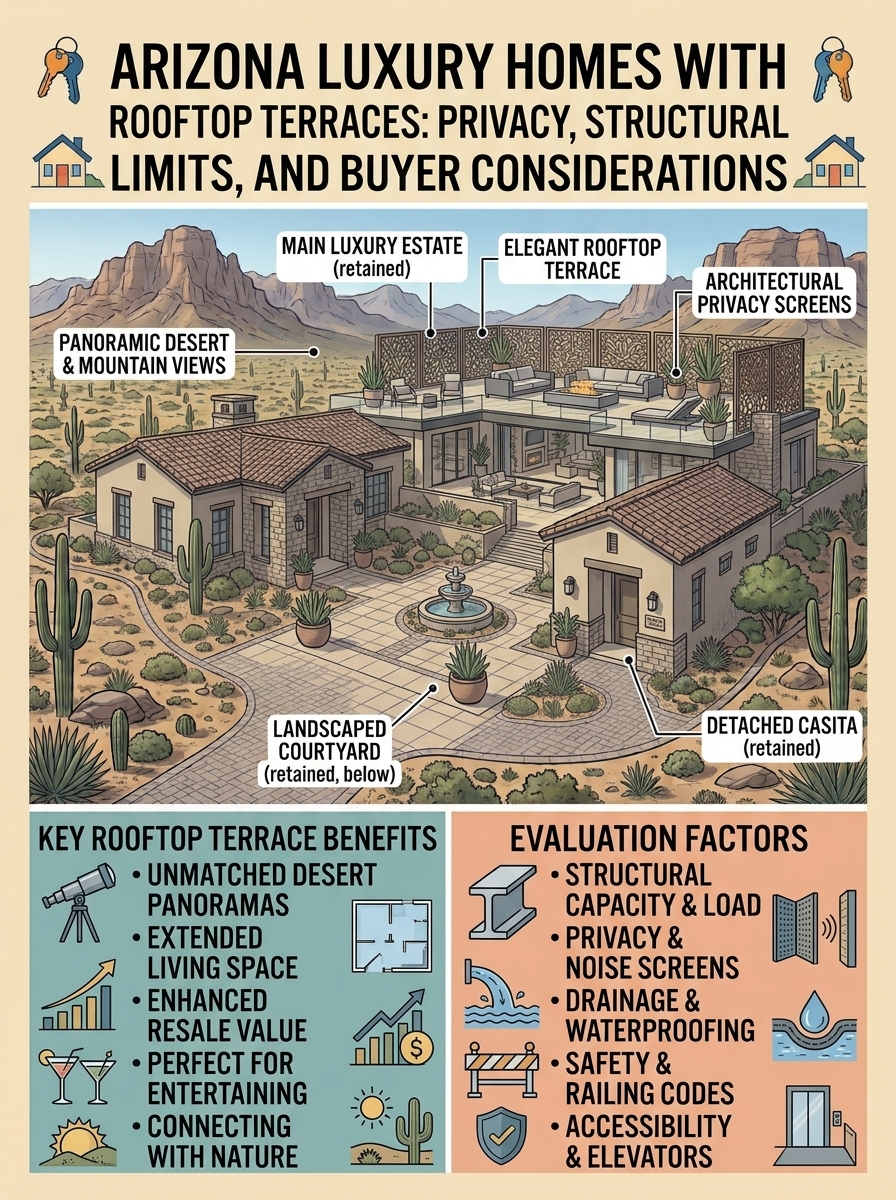
A rooftop terrace can transform the way a luxury home is experienced. Elevated above the surrounding property, it can provide panoramic views, a private outdoor retreat, and an additional space for entertaining, dining, or relaxing under the Arizona sky.
In Scottsdale, Paradise Valley, North Scottsdale, and the East Valley, rooftop terraces can be particularly appealing in contemporary residences, hillside estates, and custom homes designed around expansive outdoor living. Some feature comfortable lounge areas and outdoor kitchens, while others include fireplaces, shade structures, landscaped seating areas, or unobstructed views of the surrounding desert and mountains.
However, a rooftop terrace is more than an attractive architectural feature. It is an elevated outdoor space that depends on structural support, waterproofing, drainage, protective railings, and carefully planned access.
Buyers should also consider privacy. An elevated terrace may provide beautiful views, but it can also create sightlines toward neighboring properties, nearby streets, or other private outdoor spaces.
Before purchasing an Arizona luxury home with a rooftop terrace, buyers should understand how the space was designed, what it can safely accommodate, and what responsibilities may come with maintaining it.
1. Understand How the Rooftop Terrace Was Originally Designed
Not every rooftop terrace is constructed for the same purpose.
Some are designed as fully usable outdoor living areas, while others may be limited to occasional access for maintenance or equipment servicing. A flat roof, for example, should not automatically be treated as an approved recreational terrace.
Buyers should establish whether the space was originally designed and approved for regular occupancy and outdoor use.
Ask for:
- Original architectural plans
- Structural engineering documents
- Building permits
- Approved rooftop terrace layouts
- Records of later modifications
- Final inspection or approval documentation, where applicable
It is also important to understand whether the terrace was part of the original construction or added during a later renovation.
A rooftop area that appears finished with attractive flooring, furniture, and landscaping may still require verification of its approved use.
The original design documentation can help buyers distinguish between a purpose-built terrace and a roof area that has been adapted for outdoor use.
2. Evaluate the Structural Capacity of the Terrace
One of the most important considerations is whether the rooftop terrace can safely support its intended use.
An elevated outdoor space may need to accommodate people, furniture, planters, shade structures, outdoor kitchens, and other features. Each addition can contribute weight to the structure.
Buyers should not assume that a terrace can support every feature simply because it has enough physical space.
Ask whether the structural design accounts for:
- The expected number of occupants
- Outdoor furniture and lounge seating
- Large decorative planters
- Built-in benches
- Outdoor kitchen equipment
- Pergolas and shade structures
- Fire features
- Water features or other heavy installations
The actual allowable loads depend on the original engineering and applicable building requirements.
A qualified structural engineer should review the available documentation and evaluate any concerns about the terrace's intended use.
This is especially important if the seller has added substantial features that were not part of the original construction.
3. Investigate Whether the Terrace Has Been Modified
A rooftop terrace may look different today from the way it appeared when the home was originally completed.
Previous owners may have added decking, planters, outdoor kitchens, shade structures, or other improvements to make the space more functional.
Although these additions may enhance the property's appearance, they can also introduce structural and waterproofing considerations.
Buyers should ask:
- Have any permanent structures been added?
- Was the original terrace modified?
- Were additional supports installed?
- Has the surface material been replaced?
- Were new electrical or plumbing connections added?
- Were permits obtained for applicable modifications?
- Are updated structural plans available?
Pay particular attention to heavy installations, including masonry features, large planters, built-in seating, and water elements.
If modifications cannot be verified through documentation, a qualified professional should assess whether additional investigation is necessary.
4. Inspect Waterproofing and Roof Protection
Waterproofing is one of the most critical elements of a rooftop terrace.
Because the terrace is directly above part of the home's structure, its waterproofing system helps protect the roof assembly and potentially the living spaces below.
A failure in the waterproofing system can allow water to enter the building, causing damage that may not become visible immediately.
Buyers should look for:
- Cracks or deteriorating surface finishes
- Signs of water staining
- Bubbling or peeling materials
- Areas where water appears to collect
- Deteriorated sealant around penetrations
- Evidence of previous patchwork repairs
- Moisture-related damage on ceilings below the terrace
Ask the seller when the waterproofing system was last inspected or repaired.
It is also helpful to identify the type of waterproofing assembly used and whether maintenance records are available.
A qualified roofing or waterproofing professional can evaluate the system and identify visible concerns.
Buyers should remember that attractive terrace flooring does not necessarily reveal the condition of the waterproofing underneath.
5. Examine Drainage and Water Management
An elevated terrace needs a drainage system that can manage rainwater and prevent prolonged water accumulation.
Arizona's relatively dry climate does not eliminate this concern. During monsoon storms, heavy rainfall can occur over short periods, making effective drainage particularly important.
Depending on the design, a rooftop terrace may use:
- Roof drains
- Scuppers
- Drainage channels
- Sloped surfaces
- Secondary drainage provisions
- Overflow outlets
Buyers should ask where water flows after it reaches the terrace surface and whether the drainage system has been professionally maintained.
During a property visit, look for:
- Standing water
- Blocked drainage openings
- Debris around drains
- Water staining near exterior walls
- Deteriorated sealant
- Signs of overflow or previous leakage
It is also worth asking whether the terrace has experienced drainage problems during heavy storms.
A qualified professional can assess whether the drainage arrangement is appropriate for the design and whether any repairs or maintenance are recommended.
6. Consider Arizona's Monsoon Conditions
Rooftop terraces are directly exposed to outdoor weather conditions. In Arizona, that means buyers should consider intense sunlight, high temperatures, blowing dust, and seasonal storms.
Monsoon conditions can bring strong winds and heavy rain, creating additional demands on outdoor furniture, shade structures, railings, and drainage systems.
Buyers should evaluate:
- How exposed the terrace is to prevailing winds
- Whether furniture can be secured or stored
- Whether shade structures are properly anchored
- Whether water drains away from doors and walls
- Whether outdoor electrical fixtures are appropriately rated
- Whether loose decorative items could become hazards during storms
If the terrace includes umbrellas, retractable awnings, pergolas, or other movable features, ask how they should be secured during severe weather.
Buyers should also determine whether the property has a maintenance routine for clearing drains and removing debris before and after storm events.
7. Evaluate Privacy From Neighboring Properties
An elevated terrace can provide a sense of separation from street-level activity, but it may also create direct views into neighboring properties.
Privacy should be evaluated from the actual terrace rather than inferred from the home's exterior appearance.
Consider:
- Can neighboring homes see the terrace?
- Are nearby second-story windows at similar elevations?
- Does the terrace overlook adjacent pools or patios?
- Are there direct sightlines toward neighboring bedrooms?
- Can people on nearby properties see into the main residence?
- Does the terrace provide privacy when occupied at night?
Some homes use architectural screens, privacy walls, landscaping, or strategically positioned seating to improve separation.
However, buyers should also consider whether those features obstruct desirable views or make the space feel enclosed.
A terrace should provide a comfortable balance between openness and privacy.
8. Understand the Height and Design of Guardrails
Because rooftop terraces are elevated, protective barriers are an essential safety consideration.
Buyers should examine the condition, design, and installation of guardrails around the usable terrace area.
Depending on the applicable building requirements and the property's original approval, important features may include:
- Guardrail height
- Structural attachment
- Glass panel condition
- Secure connections
- Gaps and openings
- Handrails where required
- Protection around stair openings and other exposed edges
If the terrace uses glass railings, inspect the panels for cracks, chips, loose fittings, and deterioration around their supporting hardware.
A beautiful glass railing should not be assumed safe simply because it looks intact.
Have a qualified professional evaluate any visible concerns and confirm whether the installation is consistent with the applicable requirements.
9. Review Access to the Rooftop Terrace
The way people reach the rooftop terrace affects both convenience and everyday usability.
Some luxury homes provide direct access from an upper-level bedroom or hallway, while others use an exterior stairway or a dedicated elevator.
Buyers should evaluate:
- Whether access is through an interior or exterior entrance
- The condition of the stairs
- Door operation and locking hardware
- Lighting along the access route
- The ease of moving furniture and equipment
- Whether the route is convenient for guests
- Whether the terrace can be accessed without passing through private rooms
If the home has a private elevator, determine whether it serves the terrace level and whether the elevator's approved stops and access arrangements are documented.
Also consider whether the terrace is practical for household members with mobility limitations.
A rooftop terrace may be visually impressive, but its value as a daily living space depends partly on how comfortably people can reach it.
10. Consider Sun Exposure and Shade
Arizona's sunshine can make rooftop terraces enjoyable throughout much of the year, but the same exposure can make certain spaces uncomfortable during hot weather.
Because rooftops are often more exposed than ground-level patios, buyers should carefully evaluate the amount of direct sunlight the terrace receives.
Consider:
- Which direction does the terrace face?
- Does it receive intense afternoon sunlight?
- Is there a covered seating area?
- Are permanent shade structures installed?
- Are retractable awnings available?
- Is there enough shaded space for dining and relaxation?
- Do nearby structures provide any natural protection?
Visit the property at different times of the day if possible.
A terrace that feels pleasant during a morning showing may become significantly hotter in the afternoon.
Buyers should also ask whether the shade structures are permanent, removable, or motorized, and whether their installation has been appropriately documented.
11. Evaluate Outdoor Kitchens, Fire Features, and Other Installations
Some luxury rooftop terraces are designed as fully equipped outdoor entertaining areas.
They may include built-in grills, sinks, refrigerators, fireplaces, fire pits, or other specialized equipment.
These features can make the terrace more functional, but each one introduces additional maintenance and safety considerations.
For outdoor kitchens, evaluate:
- Gas and electrical connections
- Plumbing and drainage
- Appliance condition
- Ventilation and clearances
- Weather protection
- Countertop and cabinet condition
For fire features, buyers should determine whether the installation was properly approved and whether the gas or fuel system has been professionally maintained.
The placement of these features also matters. They should not interfere with access routes, create unsafe conditions near railings, or compromise the terrace's intended use.
A qualified contractor or relevant trade professional can evaluate specialized installations before closing.
12. Review Electrical, Lighting, and Smart-Home Features
A well-designed rooftop terrace may include lighting, electrical outlets, speakers, automated shades, and smart-home controls.
These systems can improve the usability of the space, especially for evening entertaining.
Buyers should check:
- Exterior lighting condition
- Weather-appropriate electrical fixtures
- Outlet locations
- Electrical panel capacity
- Outdoor audio equipment
- Automated shade controls
- Smart-home integration
- Available documentation for installed systems
Ask whether the terrace lighting and electrical components were installed as part of the original approved construction or added later.
If the terrace includes electrical outlets near water features or outdoor kitchen equipment, have a licensed electrician assess the installation as appropriate.
It is also worth confirming whether smart-home controls can be transferred to the new owner and whether any subscriptions or separate services are required.
13. Investigate Wind Exposure and Furniture Stability
Rooftop terraces may experience different wind conditions from areas closer to ground level.
The level of exposure depends on the home's height, surrounding buildings, terrain, and the terrace's orientation.
Buyers should consider how wind may affect:
- Outdoor dining furniture
- Lounge seating
- Umbrellas
- Retractable awnings
- Decorative screens
- Planters
- Lightweight accessories
A terrace with large open sections may require furniture and accessories specifically suited to exposed outdoor environments.
Ask the seller whether certain items need to be secured or removed during strong winds.
If the terrace includes permanent shade structures or screens, confirm that their installation and anchoring have been appropriately evaluated.
14. Understand Maintenance Requirements and Long-Term Costs
A rooftop terrace is an outdoor living space, but it is also part of the building's roof assembly.
That means buyers should consider both the upkeep of the visible terrace and the condition of the systems beneath it.
Potential maintenance expenses may include:
- Waterproofing inspections and repairs
- Drain cleaning
- Surface and tile repairs
- Sealant replacement
- Guardrail maintenance
- Exterior lighting repairs
- Pergola and shade-system servicing
- Outdoor kitchen maintenance
- Furniture and finish replacement
If the terrace has extensive landscaping or built-in planters, additional maintenance may be needed for irrigation, drainage, and waterproofing protection.
Ask the seller for maintenance records and details of previous repairs.
It is also helpful to understand whether any major components are approaching the end of their expected service life.
A professional inspection can help buyers identify issues that may require attention shortly after closing.
15. Consider How the Rooftop Terrace Affects the Home's Resale Appeal
A rooftop terrace can be a distinctive feature in an Arizona luxury property, particularly when it provides attractive views and a well-designed outdoor environment.
However, its contribution to resale appeal depends on more than its size.
Buyers should consider whether the terrace:
- Offers meaningful views
- Provides comfortable shaded areas
- Has practical access
- Maintains reasonable privacy
- Is structurally suitable for its intended use
- Has well-maintained waterproofing and drainage
- Complements the home's architectural design
- Is easy to maintain
A thoughtfully designed rooftop terrace may appeal to future buyers who value outdoor entertaining and elevated living spaces.
On the other hand, a terrace with privacy concerns, difficult access, limited shade, or unresolved structural and waterproofing issues may require additional investment.
Buyers should consider the terrace as part of the property's overall appeal rather than assuming that the feature automatically increases market value.
16. Verify Permits, Inspections, and Property Restrictions
Before purchasing a home with a rooftop terrace, buyers should review the available records associated with its construction and use.
Depending on the property and local jurisdiction, relevant documents may include:
- Approved architectural plans
- Structural engineering calculations
- Building permits
- Inspection records
- Waterproofing specifications
- Guardrail and railing details
- Electrical and plumbing permits
- Documentation of later modifications
If the terrace was added after the home was completed, buyers should pay particular attention to whether the work was properly approved.
Local building requirements can differ by jurisdiction and may change over time. For example, Phoenix adopted its 2024 Building Construction Code effective August 1, 2025, while Scottsdale publishes its own building code and permitting guidance.
Buyers should verify the requirements applicable to the property's location and construction date rather than assuming that another city's standards apply.
If the property is part of a homeowners association, review the applicable CC&Rs and other recorded restrictions for provisions affecting rooftop use, exterior modifications, noise, and shared areas.
Questions Luxury Buyers Should Ask Before Purchasing
Before making an offer on an Arizona luxury home with a rooftop terrace, consider asking the seller the following:
Construction and structural capacity
- Was the terrace included in the original construction plans?
- Is it approved for regular occupancy and recreational use?
- Are structural engineering documents available?
- Have heavy features or permanent structures been added?
- Has the terrace undergone any structural modifications?
Waterproofing and drainage
- What waterproofing system was installed?
- When was it last inspected?
- Has the home experienced water intrusion below the terrace?
- Are drains and overflow outlets regularly maintained?
- Have there been previous roof or terrace repairs?
Privacy and safety
- Can neighboring properties see into the terrace?
- Are the guardrails in good condition?
- Have glass railings been professionally evaluated?
- Is the access route safe and convenient?
- Are there any restrictions on terrace use?
Outdoor features
- Are shade structures permanently installed?
- Are outdoor kitchens and fire features properly documented?
- Are electrical and plumbing connections in good condition?
- Is the furniture designed for the terrace's wind exposure?
Ownership and maintenance
- Are maintenance records available?
- Are there outstanding repairs?
- What are the expected annual maintenance requirements?
- Have any structural or waterproofing concerns been identified?
These questions can help buyers understand the rooftop terrace as a functional part of the property rather than simply an attractive outdoor feature.
The Murphy Group Arizona Perspective
A rooftop terrace can add a distinctive dimension to a luxury home, especially when it captures Arizona's desert scenery and provides a comfortable setting for outdoor living.
However, the best terraces are not defined by views alone. They should also be thoughtfully designed, structurally appropriate, private enough for the homeowner's preferences, and practical to maintain.
As Mary Murphy of The Murphy Group Arizona explains:
“A beautiful rooftop terrace can create an entirely different experience of a home. But buyers should look beyond the view and understand how the space was designed, how it is protected from the elements, and whether it truly supports the way they want to live.”
For buyers exploring luxury properties in Scottsdale, Paradise Valley, North Scottsdale, and the East Valley, evaluating the terrace alongside the home's structure, roof system, privacy, and outdoor features can provide a more complete picture of the property.
The goal is to find a home where elevated outdoor living is not only visually impressive but also functional and thoughtfully maintained.
The Bottom Line: Look Beyond the View
An Arizona luxury home with a rooftop terrace can offer an exceptional outdoor living experience, combining elevated views, entertaining space, and architectural distinction.
But before purchasing, buyers should carefully evaluate the structural capacity, waterproofing, drainage, guardrails, access, privacy, sun exposure, and maintenance requirements.
It is particularly important to verify that the terrace was designed and approved for its intended use. Buyers should also arrange appropriate professional evaluations when structural, roofing, or waterproofing questions arise.
A rooftop terrace should be considered an extension of the home's overall building system, not simply an attractive space above the roof.
When its design, condition, and intended use are properly understood, buyers can make a more informed decision about whether the property offers the outdoor lifestyle and long-term ownership experience they expect.
Explore Arizona Luxury Real Estate With The Murphy Group Arizona
If you're considering a luxury home in Scottsdale, Paradise Valley, North Scottsdale, or the East Valley, The Murphy Group Arizona can help you look beyond the listing photos and consider the property, neighborhood, and long-term ownership experience.
From rooftop terraces and elevated outdoor living to structural considerations, privacy, waterproofing, and property maintenance, a thoughtful approach to due diligence can help you make a more informed decision.
Explore Arizona luxury real estate with The Murphy Group Arizona and discover your next exceptional property.
Website: www.mgsellsarizona.com

Mary Murphy
Team Leader | The Murphy Group - AZ | eXp Luxury | PLACE
or another way