

Categories
Scottsdale Real Estate, Scottsdale Luxury Real Estate, Paradise Valley Luxury, Paradise Valley Real Estate, North Scottsdale homes, North Scottsdale real estate, Arizona Luxury, Arizona Real Estate, Private Guest Casitas,, Guest House Permits, Luxury Property Due Diligence, Short-Term Rental Restrictions, East Valley, East Valley Luxury, East Valley real estatePublished October 13, 2026
Arizona Luxury Homes With Private Guest Casitas: Understanding Permitted Uses and Restrictions

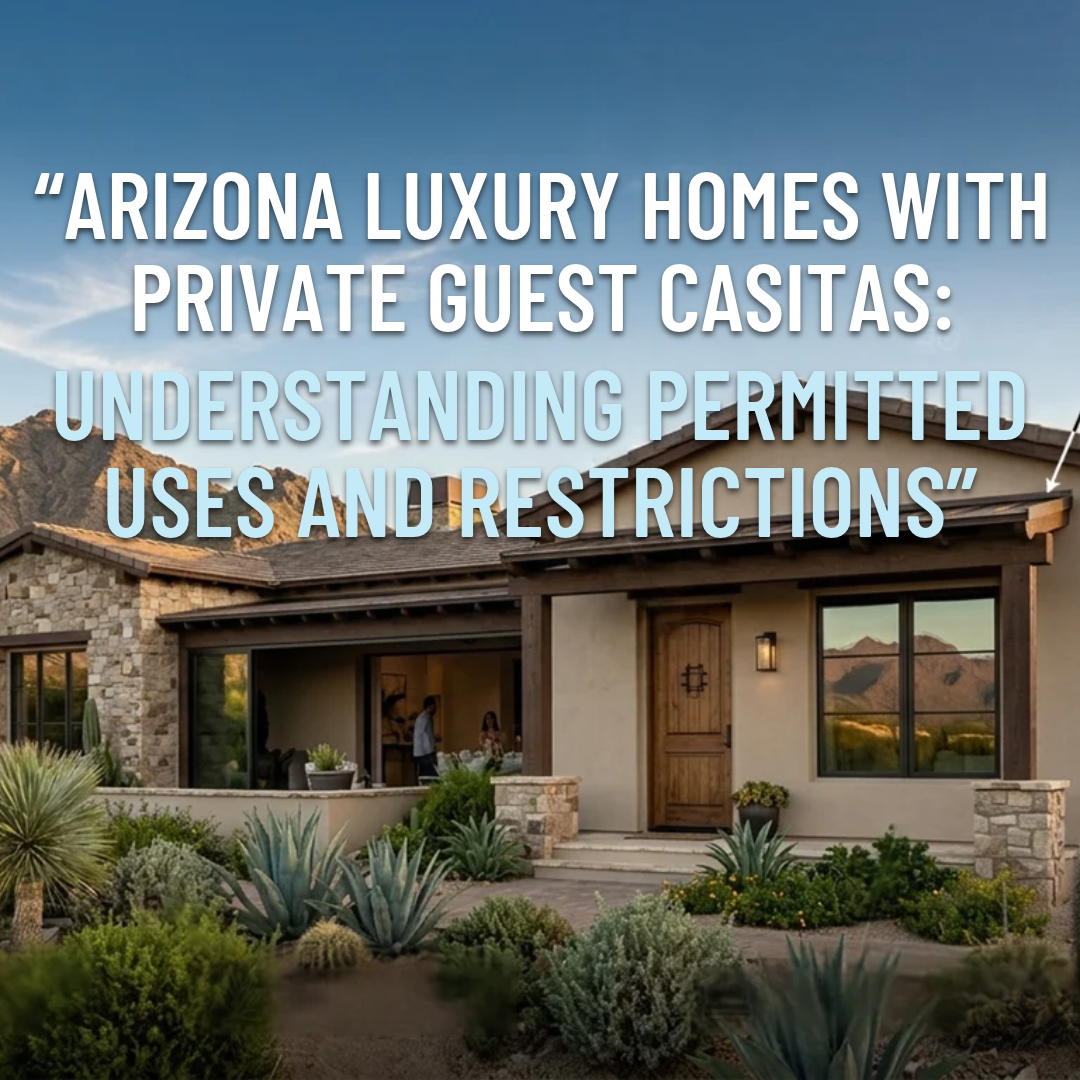
Imagine discovering an Arizona luxury estate that offers everything you've been searching for.
The main residence features expansive living spaces, elegant finishes, a resort-style pool, and breathtaking desert or mountain views. Beyond the primary home, a separate guest casita provides additional privacy, creating a comfortable retreat for visiting family, friends, or other guests.
For some buyers, the casita is one of the property's most appealing features.
It could provide a private space for aging parents, accommodate adult children returning home, give overnight guests greater independence, or create a peaceful retreat away from the main living areas.
Depending on the property's location and applicable regulations, buyers may also wonder whether the casita can be rented separately, used as a vacation rental, or adapted into an accessory dwelling unit.
But there is an important distinction to understand: a structure that looks like an independent residence is not necessarily permitted to operate as one.
A casita's appearance, kitchen facilities, private entrance, and bathroom do not independently establish what uses are legally allowed. Its permitted use may depend on local zoning regulations, building permits, utility arrangements, recorded restrictions, and the property's specific approvals.
For example, Scottsdale distinguishes between a guest house intended to accommodate guests of the main residence and an accessory dwelling unit (ADU), which may be rented separately when the applicable requirements are met.
These distinctions matter when purchasing a high-value property, especially if the casita is a major reason for buying the estate.
Before closing, buyers should understand what the structure is approved for, what restrictions apply, and whether their intended use is legally and practically feasible.
Here's what Arizona luxury buyers should investigate before making a commitment.
1. Determine Whether the Casita Is Legally Classified as a Guest House or an ADU
The first step is establishing the casita's legal classification.
In everyday real estate descriptions, terms such as casita, guesthouse, guest suite, and detached living quarters are often used interchangeably. However, the terminology in a listing does not necessarily reflect the property's official zoning classification.
A guest house may be intended for visitors staying in connection with the primary residence, while an ADU is generally a secondary, self-contained dwelling associated with a primary home.
The distinction can affect whether separate occupancy, independent rental, utility arrangements, and other uses are permitted.
Before proceeding, ask:
- How is the structure classified in the property's approved plans and municipal records?
- Was it approved as a guest house, ADU, or another type of accessory structure?
- Does the approved use match the structure's current configuration?
- Does it contain a kitchen, bathroom, sleeping area, or separate entrance?
- Are there restrictions on who may occupy it?
- Is separate rental use allowed under the applicable regulations?
Do not assume that the presence of a full kitchen automatically makes the structure a legally approved dwelling unit.
Likewise, a building described as a guest casita in a marketing brochure may have a different permitted use from what a buyer expects.
Request the relevant permit records and have the property's classification confirmed by the appropriate local planning or building department.
2. Verify the Local Zoning Rules Before Assuming the Casita Can Be Rented
Arizona does not have one uniform set of local zoning rules governing every residential casita. Requirements can differ between cities, towns, counties, and specific zoning districts.
Scottsdale provides a useful example of why this distinction matters.
Under the city's published rules, a guest house cannot be rented independently from the main single-family residence. By contrast, qualifying ADUs may be rented separately, subject to applicable requirements.
For buyers considering properties in Scottsdale, Paradise Valley, or other Arizona communities, the appropriate approach is to verify the rules that apply to the exact parcel.
Ask the local jurisdiction:
- Is the existing casita an approved use for this property?
- Can it be occupied independently of the main residence?
- Is long-term rental use permitted?
- Is short-term rental use permitted?
- Are there occupancy or owner-residency requirements?
- Are there restrictions on separate entrances, parking, or utilities?
- Does the property's zoning impose additional conditions?
A property with a beautifully finished casita may still be unsuitable for a buyer whose plans depend on independent rental income.
If rental flexibility is important to your purchase, obtain confirmation of the applicable requirements before treating the casita as an income-producing asset.
3. Confirm That the Casita Was Built With the Required Permits
A finished interior does not establish that a casita was properly permitted.
Some properties may have been expanded or remodeled over time, including the addition of bathrooms, kitchens, plumbing, electrical systems, or separate living areas. Work completed by a previous owner may not have received all the approvals required at the time.
Before closing, request the available documentation for the original construction and any subsequent modifications.
Look for:
- Building permits and approved construction plans
- Final inspection records or certificates, where applicable
- Plumbing and electrical permits
- Records of additions or structural alterations
- Documentation of any approved change in use
- Records confirming the permitted size and location
For example, the Town of Paradise Valley identifies guest houses among the structures requiring a building permit application.
If the casita appears to have been built without permits, or the available records do not match its current configuration, ask the relevant building department how the discrepancy should be addressed.
Unpermitted work may require additional inspections, corrective construction, or other approvals. The outcome depends on the circumstances and the applicable local requirements.
Do not assume that an older structure is automatically exempt from review simply because it has existed for years.
The goal is to establish whether the casita's construction, current configuration, and intended use are adequately documented before you take ownership.
4. Understand Size, Setback, and Lot Coverage Restrictions
A casita may fit comfortably within the property's landscaping while still being subject to zoning restrictions affecting its size or location.
Local regulations can govern building height, setbacks from property lines, lot coverage, separation between structures, and the placement of accessory buildings.
These requirements can be particularly important for luxury estates with expansive patios, swimming pools, retaining walls, landscaped courtyards, or multiple detached structures.
Scottsdale, for example, applies specific size and setback requirements to guest houses and ADUs. Its guest-house rules generally limit the combined floor area of guest houses to no more than half the floor area of the main residence, while its ADU rules establish different size limits and development standards.
When evaluating a property, investigate:
- The casita's approved floor area
- Its distance from property boundaries
- Its location relative to the main residence
- Applicable height and lot coverage limits
- Any required separation between buildings
- Whether the structure occupies a restricted area
- Whether the existing layout matches approved plans
If you intend to enlarge the casita or add another detached structure, do not assume that the property's acreage alone makes the project permissible.
Have the local jurisdiction or a qualified design professional evaluate the parcel's zoning and development standards before budgeting for an expansion.
5. Investigate Kitchen and Bathroom Facilities
The interior configuration of a casita can influence how it is classified and used.
A simple guest suite may include a bedroom and bathroom, while a more independent unit may contain a kitchen, sleeping area, and sanitary facilities.
However, the legal significance of these features depends on the local definition of a guest house, ADU, or other permitted structure.
During due diligence, establish which facilities were approved and whether the existing layout is consistent with those approvals.
Questions to consider include:
- Was the kitchen included in the approved plans?
- Were plumbing and electrical installations properly permitted?
- Does the current layout match the recorded or approved configuration?
- Is the structure approved for independent residential occupancy?
- Would converting a wet bar into a full kitchen change the applicable requirements?
- Would adding a bathroom or separate entrance require additional approvals?
These questions matter if you plan to use the casita for extended family visits, independent living, or rental purposes.
For example, a buyer may assume that adding a small kitchen will make a guest suite suitable for independent rental. Depending on the jurisdiction and the existing approval, that change could require additional review.
Before undertaking modifications, confirm the proposed work with the relevant building and planning departments.
6. Review Utility Connections and Infrastructure
A private casita can place additional demands on a property's water, sewer, electrical, gas, and heating or cooling systems.
The permitted utility arrangement may also differ depending on whether the structure is classified as a guest house or an ADU.
Scottsdale's published requirements illustrate this distinction: guest houses must share the main residence's utility connections and cannot be separately metered, while ADUs have specific requirements for separately metered electrical and gas connections and separate private-side water and sewer connections to the existing public connections. <Cite refs={["turn835230search0","turn835230search2"]}/>
For properties in other Arizona communities, verify the applicable local standards rather than assuming Scottsdale's rules apply.
Ask for information about:
- Electrical capacity and approved connections
- Water and sewer arrangements
- Gas connections, if applicable
- Heating and cooling equipment
- Hot-water systems
- Drainage and wastewater infrastructure
- Utility metering and billing arrangements
- The system's ability to support the intended occupancy
If the casita relies on a private well or septic system, additional investigation may be necessary to establish whether the existing infrastructure is appropriate for the property's current and proposed use.
For an estate with several structures, a qualified contractor can help identify whether additional capacity or upgrades may be needed.
7. Determine Whether Separate Rental Income Is Actually Permitted
Some buyers view a private casita as an opportunity to generate rental income or offset the cost of maintaining a luxury property.
That possibility should be evaluated carefully.
A casita that is suitable for family accommodation may not be approved for independent rental. Even where separate rental is allowed, additional conditions may govern occupancy, owner residency, utility arrangements, registration, or other requirements.
In Scottsdale, an approved ADU may be rented separately when the applicable rules are satisfied, while a guest house cannot be rented independently from the main residence.
Before relying on potential income, verify:
- The structure's official classification
- Whether independent rental is allowed
- Any owner-occupancy requirements
- Whether long-term and short-term rentals are treated differently
- Applicable registration or tax obligations
- Any restrictions imposed by recorded covenants or an HOA
- Whether the existing structure meets the necessary requirements
Avoid estimating a property's investment return using rental income that has not been verified as permissible.
If rental flexibility is central to your purchase, obtain appropriate confirmation and discuss the proposed use with a real estate professional and, where necessary, a qualified attorney.
8. Understand Short-Term Rental Restrictions
The ability to rent a casita independently on a long-term basis does not automatically mean that every form of short-term rental is allowed.
Short-term rentals may be subject to different operational requirements, including registration, taxes, emergency contacts, occupancy limitations, and restrictions on certain nonresidential activities.
Scottsdale's published rules distinguish between approved dwelling units and accessory guest houses and require the main residence and accessory guest house to be offered for rent together rather than independently when operated as a vacation or short-term rental under those rules. The city also identifies registration and other operational obligations.
If you are considering vacation rental use, verify:
- Whether the casita qualifies for the intended rental arrangement
- Whether it can be advertised separately
- Whether the main residence must be rented with it
- What registration and tax requirements apply
- Whether occupancy limits affect your plans
- Whether neighborhood restrictions or private covenants apply
- Whether the property can be used for the intended commercial or residential purpose
Do not confuse permission to operate a short-term rental with permission to host events, operate a commercial venue, or use the property for other activities.
The rules governing each activity may be different.
9. Check HOA Rules, CC&Rs, and Recorded Restrictions
Local zoning approval is only one part of the investigation.
A luxury estate may also be subject to a homeowners association, recorded covenants, conditions and restrictions (CC&Rs), architectural guidelines, or other private agreements.
These documents may affect how the casita can be used, whether exterior modifications require approval, or whether rental activity is restricted.
Arizona state law and local regulations can limit some private restrictions, but buyers should not assume that every HOA rule is unenforceable or that municipal approval overrides all private obligations.
Request and review the applicable documents, including:
- HOA governing documents
- CC&Rs and recorded amendments
- Architectural review requirements
- Rental and occupancy restrictions
- Rules affecting exterior additions or modifications
- Any recorded deed restrictions associated with the casita
Scottsdale's guest-house and ADU guidance specifically recognizes that private restrictions can remain relevant to certain property uses.
If the casita is subject to a deed restriction, have the relevant document reviewed to determine exactly what it requires and whether it affects your plans.
A property may satisfy local zoning requirements while remaining subject to additional private obligations.
10. Evaluate Privacy, Parking, and Access
Even when a casita is legally approved, its location and practical arrangement can affect the main residence's privacy and everyday convenience.
A separate entrance may provide independence for guests, but it can also create additional vehicle movements or bring occupants closer to areas the primary homeowner considers private.
Before purchasing, consider how the casita functions in relation to the main residence.
Evaluate:
- The location of its entrance
- The walking route between buildings
- Available parking
- Outdoor seating and private-use areas
- Views between the casita and the main house
- Noise transfer between living spaces
- Lighting and security arrangements
- Access for maintenance and emergency services
If the casita is intended for multigenerational living, consider whether the layout supports accessibility, comfort, and an appropriate level of independence.
If you plan to rent it, investigate whether the anticipated occupancy and parking arrangements comply with the applicable requirements.
For a luxury property, these practical considerations can be just as important as the structure's interior finishes.
11. Consider the Impact on Future Expansion and Resale
A private casita may make a property more attractive to buyers who value guest accommodation, multigenerational living, or flexible living arrangements.
However, its contribution to the property's appeal depends partly on whether the structure is properly documented and suited to the uses prospective buyers may want.
An attractive casita with unclear permits or restrictive occupancy conditions may create uncertainty during a future sale.
Before closing, determine whether the structure's current use and documentation are consistent with your long-term plans.
Consider:
- Whether the casita can be expanded
- Whether an additional ADU may be permitted
- Whether the existing structure can be converted to another approved use
- Whether current restrictions affect independent occupancy
- Whether additional utility capacity would be needed
- Whether future improvements would require new permits
- Whether documented restrictions could influence future buyers
Do not assume that an existing guest house can automatically be converted into an ADU.
Scottsdale, for example, states that a guest house may be converted to an ADU if it meets the applicable ADU requirements and receives approval.
If flexibility is important, confirm the feasibility of the intended change before treating it as a benefit of the purchase.
12. Investigate the Casita Before Closing
The most effective way to manage uncertainty is to include the casita in the property's due diligence from the beginning.
Do not wait until after closing to discover that the structure's permitted use differs from your expectations.
Ask the seller for available construction plans, permits, inspection records, and any documents relating to restrictions or changes in use.
Depending on the property, your investigation may involve:
- Reviewing municipal building and zoning records
- Confirming the legal classification of the structure
- Comparing its current layout with approved plans
- Inspecting its condition and supporting infrastructure
- Reviewing HOA documents and recorded restrictions
- Verifying rental permissions, if relevant
- Confirming applicable occupancy and utility requirements
- Obtaining professional advice on proposed modifications
If discrepancies arise, ask the appropriate jurisdiction how they can be resolved and consult your real estate professional about the relevant contractual deadlines.
A discrepancy does not necessarily mean the property cannot be purchased. However, you should understand the required corrective work, potential costs, and restrictions before making a final decision.
The objective is to purchase the casita you can legally use, not simply the one that appears to meet your needs.
A Murphy Group Perspective
“A private casita can add tremendous flexibility to a luxury property, whether it's used for visiting family, multigenerational living, or another permitted purpose. The important step is understanding how the structure is approved, what restrictions apply, and whether its permitted uses align with the buyer's long-term plans.”
— Mary Murphy, The Murphy Group
For Arizona luxury buyers, a casita can be an important part of the property's overall appeal. Understanding its legal classification, permits, utility arrangements, and use restrictions helps ensure that the purchase aligns with both your lifestyle and your expectations for future ownership.
The Bottom Line
Arizona luxury homes with private guest casitas can offer valuable flexibility, but buyers should verify the structure's permitted uses before closing.
Investigate:
- Legal classification: Establish whether the casita is approved as a guest house, ADU, or another type of structure.
- Zoning: Confirm the requirements applicable to the exact property and jurisdiction.
- Building permits: Review construction approvals and documentation for subsequent modifications.
- Size and placement: Verify applicable floor-area limits, setbacks, and development standards.
- Interior facilities: Confirm that kitchens, bathrooms, and other features are consistent with the approved plans.
- Utilities: Understand the required connections and whether additional infrastructure is needed.
- Rental restrictions: Verify whether independent long-term or short-term rental is permitted.
- Private restrictions: Review HOA rules, CC&Rs, and recorded deed restrictions.
- Practical use: Evaluate access, privacy, parking, and the property's suitability for your intended occupants.
- Future flexibility: Confirm whether proposed expansions or changes in use are feasible.
A private casita can enhance the experience of owning a luxury estate, but its true value depends on more than its design and amenities.
The best purchase decision comes from understanding not only what the casita offers today, but also what you are legally permitted to do with it tomorrow.
Explore Arizona Luxury Real Estate With The Murphy Group
If you're considering a luxury home in Scottsdale, Paradise Valley, North Scottsdale, or the East Valley, The Murphy Group can help you look beyond the listing photos and consider the property's features, permitted uses, and long-term ownership experience.
From private guest casitas and multigenerational living arrangements to zoning considerations, property infrastructure, and renovation plans, a thoughtful approach to due diligence can help you ask better questions before making a major investment.
Explore Arizona luxury real estate at mgsellsarizona.com.

Mary Murphy
Team Leader | The Murphy Group - AZ | eXp Luxury | PLACE
or another way